


Martial arts expert Lin Chang-hsiang (
Like all masters of wushu, or guoshu (
What sets him apart from his peers, however, is his instruments of death, some of which are over 300 years old and all of which are housed in his specially built arsenal in Danshui.

When he's not polishing his broadswords or sharpening his spears, the soft-spoken and mild-mannered wushu master is a busy chap. He teaches martial arts-based fitness programs at over a dozen schools, sits on the board of several of northern Taiwan's physical-education committees and manages his own school called the Qingdao Wuguan (
In 1995, Lin helped to establish the biennial Danshui Custodian's Cup (
The contest attracts an average of 80 teams of every level. High school teams, martial arts dojos and even military units now all compete in the event and the number of competitors has risen from less than 400 to over 1,000.

PHOTOS: GAVIN PHIPPS, TAIPEI TIMES
"Because there had never been a high-level national wushu competition in Taiwan, the Custodian's Cup has somehow filled this void," Lin said. "It has become one of, if not the most talked-about contest, and we get teams from all over Taiwan wanting to compete now."
In addition to his numerous commitments, Lin also serves as quasi-envoy for Taiwan's numerous wushu federations. He travels extensively to give demonstrations, lectures and to teach wushu to students in Europe, Central and North America and China.
Despite Lin's teaching and administrative duties, he still finds time to enjoy his favorite pastime -- collecting and restoring ancient Chinese weapons.
Lin began collecting old swords, spears, staffs and other weaponry 10 years ago, but it wasn't until 2000 that he finally found a permanent home for his massive collection.
His private arsenal is stocked with over 1,000 weapons ranging from Ming Dynasty (1368 to 1644) cavalry swords and infantry short swords, to Qing Dynasty (1644 to 1911) knuckle-dusters, maces and tridents. The collection also includes numerous contemporary reproductions for use in wushu demonstrations, competitions and movies.
The collection is not housed in shiny display cases and there are no printed explanations about what the objects are, but the assortment of antique weapons remains one of the largest such collections to be found anywhere in Taiwan.
As well as housing his collection of weapons the private museum, which Lin named the Taosheng Ancient Chinese Military Weapons Museum (
"I wanted to pay homage to my teacher and figured that the most fitting way to do this was to name the rooms in which I keep my collection after him," said Lin.
"He's a great man and a truly honorable teacher. He might be 91 years old, but he can still knock me around like I'm a student."
Stacked on display racks, the rusted bladed implements of war look harmless enough today, but Lin is quick to point out that many, if not all of the ancient weapons were probably put to use by their original owners at one time or another.
"There's obviously no way to tell who used what and when, but you can tell by looking at the blades if they were used. I'd say that over half of the swords in the collection saw combat," said Lin.
"It's a pretty gruesome thought that many of the weapons were used. I don't really like to think about that much."
Over the years, Lin has procured weapons from many sources around the world.
He's purchased from private collectors in Taiwan, some rather dubious sources in China and collectors and museums in Europe. Lin coyly avoids talk of the exact amount of capital he's invested in his collection, but he modestly admits that it is "quite a bit of money."
"I don't think you can put a price on the collection. I didn't start collecting for financial gain. I did it because I had a passion for the historical development and use of ancient Chinese hand-held weapons," he said.
"People always tell me that because the collection is so unique that I should invest in expensive display cases and charge people to see it. But it's a hobby and not a business so I have no intention of doing either of these things."
Because he treats his collection as a pastime rather than a calling, Lin doesn't advertise or publicize his massive armory.
Since its establishment, however, his private museum hasn't gone unnoticed, and he gets dozens of calls every month from people interested in viewing his collection.
"I get people calling me and asking to see the weapons, but as it's not a museum with regular opening hours I have a policy of only allowing groups to view the displays," said Lin.
"I haven't got the time to sit here all day and I'm certainly too busy to show individual people around every day."
Those lucky enough to be given a tour of Lin's private arsenal are told in detail about the history of each weapon and he also gives dexterous displays of sword and spear play and lessons in the correct usage of all the weapons in his collection.
All of which can prove to be rather nerve-racking for visitors, as he might be highly trained, but the sight of him wielding a cavalry sword in the confines of his museum means that visitors do on occasion find themselves ducking and edging away from the master as he gives his up-close and in-depth narratives.
Those interested in viewing Lin's collection can make arrangements by calling (02) 2623 8417.

In late October of 1873 the government of Japan decided against sending a military expedition to Korea to force that nation to open trade relations. Across the government supporters of the expedition resigned immediately. The spectacle of revolt by disaffected samurai began to loom over Japanese politics. In January of 1874 disaffected samurai attacked a senior minister in Tokyo. A month later, a group of pro-Korea expedition and anti-foreign elements from Saga prefecture in Kyushu revolted, driven in part by high food prices stemming from poor harvests. Their leader, according to Edward Drea’s classic Japan’s Imperial Army, was a samurai

The following three paragraphs are just some of what the local Chinese-language press is reporting on breathlessly and following every twist and turn with the eagerness of a soap opera fan. For many English-language readers, it probably comes across as incomprehensibly opaque, so bear with me briefly dear reader: To the surprise of many, former pop singer and Democratic Progressive Party (DPP) ex-lawmaker Yu Tien (余天) of the Taiwan Normal Country Promotion Association (TNCPA) at the last minute dropped out of the running for committee chair of the DPP’s New Taipei City chapter, paving the way for DPP legislator Su

It’s hard to know where to begin with Mark Tovell’s Taiwan: Roads Above the Clouds. Having published a travelogue myself, as well as having contributed to several guidebooks, at first glance Tovell’s book appears to inhabit a middle ground — the kind of hard-to-sell nowheresville publishers detest. Leaf through the pages and you’ll find them suffuse with the purple prose best associated with travel literature: “When the sun is low on a warm, clear morning, and with the heat already rising, we stand at the riverside bike path leading south from Sanxia’s old cobble streets.” Hardly the stuff of your
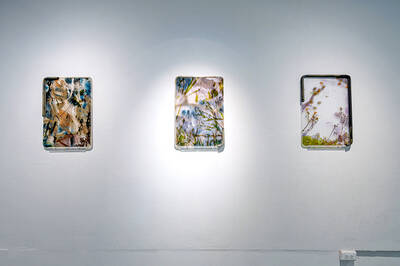
Located down a sideroad in old Wanhua District (萬華區), Waley Art (水谷藝術) has an established reputation for curating some of the more provocative indie art exhibitions in Taipei. And this month is no exception. Beyond the innocuous facade of a shophouse, the full three stories of the gallery space (including the basement) have been taken over by photographs, installation videos and abstract images courtesy of two creatives who hail from the opposite ends of the earth, Taiwan’s Hsu Yi-ting (許懿婷) and Germany’s Benjamin Janzen. “In 2019, I had an art residency in Europe,” Hsu says. “I met Benjamin in the lobby


 RSS
RSS