


For most of us in Taiwan, genetically modified (GM) foods have been merely fodder for dinnertime debate. But if you've had the debate while eating tofu or anything seasoned with soy sauce or fried in corn oil, chances are that genetically modified foods were the dinner itself.
Ready or not, the great edible experiment of our time is moving from Petri dishes to dinner plates.
Those who are ready are local researchers and biotechnology businesses who claim the technology can reduce agricultural losses at home, alleviate hunger in developing nations and reduce the use of environmentally harmful pesticides and herbicides around the globe.

PHOTOS: AGENCIES
Those against it -- consumer watchdogs and health organizations -- say more must be done to assure the safety of genetically modified foods and guarantee the rights of those who wish to avoid them through better labeling. One thing both sides agree on, however, is the need for the billions of consumers in the middle to be better educated about what they eat.
GROWING AND GROWING
Here in Taiwan, the products currently on the market that contain genetically modified organisms, or GMOs, are soybeans and corn. Taiwan purchases the vast majority of these staple products from the US.

According to Council of Agriculture statistics, of the 2.5 million tonnes of soybeans imported last year, half were genetically modified and over 30 percent of the 6 million tonnes of corn brought to Taiwan came from biologically engineered crops. That these figures will rise in coming years is all but guaranteed. Last year, 81 million hectares of arable land in 17
countries were planted with GM crops, a 20 percent increase over 2003, according to the non-profit International Service for the Acquisition of Agri-biotech Applications (ISAAA). Over 8 million farmers produced GM corn and soybeans last year and ISAAA predicts that by the end of the decade up to 15 million farmers will grow biotech crops on 150 million hectares covering 30 countries. China is expected to approve a type of insect-resistant rice by the end of this year, a move many say will open the industry floodgates when the world's most populous nation goes biotech.
Taiwan's own history of biotech agriculture began in the late 1970s, when Papaya Ring Spot Virus (

"At that time, fruit was one of Taiwan's biggest industries," Yeh said. "For us to lose a whole crop was devastating and the thought of losing more was frightening. The government decided the best course of action was to study ways to prevent future losses through better science."
The fruit of Yeh's efforts was a papaya genetically modified to resist the disease, but many more applications of genetic modification would come in the nearly 30 years of research conducted by thousands of scientists around the globe.
In the US, a hybrid corn resistant to root worms and a type of herbicide-tolerant soybean have been developed. Taiwanese scientists have also engineered a sweeter strawberry and scientists in Brazil are at work on a type of coffee tree that is easier to harvest.
A team of international scientists -- including several in Taiwan -- has worked together to engineer a type of rice containing beta carotene. Golden rice, as it's known, is said to be the genetically modified equivalent of fluoridated water or iodized salt and the key to ending vitamin A deficiency in poor nations, an ailment that kills between 1 and 2 million people and permanently blinds another half million every year. Scientists have also begun planting "pharmaceutical rice" genetically engineered to produce human proteins for drug production.
However, of these and dozens of other genetically modified plants, the only products approved for sale on the international market are hybrids of corn and soybeans.
That's the official status at least. In practice, many of these products have already found their way into the food supply. Here in Taiwan, in 2003, the Department of Health conducted a random sampling of papaya available at grocers and fruit stands and found seven out of 70 to be genetically modified. In China, scientists at Huazhong Agriculture University were so confident of their strain of bug-resistant rice that they began selling it at the university store even though it's still awaiting government approval. It sold out within a month while authorities looked the other way.
More recently, the EU voted to ban imports of corn gluten from the US after Swiss agrochemical company Syngenta inadvertently sold a batch of unapproved biotech corn to the US that was then resold to the EU.
TRYING ON NEW GENES
To understand the trepidation in getting GM foods to market, it's necessary to know a bit about the science behind them and, specifically, to be aware of what scientists themselves still don't know about the long-term effects of biological engineering. While there are several ways to genetically modify a species of plant, they all involve taking specific clippings of DNA from one plant and combining it with the DNA of the plant that is to be modified.
In the case of Taiwan's sweeter strawberry, for instance, scientists first found a "sweet gene" present in garden-variety tomatoes, clipped the gene from its original strand of DNA and attached it to bacteria whose own DNA had been stripped down to make room for the sweet gene. The bacteria was then introduced to the nucleus of extracted strawberry cells and sprouts of a sweeter strawberry were grown in Petri dishes.
The unknown variable is the stability of the sweeter strawberry's recombinant DNA and what effects it might have on the human body. Might it cause an allergic reaction in someone? Could the new strand of DNA combine with bacteria in the stomach to create some unforeseen problem?
Ecologically, too, there is cause for concern. Genetically modified strawberries -- or any plant for that matter -- planted in proximity to natural varieties will outcrop and share their engineered traits with their neighbors. This happened in 2001 in Mexico, where local varieties of corn were contaminated by GM corn.
Last year in the US, the government published a report showing that genetically modified grass in Oregon found its way into unmodified grass 19km away. Though growers try to isolate GM crops from non-GM crops, nature respects no boundaries.
Taiwan is almost certain to allow the commercial planting of GM rice in the near term. In a country where rice paddies quilt much of the flatlands, preventing outcropping would be difficult, if not impossible, according to Yeh.
Farmers who promise customers that their products are free from biotech tampering would lose out, as would biological diversity in general. There are some 140,000 varieties of rice that have been created by farmers in Asia, many thousands of them in Taiwan. Outcropping contamination would only reduce that number.
There are fears that farmers could lose out in other ways, as well. The non-profit organization ActionAid released a study in 2001 stating that, of 250 patents on rice, 61 percent were owned by one of six multi-national seed companies. Three of those companies are also the world's biggest makers of pesticides and herbicides.
ActionAid speculated that, through patents and contracts, those companies might seek to change traditional farming practices or even assert intellectual property ownership over the harvested rice. Finally, there is even a debate as to whether GM crops provide their promised benefits.
A study by Greenpeace showed that for a person to get their daily requirement of vitamin A from Golden rice, they'd have to eat 3.7kg of the rice each day.
"A normal daily intake of 300g of rice would, at best, provide 8 percent of vitamin A needed daily," according to the report.
A second generation of the strain, Golden rice 2, promises 23 times more beta carotene, but has yet to undergo clinical testing.
CONSUMER CONCERNS
Jason Lee (
"Currently, the government only requires that packaged corn and soybeans be labeled," he said.
"But soy and corn products purchased in traditional markets aren't labeled."
His foundation is calling for clearer labeling of GM foods and more stringent standards.
According to Department of Health guidelines, GM soybean oil, corn oil, corn starch and corn syrup do not need to be labeled. And on those products where labeling is required, "genetically modified" (基因改造) must be printed in a font with a width and length "not less than 2mm" -- a limit that is rarely strayed from, as genetic modification is hardly seen as a selling point.
"People need to be aware of what they're eating,"Lee said.
"It's not only warning people about genetically modified foods, but getting them to question if this is something they want to be eating."

Last week Joseph Nye, the well-known China scholar, wrote on the Australian Strategic Policy Institute’s website about how war over Taiwan might be averted. He noted that years ago he was on a team that met with then-president Chen Shui-bian (陳水扁), “whose previous ‘unofficial’ visit to the US had caused a crisis in which China fired missiles into the sea and the US deployed carriers off the coast of Taiwan.” Yes, that’s right, mighty Chen caused that crisis all by himself. Neither the US nor the People’s Republic of China (PRC) exercised any agency. Nye then nostalgically invoked the comical specter

Relations between Taiwan and the Czech Republic have flourished in recent years. However, not everyone is pleased about the growing friendship between the two countries. Last month, an incident involving a Chinese diplomat tailing the car of vice president-elect Hsiao Bi-khim (蕭美琴) in Prague, drew public attention to the People’s Republic of China’s (PRC) operations to undermine Taiwan overseas. The trip was not Hsiao’s first visit to the Central European country. It was meant to be low-key, a chance to meet with local academics and politicians, until her police escort noticed a car was tailing her through the Czech capital. The
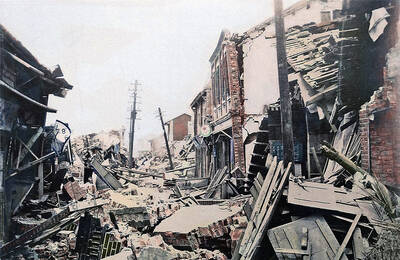
April 15 to April 21 Yang Kui (楊逵) was horrified as he drove past trucks, oxcarts and trolleys loaded with coffins on his way to Tuntzechiao (屯子腳), which he heard had been completely destroyed. The friend he came to check on was safe, but most residents were suffering in the town hit the hardest by the 7.1-magnitude Hsinchu-Taichung Earthquake on April 21, 1935. It remains the deadliest in Taiwan’s recorded history, claiming around 3,300 lives and injuring nearly 12,000. The disaster completely flattened roughly 18,000 houses and damaged countless more. The social activist and

Over the course of former President Ma Ying-jeou’s (馬英九) 11-day trip to China that included a meeting with Chinese Communist Party (CCP) leader Xi Jinping (習近平) a surprising number of people commented that the former president was now “irrelevant.” Upon reflection, it became apparent that these comments were coming from pro-Taiwan, pan-green supporters and they were expressing what they hoped was the case, rather than the reality. Ma’s ideology is so pro-China (read: deep blue) and controversial that many in his own Chinese Nationalist Party (KMT) hope he retires quickly, or at least refrains from speaking on some subjects. Regardless


 RSS
RSS