


Kun opera is regarded by many as the most venerable and influential form of Chinese opera, dating back at least to the 1500s. It has long existed in the shadow of its more showy descendent, Beijing opera, but is now making something of a comeback.
Kun was revealed to a wider audience as something beautiful and even erotic in April last year when Kenneth Pai's (
As tickets for that show were so hard to come by, it is no surprise that Peony Pavilion is being restaged, this time by the Taipei Chinese Orchestra (

Chang -- whose rendition of Du Liniang (
The TCO's staging is being billed as the "highlights edition," since it has compressed the 20 hours of the original into two parts (Pai's version was split into three parts), retaining the overall structure but seeking to appeal to contemporary audiences by focusing on the most famous scenes. This is a slight shift of emphasis from Pai's production, in which he said he wanted to get away from the highlight format and give audiences a glimpse of the opera's monumental structure.
Peony Pavilion is one of Chinese literature's great love stories, its status similar to the stories of Romeo and Juliet or Abelard and Heloise. It is an extended exposition on the theme of love in all its aspects, and indeed has been described as Chinese literature's "book of love." To see this work presented by one of the foremost Kun opera troupes under the artistic direction of one of the form's recognized masters is an opportunity not to be missed.
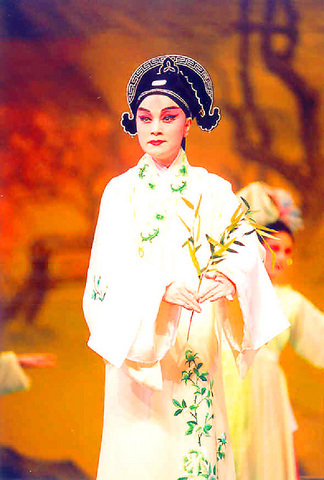
The revival of Kun's fortunes has seen the establishment in Taiwan of a number of local Kun groups. For those who simply want a quick taste of Kun, the Watermill Kun Opera Troupe (
The Jiangsu Provincial Kun Opera's presentation of Peony Pavilion will take place at the Zhong Shan Hall (
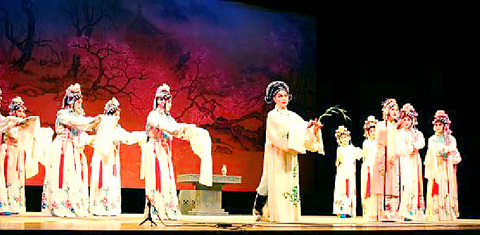
PHOTO COURTESY OF THE TAIPEI CHINESE ORCHESTRA

In late October of 1873 the government of Japan decided against sending a military expedition to Korea to force that nation to open trade relations. Across the government supporters of the expedition resigned immediately. The spectacle of revolt by disaffected samurai began to loom over Japanese politics. In January of 1874 disaffected samurai attacked a senior minister in Tokyo. A month later, a group of pro-Korea expedition and anti-foreign elements from Saga prefecture in Kyushu revolted, driven in part by high food prices stemming from poor harvests. Their leader, according to Edward Drea’s classic Japan’s Imperial Army, was a samurai

The following three paragraphs are just some of what the local Chinese-language press is reporting on breathlessly and following every twist and turn with the eagerness of a soap opera fan. For many English-language readers, it probably comes across as incomprehensibly opaque, so bear with me briefly dear reader: To the surprise of many, former pop singer and Democratic Progressive Party (DPP) ex-lawmaker Yu Tien (余天) of the Taiwan Normal Country Promotion Association (TNCPA) at the last minute dropped out of the running for committee chair of the DPP’s New Taipei City chapter, paving the way for DPP legislator Su

Located down a sideroad in old Wanhua District (萬華區), Waley Art (水谷藝術) has an established reputation for curating some of the more provocative indie art exhibitions in Taipei. And this month is no exception. Beyond the innocuous facade of a shophouse, the full three stories of the gallery space (including the basement) have been taken over by photographs, installation videos and abstract images courtesy of two creatives who hail from the opposite ends of the earth, Taiwan’s Hsu Yi-ting (許懿婷) and Germany’s Benjamin Janzen. “In 2019, I had an art residency in Europe,” Hsu says. “I met Benjamin in the lobby
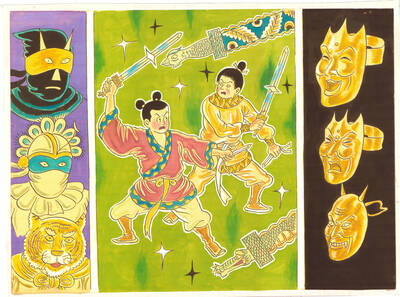
April 22 to April 28 The true identity of the mastermind behind the Demon Gang (魔鬼黨) was undoubtedly on the minds of countless schoolchildren in late 1958. In the days leading up to the big reveal, more than 10,000 guesses were sent to Ta Hwa Publishing Co (大華文化社) for a chance to win prizes. The smash success of the comic series Great Battle Against the Demon Gang (大戰魔鬼黨) came as a surprise to author Yeh Hung-chia (葉宏甲), who had long given up on his dream after being jailed for 10 months in 1947 over political cartoons. Protagonist


 RSS
RSS