


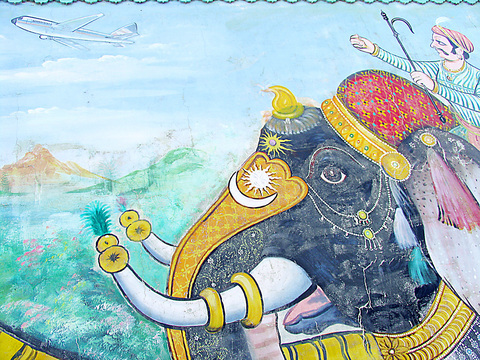
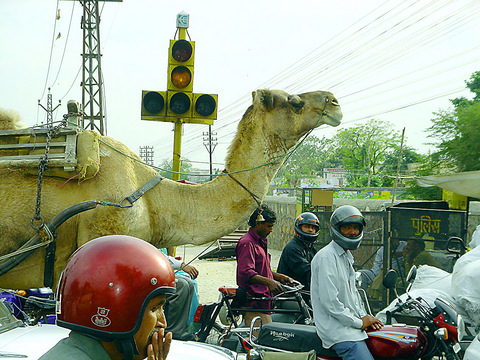
India is the soul of a material world and an early morning taxi ride from Indira Ghandi International Airport into New Delhi confirms this. Muezzin call on Muslims to pray, churches and temples dot the route. Holy cows steer unsteadily down the road, blessed monkeys throw fruit at cars, camel carts rumble along and there is a painted elephant tied up cowboy-style on the street, sweeping discarded vegetables into its mouth with its trunk. In the clean blue sky above, vultures wheel and glide searching for death.
The morning light reveals the whole spectrum of colors, which are intense, even psychedelic. Children without shoes play cricket in the parks and men dress in white flannels for their games. Tiny, scarred women in dust-coated saris offer up their children to the windows of cars asking for alms. The roadsides are crowded with vendors offering a bewildering range of foods, textiles and other goods. The taxi driver has an orange tilak on his forehead and a host of miniature gods swinging from the roof of his vehicle. He waits patiently for the buffalo to be driven off the street and stops to ask you to feed the monkeys.
India is said to be on the verge of massive economic expansion, with an economic growth rate of around 7 percent in the last few years. It is expected by some analysts to rival China as the world's next financial powerhouse. Construction is evident everywhere in the capital city and a mass rapid transport system is being developed, often using human labor instead of heavy-duty mechanical equipment. The smart sections of town, like Connaught Place, are being spruced up. Gleaming new offices are being constructed and US sports shops sell lifestyles to the well-off.

It is an amazing and often jarring coexistence of man and animal, a clash of metropolis and nature, old and new, business against tradition, religion versus progress. It is chaotic and seems ungovernable. This is one of the attractions of India and also the reason why it provides such a strong cultural shock for visitors. But how long the country can continue in such a bipolar way is moot.
Change is in the air, and as part of India's transformation Delhi authorities are clearing the city of its approximately 35,000 cows. New highways are being laid and the infrastructure needed to bring India up to par in the league of developed nations is being built. Now is a good time to visit the country and view some of the sights that have been part of its history for millennia, but may disappear in the coming decades.
Delhi is the drop-off and starting point for most travelers to India. It's worth looking around, though some avoid the place if they can because of the trash, hassle and chaos. This is a mistake. You can find tranquility if you need it in parks or temple areas, and there are plenty of popular and cultural attractions. There are backpacker areas in the old city, where there is cheap accommodation and plenty of shops and alleys to explore.
Britain's colonial mark is evident in the center of the city. The 42m-high India Gate looks down on the Kingsway, a wide avenue that leads to the president's estate and is flanked by a park. There is also the circular Indian parliament building nearby (that looks as though it has seen better days) and the foundation stones of New Delhi at the secretariat buildings, laid by King George V and Queen Mary in 1911. The National Museum is a little shabby, perhaps, but is enlightening with its collection from the Harappan period, an Indus Valley civilization that was as advanced as early Egyptian and Chinese societies 5,000 years ago.
Do not miss Humayun's Tomb, or the "baby Taj Mahal" as it is often called. Built by the Mughals, Muslim emperors who ruled from 1526 to 1858, the domed building of red sandstone inlaid with black and white marble formed the template for the Taj Mahal, which is in Agra. Do stay for the sunset, when the golden reflection of the building is caught by the channels of water that bisect the gardens.
From Delhi one can access the splendors of Rajasthan and the cities of Agra and Varanasi in Utter Pradesh. Further afield is Punjab to the northwest and the tea plantations of Darjeeling in the northeast. It is possible to view many of the main attractions in the north of India in about three weeks, using public transport and by hiring a driver, which is not an expensive option for groups.

Starting in Delhi, head southwest for the Great Thar Desert and Jaisalmer, a walled city that has a magical feel to it, as if it was imagined rather than built. You can stay in centuries-old havelis, or former merchants' houses, at a reasonable cost. Do take advantage of the competition among tour operators here to take a trek into the desert. Five-star tourists need not apply since this is camping under the stars and eating what the camel drivers prepare. But it is an unforgettable experience, especially if it is a clear night and you can make out the milky way. Ensure your guides are reputable and ask fellow tourists for their advice.
From Jaisalmer you can either visit Bikaner (famous for its holy rodent temple) or Udaipur ("the Venice of the East") before looping back to Delhi and the Taj Mahal in nearby Agra. Everyone calls Agra "aggro," and this fairly sums up the place. It's a flea trap, rip-off, one-stop town with nothing much to recommend it but the wonder of the world in its backyard. Stay one day and spend all of it in the grounds of the Taj Mahal.
There are many forts in northern India and before you get blase about them check out Jaipur and Jodhpur. The former is known as the "Pink City," since many of the houses and monuments were first painted this color in order to welcome Britain's Prince of Wales in the late 19th century. The sandstone Palace of the Winds and City Palace complex are awesome and give a flavor of the Raj. But Jaipur is a busy city full of commerce and the "Blue City" of Jodhpur, with its antique markets and alleyways is a more pleasant place to while away time. Majestic Fort towers over Jodhpur and provides an eagle's eye of the plains below.

Varanasi is to the east of Delhi and is best reached on the overnight train. It is another hot tourist destination so you will be greeted on arrival by hundreds of touts, some good, some bad. It is a sound idea to book accommodation in advance as the best places by the main ghats of the Ganges River fill up quickly.
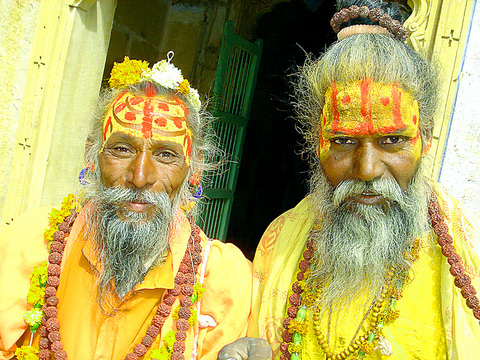
Varanasi is where many Hindus come to die since the dispersal of their ashes in the holy waters are said to assure them of salvation. At dawn and dusk the sadhus, or holy men, practice their rituals at the ghats. You can also view the process of burning a body and sending it off down the river -- if you feel so inclined. Though the waters of the Ganges hardly resemble "the nectar of immortality" in terms of purity, there were fish, and clearly efforts to clean up what used to be one of the most polluted rivers in the world are paying off.
Finally, if you have time, take a hire car or train from Varanasi to the Mahabodhi Temple in Bodhgaya, which is where the Buddha became enlightened around 2,600 years ago. The Bodhi tree by the temple is a descendant of the original and this is why thousands of pilgrims (including the Dalai Lama every December) meditate under it.

Like the Dalai Lama, it is best to visit northern India during the winter season (late October to early April), avoiding the Indian summer heat and monsoons. To avoid backtracking and to make the most of your time, consider taking an airplane at some point in your journey, as domestic flights are frequent and inexpensive.
Though people are generally friendly and hospitable in India, tourists do disappear and get injured. There were troubles between Muslims and Hindus in Varanasi when we visited in early April, and there were tales of bombs going off at the main ghat. Private militias patrolled the hotel environs.
That said, as befits a religious or spiritual haven, everyone should make the pilgrimage to India if they can at some point in their life. It has so much to offer, teach and delight. As for the changes which development will bring, yes Delhi will be different when cows no longer command the streets, but this is a quaint detail and I suspect India will always be the spiritual guardian of a material world.


Last week Joseph Nye, the well-known China scholar, wrote on the Australian Strategic Policy Institute’s website about how war over Taiwan might be averted. He noted that years ago he was on a team that met with then-president Chen Shui-bian (陳水扁), “whose previous ‘unofficial’ visit to the US had caused a crisis in which China fired missiles into the sea and the US deployed carriers off the coast of Taiwan.” Yes, that’s right, mighty Chen caused that crisis all by himself. Neither the US nor the People’s Republic of China (PRC) exercised any agency. Nye then nostalgically invoked the comical specter

Relations between Taiwan and the Czech Republic have flourished in recent years. However, not everyone is pleased about the growing friendship between the two countries. Last month, an incident involving a Chinese diplomat tailing the car of vice president-elect Hsiao Bi-khim (蕭美琴) in Prague, drew public attention to the People’s Republic of China’s (PRC) operations to undermine Taiwan overseas. The trip was not Hsiao’s first visit to the Central European country. It was meant to be low-key, a chance to meet with local academics and politicians, until her police escort noticed a car was tailing her through the Czech capital. The
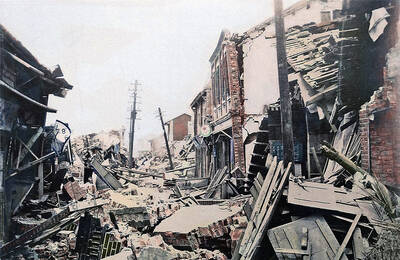
April 15 to April 21 Yang Kui (楊逵) was horrified as he drove past trucks, oxcarts and trolleys loaded with coffins on his way to Tuntzechiao (屯子腳), which he heard had been completely destroyed. The friend he came to check on was safe, but most residents were suffering in the town hit the hardest by the 7.1-magnitude Hsinchu-Taichung Earthquake on April 21, 1935. It remains the deadliest in Taiwan’s recorded history, claiming around 3,300 lives and injuring nearly 12,000. The disaster completely flattened roughly 18,000 houses and damaged countless more. The social activist and

Over the course of former President Ma Ying-jeou’s (馬英九) 11-day trip to China that included a meeting with Chinese Communist Party (CCP) leader Xi Jinping (習近平) a surprising number of people commented that the former president was now “irrelevant.” Upon reflection, it became apparent that these comments were coming from pro-Taiwan, pan-green supporters and they were expressing what they hoped was the case, rather than the reality. Ma’s ideology is so pro-China (read: deep blue) and controversial that many in his own Chinese Nationalist Party (KMT) hope he retires quickly, or at least refrains from speaking on some subjects. Regardless


 RSS
RSS