


At the bottom of the mountainous dunes once traversed by traders and pilgrims on the ancient Silk Road, Wang Qixiang stood with a camera draped around his neck. He was a modern-day pilgrim of sorts -- a tourist.
He and his wife had traveled by train more than 2,700km from eastern China to the forbidding emptiness of the Gobi Desert to glimpse at a famous pool of water known as Crescent Lake. They came because the lake has been rapidly shrinking into the desert sand, and they feared it might soon disappear.
"It is a miracle of the desert," said Wang, 67.

PHOTO: NY TIMES
In this desert oasis where East once met West and that is home to one of the world's greatest shrines to Buddhism, the water is disappearing. Crescent Lake has dropped more than 8m in the last three decades, while the underground water table elsewhere in the area has fallen by as much as 11m.
An ancient city that once served as China's gateway to the West, Dunhuang is now threatened by very modern demands. A dam built three decades ago to help local farming, combined with a doubling of the population, have overstressed a fragile desert hydrology that had been stable for thousands of years.
"I would call it an ecological crisis," said Zhang Mingquan, a professor at Lanzhou University who specializes in the region's hydrology. "The problem is the human impact. People are overusing the amount of water that the area can sustain."
Here, as elsewhere in western China, the country's poorest region, the emphasis in recent decades has been on economic development at all costs. Isolated by the desert, Dunhuang has virtually no industry, so agriculture has dominated the local economy. In the 1970s, the government dammed the Dang River, which once flowed past the city, to provide better irrigation for farmland and to help relieve poverty.
Farming did improve, but in a fashion that brought a larger burden: A desert oasis that had fewer than 100,000 people before the dam now has roughly 180,000. As more people arrived, the underground water table that is the city's main source of drinking water starting dropping.
The pressure now to preserve Dunhuang is amplified by the growing recognition of the city's major cultural and historic significance.
The nearby Mogao Caves, painted with murals dating to the fourth century, were built by the monks who helped bring Buddhism from India. The caves have been designated as a World Heritage Site by the UN.
The caves are a legacy of Dunhuang's emergence more than 2,000 years ago during the Han Dynasty as a crucial entrance into China by the Silk Road, which served as the principal trade route to the West. Merchants and pilgrims made the journey by following the string of oases that skirted the brutal Taklamakan Desert, which many considered haunted by demons and ghosts.
"At times one can hear coughing, or sobbing, but suddenly one does not know where to turn. Thus many perish," the famous seventh-century Chinese monk Xuanzang wrote of the voices he heard in the brutal heat. He described the desert as so bleak and empty that travelers stacked up bones as landmarks.
Farming in Dunhuang also dates to the Han Dynasty, and among the tens of thousands of manuscripts found inside the Mogao Caves was a map that detailed the region's critical water sources. Now, in the village of Zhabacha, about 10km north of the city center, the water table has dropped more than 1.5m in the past five years alone.
Beneath a midday sun last Tuesday that had driven other farmers into their crumbling adobe homes, He Zhailin flooded a small plot of wheat with water. He said he has tripled his amount of cultivated land during the past decade and that some farmers had expanded even more. Until recently, he said, government officials had encouraged farmers to plant more crops.
"There was a lot of water, so the government encouraged people to cultivate the land," recalled He, 40. "At the time, it never dried up."
Now, local officials have introduced a strict policy known as the "Three Forbids" that bans any new farmland, forbids new migrants from moving to the city and prohibits any new wells. The need to protect the underground water is magnified by the fact that almost 90 percent of water from the Dang Reservoir is dedicated to agriculture.
Zhang, the Lanzhou University professor, stressed that reducing consumption is the problem and noted that the supply of glacial melt from the Qilian Mountains that feeds the Dang River -- and by extension the rest of the oasis -- remains largely unchanged from centuries ago. Even so, there are proposals to divert water from a river in adjacent Tibet, though the likelihood of such a plan is far from certain.
Conservation has become particularly critical because Dunhuang has emerged as one of the leading tourist attractions in western China, giving the city a veneer of prosperity rare in rural regions. Last year, more than 430,000 tickets were sold to the Mogao Caves. In all likelihood, even more people visited Crescent Lake, which is nestled in the picturesque dunes known as the Singing Sands.
The lake, also a World Heritage Site, began shrinking in the 1970s and is now about a third of its original size. In the 1990s, officials tried pumping in water but quit because the transfers were polluting the lake. More recently, reservoirs have been built a short distance away in hopes that water would seep into the ground and help Crescent Lake.
"As local people, we are very worried," said Fan Cun, who heads the agency overseeing the lake. "We would have failed future generations if we watch this lake disappear."

Last week Joseph Nye, the well-known China scholar, wrote on the Australian Strategic Policy Institute’s website about how war over Taiwan might be averted. He noted that years ago he was on a team that met with then-president Chen Shui-bian (陳水扁), “whose previous ‘unofficial’ visit to the US had caused a crisis in which China fired missiles into the sea and the US deployed carriers off the coast of Taiwan.” Yes, that’s right, mighty Chen caused that crisis all by himself. Neither the US nor the People’s Republic of China (PRC) exercised any agency. Nye then nostalgically invoked the comical specter
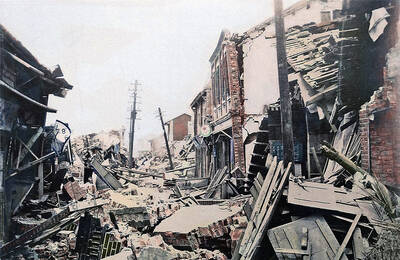
April 15 to April 21 Yang Kui (楊逵) was horrified as he drove past trucks, oxcarts and trolleys loaded with coffins on his way to Tuntzechiao (屯子腳), which he heard had been completely destroyed. The friend he came to check on was safe, but most residents were suffering in the town hit the hardest by the 7.1-magnitude Hsinchu-Taichung Earthquake on April 21, 1935. It remains the deadliest in Taiwan’s recorded history, claiming around 3,300 lives and injuring nearly 12,000. The disaster completely flattened roughly 18,000 houses and damaged countless more. The social activist and

Over the course of former President Ma Ying-jeou’s (馬英九) 11-day trip to China that included a meeting with Chinese Communist Party (CCP) leader Xi Jinping (習近平) a surprising number of people commented that the former president was now “irrelevant.” Upon reflection, it became apparent that these comments were coming from pro-Taiwan, pan-green supporters and they were expressing what they hoped was the case, rather than the reality. Ma’s ideology is so pro-China (read: deep blue) and controversial that many in his own Chinese Nationalist Party (KMT) hope he retires quickly, or at least refrains from speaking on some subjects. Regardless

Approaching her mid-30s, Xiong Yidan reckons that most of her friends are on to their second or even third babies. But Xiong has more than a dozen. There is Lucky, the street dog from Bangkok who jumped into a taxi with her and never left. There is Sophie and Ben, sibling geese, who honk from morning to night. Boop and Pan, both goats, are romantically involved. Dumpling the hedgehog enjoys a belly rub from time to time. The list goes on. Xiong nurtures her brood from her 8,000 square meter farm in Chiang Dao, a mountainous district in northern Thailand’s


 RSS
RSS