


If you're interested in enjoying an evening of Chinese opera, but the Peking style is a bit too harsh-sounding for your taste, kunqu (
Seden Society (
Seden Society, previously known as Women's Group Theater (
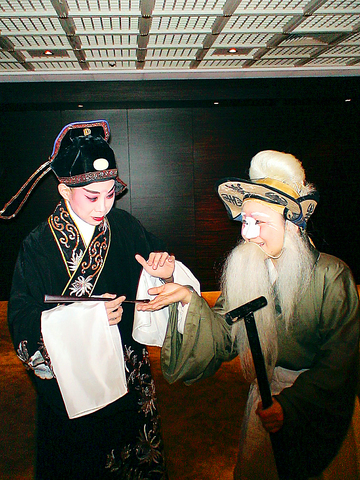
PHOTOS COURTESY OF CKS CULTURAL CENTER
Kunqu has a 600-year his-tory, 400 years more than that of the relatively young Peking opera. It emerged from Kunshan in Jiangsu Province, then spread to nearby provinces, later finding favor in Beijing's imperial courts. Kunqu is noted for its flowing melodies and especially poetic language, which made it a favorite of aristocratic audiences. It is subtler and more refined than its younger, more popular sister from the north.
Less popular, but still brilliant in its own right, kunqu caught the eye of UNESCO and became a "Masterpiece of the Oral and Intangible Heritage of Humanity" in 2001, an honor given to 19 other outstanding "endangered" cultural forms of expression from different regions of the world. Kunqu was the only Chinese art form that was included.
Seden's Portrait of Love demonstrates exactly why kunqu shouldn't be allowed to disappear. It's a selection from the kunqu classic West Tower Records (
While the poetic lines require at least high-school-level Chinese to appreciate, the style of delivery walks the thin-but-captivating line between expressive and exaggerated. The songs are melodic and soulful, and they avoid the harsh, high pitch that turns many an unaccustomed ear away from Peking Opera.
One of Portrait of Love's more entertaining elements comes in the form of the clown role, a servant played by Ma Zhao-qi (
Performances will be held in the Experimental Theater on the third floor of the National Theater Hall (21-1 Zhongshan South Road, Taipei) tonight through Sunday night at 7:30pm and also on Sunday for a matinee at 2:30pm. The production will be in Ilan's National Center for the Traditional Arts (

Last week Joseph Nye, the well-known China scholar, wrote on the Australian Strategic Policy Institute’s website about how war over Taiwan might be averted. He noted that years ago he was on a team that met with then-president Chen Shui-bian (陳水扁), “whose previous ‘unofficial’ visit to the US had caused a crisis in which China fired missiles into the sea and the US deployed carriers off the coast of Taiwan.” Yes, that’s right, mighty Chen caused that crisis all by himself. Neither the US nor the People’s Republic of China (PRC) exercised any agency. Nye then nostalgically invoked the comical specter

Relations between Taiwan and the Czech Republic have flourished in recent years. However, not everyone is pleased about the growing friendship between the two countries. Last month, an incident involving a Chinese diplomat tailing the car of vice president-elect Hsiao Bi-khim (蕭美琴) in Prague, drew public attention to the People’s Republic of China’s (PRC) operations to undermine Taiwan overseas. The trip was not Hsiao’s first visit to the Central European country. It was meant to be low-key, a chance to meet with local academics and politicians, until her police escort noticed a car was tailing her through the Czech capital. The

April 15 to April 21 Yang Kui (楊逵) was horrified as he drove past trucks, oxcarts and trolleys loaded with coffins on his way to Tuntzechiao (屯子腳), which he heard had been completely destroyed. The friend he came to check on was safe, but most residents were suffering in the town hit the hardest by the 7.1-magnitude Hsinchu-Taichung Earthquake on April 21, 1935. It remains the deadliest in Taiwan’s recorded history, claiming around 3,300 lives and injuring nearly 12,000. The disaster completely flattened roughly 18,000 houses and damaged countless more. The social activist and

Over the course of former President Ma Ying-jeou’s (馬英九) 11-day trip to China that included a meeting with Chinese Communist Party (CCP) leader Xi Jinping (習近平) a surprising number of people commented that the former president was now “irrelevant.” Upon reflection, it became apparent that these comments were coming from pro-Taiwan, pan-green supporters and they were expressing what they hoped was the case, rather than the reality. Ma’s ideology is so pro-China (read: deep blue) and controversial that many in his own Chinese Nationalist Party (KMT) hope he retires quickly, or at least refrains from speaking on some subjects. Regardless


 RSS
RSS