


Just a few years ago ailments such as type-2 diabetes, high blood pressure, worn joints, liver disease and gall stones occurred only in adults and mostly among the elderly. Now more and more children are being affected.
The implications are wide-ranging. A life of discomfort and pain lies ahead for the sufferer, there are huge costs for state health systems and the economy is affected.
Children, parents and pediatricians confront these challenges to an extent unknown before and face challenges that include recognizing these ailments early on and treating the young sufferer as best as possible.
"The causes of these lifestyle diseases lie in lack of physical exercise, poor nutrition and obesity," says Martin Wabitsch, professor of endocrinology, diabetes and overweight at the University of Ulm's pediatric clinic.
"Often these three factors occur in tandem. Overweight -- or obesity in its extreme form -- is caused by lack of exercise and poor nutrition," Wabitsch says.
The professor estimates that 15 percent to 20 percent of all German children are overweight or obese. They run a higher risk of suffering diseases once typical of the aged.
Pediatricians recommend that these children are specially screened to measure blood sugar, cholesterol, blood pressure and changes to blood vessels.
"Family history also provides valuable insights. If diabetes occurs frequently, the child is also sent to have the beta cells responsible for producing insulin screened," Wabitsch says.
Standard tests do not measure these indicators, so that these serious illnesses can lie hidden for years if this special screening is not undertaken.
"If the family doctor does not offer this screening to an overweight child, then the parents should definitely push for it," Wabitsch believes.
The first signs of illness are difficult for the untrained eye to recognize. Type-2 diabetes takes hold slowly without showing noticeable symptoms.
In Germany there are thought to be around 15,000 children with this ailment, although only 500 are currently undergoing treatment.
"Over the last 10 years the number of children who have become ill with type-2 diabetes has risen by several hundred percent," according to Wolfram Hartmann, the head of the German association of pediatricians.
Once the long-term consequences of the disease -- damage to the retina and the kidneys or circulation problems in the arms and legs -- are discovered, it is often too late.
In the same way, high blood pressure, metabolic and blood vessel problems, which can lead to arteriosclerosis, heart attacks and strokes in the longer term, remain undetected for far too long without special screening.
By contrast, orthopaedic problems like bad knees and signs of wear in the hip joints and back are often soon noticed as they cause pain.
These are in general indications of future arthritis.
"Every child or young person must be able to walk five to 10 kilometers. If they can't, the reason must be found," Hartmann says.
According to Wabitsch, some 2 percent of seriously overweight children suffer with gall stones. Uncovering this requires careful interpretation of symptoms.

In late October of 1873 the government of Japan decided against sending a military expedition to Korea to force that nation to open trade relations. Across the government supporters of the expedition resigned immediately. The spectacle of revolt by disaffected samurai began to loom over Japanese politics. In January of 1874 disaffected samurai attacked a senior minister in Tokyo. A month later, a group of pro-Korea expedition and anti-foreign elements from Saga prefecture in Kyushu revolted, driven in part by high food prices stemming from poor harvests. Their leader, according to Edward Drea’s classic Japan’s Imperial Army, was a samurai
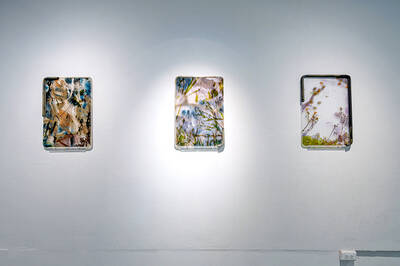
Located down a sideroad in old Wanhua District (萬華區), Waley Art (水谷藝術) has an established reputation for curating some of the more provocative indie art exhibitions in Taipei. And this month is no exception. Beyond the innocuous facade of a shophouse, the full three stories of the gallery space (including the basement) have been taken over by photographs, installation videos and abstract images courtesy of two creatives who hail from the opposite ends of the earth, Taiwan’s Hsu Yi-ting (許懿婷) and Germany’s Benjamin Janzen. “In 2019, I had an art residency in Europe,” Hsu says. “I met Benjamin in the lobby
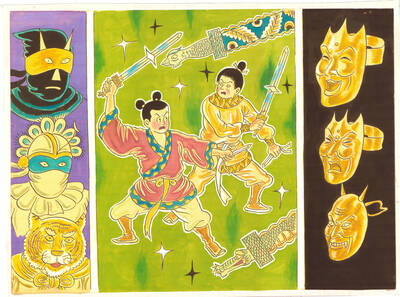
April 22 to April 28 The true identity of the mastermind behind the Demon Gang (魔鬼黨) was undoubtedly on the minds of countless schoolchildren in late 1958. In the days leading up to the big reveal, more than 10,000 guesses were sent to Ta Hwa Publishing Co (大華文化社) for a chance to win prizes. The smash success of the comic series Great Battle Against the Demon Gang (大戰魔鬼黨) came as a surprise to author Yeh Hung-chia (葉宏甲), who had long given up on his dream after being jailed for 10 months in 1947 over political cartoons. Protagonist

Peter Brighton was amazed when he found the giant jackfruit. He had been watching it grow on his farm in far north Queensland, and when it came time to pick it from the tree, it was so heavy it needed two people to do the job. “I was surprised when we cut it off and felt how heavy it was,” he says. “I grabbed it and my wife cut it — couldn’t do it by myself, it took two of us.” Weighing in at 45 kilograms, it is the heaviest jackfruit that Brighton has ever grown on his tropical fruit farm, located


 RSS
RSS