


The tough reality of European cinema is that about 70 percent of ticket sales here are for American movies. And despite a few recent cross-border successes such as The Chorus or A Very Long Engagement, the figures are not budging.
As Europe debates its new constitution and future as never before, politicians at the Cannes Film Festival are focusing on one small-scale idea: how Internet movie distribution might overcome some pitfalls of the box office.
The EU's commissioner for media, Viviane Reding, was to meet Tuesday with film and telecommunication executives to talk about possible policies for film distribution online, and how similar technologies could promote cultural diversity.
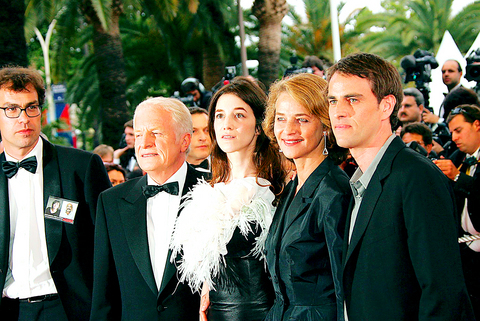
PHOTO: EPA
If more movie-lovers can pick films from a wide selection online, the theory goes, they might not opt for multiplex hits.
"We produce 750 to 800 films a year in Europe," Reding said. "The problem is that many of these movies never reach the screens. Citizens don't have access to a lot of these movies, and because of that, new technologies can help."
Beyond that are broader issues. One question now is what exactly is a European movie?

PHOTO: AFP
A Paris court ruled in November that A Very Long Engagement was too American to compete in French film festivals because of its Warner Bros backing. The ruling has been appealed.
There are also questions about another Warner Bros picture, Harry Potter and the Prisoner of Azkaban. It was shot by Mexican director Alfonso Cuaron but based on a British book, filmed in Britain and had a mostly British cast.
``The UK film council considers that Harry Potter is British,'' said Andre Lange, head of markets and financing at the European Audiovisual Observatory. ``In our statistics, we count it as American.''
The observatory says 71.4 percent of last year's movie admissions in the 25 European Union countries were for American films, while homegrown films accounted for 26.5 percent. The figure was about the same the year before.
For European talent, the dilemma is often whether to work at home or in Hollywood, which brings more money and fame. Spanish stars Antonio Banderas and Penelope Cruz have
careers on both sides of the Atlantic. Two German directors -- Wolfgang Petersen (Troy) and Roland Emmerich (The Day After Tomorrow) -- were behind two of Hollywood's biggest recent productions.
Then there are European filmmakers who shoot movies in English with Hollywood stars.
In Cannes, Wim Wenders of Germany is showing Don't Come Knocking, about a washed-out former star of movie Westerns and featuring Sam Shepard, Sarah Polley and Tim Roth. Lars von Trier of Denmark cast Bryce Dallas Howard (The Village) in his film set in 1930s America, Manderlay.
Dominik Moll, the French filmmaker whose Lemming played opening night, says his next project may take him to the United States. He hopes to adapt two stories by US author TC Boyle.
``The idea would be to shoot them in America with American actors but with French production, to keep the control,'' Moll said. He said he was not ready to try the American studio system.
One fear in Europe is that because American studios are courting European talent, the continent might one day be left with only art-house films.
Preserving Europe's diversity is one of the central questions in EU cultural debates. France is especially attached to its right to subsidize movies, protecting the industry from Hollywood.
French President Jacques Chirac invited hundreds of artists and intellectuals from around Europe to the Elysee Palace this month to promote the European constitution as a barrier against "homogenization."
France is in a heated debate ahead of a May 29 referendum on whether to ratify the constitution, which includes measures that will continue to protect state aid for the audiovisual sector.
In France, the industry had a particularly successful year.
The Chorus, the French tale of singing schoolboys, was nominated for Best Foreign Language Film at the Academy Awards and was the biggest box-office hit at home.
The movie drew fans in part for its very specific postwar small-town-France setting.
Lange said that with more hit movies like those, a stronger European film industry might build confidence in the entire European project: "Films contribute to your understanding about your neighbors, their social and historical issues."

In late October of 1873 the government of Japan decided against sending a military expedition to Korea to force that nation to open trade relations. Across the government supporters of the expedition resigned immediately. The spectacle of revolt by disaffected samurai began to loom over Japanese politics. In January of 1874 disaffected samurai attacked a senior minister in Tokyo. A month later, a group of pro-Korea expedition and anti-foreign elements from Saga prefecture in Kyushu revolted, driven in part by high food prices stemming from poor harvests. Their leader, according to Edward Drea’s classic Japan’s Imperial Army, was a samurai

Located down a sideroad in old Wanhua District (萬華區), Waley Art (水谷藝術) has an established reputation for curating some of the more provocative indie art exhibitions in Taipei. And this month is no exception. Beyond the innocuous facade of a shophouse, the full three stories of the gallery space (including the basement) have been taken over by photographs, installation videos and abstract images courtesy of two creatives who hail from the opposite ends of the earth, Taiwan’s Hsu Yi-ting (許懿婷) and Germany’s Benjamin Janzen. “In 2019, I had an art residency in Europe,” Hsu says. “I met Benjamin in the lobby

April 22 to April 28 The true identity of the mastermind behind the Demon Gang (魔鬼黨) was undoubtedly on the minds of countless schoolchildren in late 1958. In the days leading up to the big reveal, more than 10,000 guesses were sent to Ta Hwa Publishing Co (大華文化社) for a chance to win prizes. The smash success of the comic series Great Battle Against the Demon Gang (大戰魔鬼黨) came as a surprise to author Yeh Hung-chia (葉宏甲), who had long given up on his dream after being jailed for 10 months in 1947 over political cartoons. Protagonist

The following three paragraphs are just some of what the local Chinese-language press is reporting on breathlessly and following every twist and turn with the eagerness of a soap opera fan. For many English-language readers, it probably comes across as incomprehensibly opaque, so bear with me briefly dear reader: To the surprise of many, former pop singer and Democratic Progressive Party (DPP) ex-lawmaker Yu Tien (余天) of the Taiwan Normal Country Promotion Association (TNCPA) at the last minute dropped out of the running for committee chair of the DPP’s New Taipei City chapter, paving the way for DPP legislator Su


 RSS
RSS