


Silence reigns over a packed commuter train pulling into London as hundreds of men and women wrestle separately with a Japanese puzzle that has taken Britain by storm, and now threatens to conquer the world.
Sudoku, a simple-to-learn but fiendishly complex grid-based number game, is attracting new fans by the minute with its unique concoction of logic, digits and sheer patience.
Over the past week, newspapers have scrambled over each other to produce their own versions, seen as a sure-fire way to reel in readers. A magazine is also being launched and technophiles can even play the game on their mobile phones.
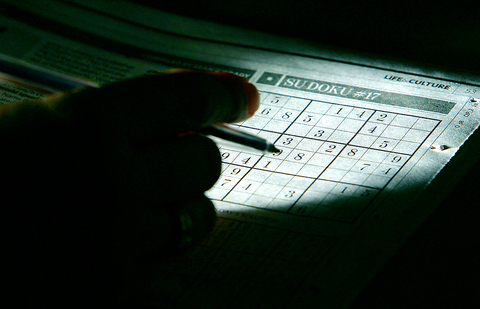
PHOTO: AFP
"Its brilliance is in its simplicity," said Mike Harvey, features editor of The Times newspaper, which introduced Sudoku to Britain last November and had a near-monopoly of the market until the past few days.
"It is the only puzzle I have come across where the instructions are so simple and easy to understand but the solution can be so complicated," he said.
"As soon as we launched it we thought it was going to be very big. However, we were pretty amazed at how big it has become," Harvey said.
"Now that everyone has jumped on the bandwagon it is an absolutely huge and national phenomenon and increasingly an international phenomenon."
Sudoku, which roughly translates as "single figure," requires a player to put the digits one to nine in a box made up of 81 squares, so that no number is repeated in any of the nine vertical or horizontal lines.
To complicate matters further, the grid is also sub-divided into nine blocks of nine single squares, and they too must each contain the numbers one to nine.
"It just seems to be one of those things that our readers have really taken to heart," said Derek Brown, deputy features editor of Britain's best-selling daily newspaper, The Sun, which launched a "Sun Doku" last week.
"It is one of those things that is easy to learn but difficult to master," he said, noting that the game was now a permanent fixture in his tabloid.
Despite its Japanese name, the original concept of Latin Squares -- a grid in which every number or symbol occurs once in each row -- was dreamt up in the 18th century by famous Swiss mathematician Leonhard Euler.
The modern-day version, which differs due to its nine sub-divided blocks, was spotted in an American magazine by a Japanese magazine publisher, Nikoli, in the early 1980s and taken back to Japan, where Sudoku was born.
It only began to catch on as a worldwide craze, however, after a retired Hong Kong judge and puzzle fan, Wayne Gould, picked up a Sudoku book while on holiday in Tokyo in 1997 and decided to write a computer program to generate his own puzzle grids, which he began giving to newspapers last year.
"It is a welcome relief from the word games that you find everywhere in newspapers," Gould, a native New Zealander, said in a telephone interview.
"And it is not actually a numbers puzzle either, although it looks like one. It is a logic puzzle and there are very few puzzles that test logic, which is a thing we should be using every day," the 59-year-old said.
Gould, who has his own Web site www.sudoku.com, generates hundreds of Sudoku puzzles a day, which he provides to at least a dozen newspapers in Britain, the US, New Zealand and South Africa -- and the list is growing.
"It has spread all over the world in a strange variety of countries," he said, citing Croatia and Slovakia, while deals with dailies in the United Arab Emirates and Barbados are also in the pipeline.
"Just at the moment, with the upsurge of interest, I am getting three or four enquiries from around the world a day so it won't be long before it is everywhere," he predicted.
The brain teaser comes in different levels from easy, which can take up to an hour to crack, to fiendish, which often proves too difficult to solve, resulting in the dreaded moment when a player realizes he or she has repeated a number in one of the lines or boxes and has to back-track or start again.
"If you get it wrong it is really frustrating," said Nicholas Webb, a London lawyer who has been hooked on Sudoku since it first appeared in The Times.
At the same time, the 28-year-old who "Sudokus" regularly on the bus to work, said, "There is a great feeling of satisfaction when you finish one of them."

In late October of 1873 the government of Japan decided against sending a military expedition to Korea to force that nation to open trade relations. Across the government supporters of the expedition resigned immediately. The spectacle of revolt by disaffected samurai began to loom over Japanese politics. In January of 1874 disaffected samurai attacked a senior minister in Tokyo. A month later, a group of pro-Korea expedition and anti-foreign elements from Saga prefecture in Kyushu revolted, driven in part by high food prices stemming from poor harvests. Their leader, according to Edward Drea’s classic Japan’s Imperial Army, was a samurai

Located down a sideroad in old Wanhua District (萬華區), Waley Art (水谷藝術) has an established reputation for curating some of the more provocative indie art exhibitions in Taipei. And this month is no exception. Beyond the innocuous facade of a shophouse, the full three stories of the gallery space (including the basement) have been taken over by photographs, installation videos and abstract images courtesy of two creatives who hail from the opposite ends of the earth, Taiwan’s Hsu Yi-ting (許懿婷) and Germany’s Benjamin Janzen. “In 2019, I had an art residency in Europe,” Hsu says. “I met Benjamin in the lobby
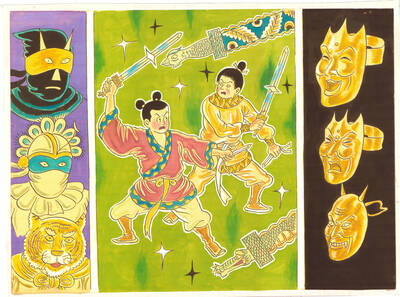
April 22 to April 28 The true identity of the mastermind behind the Demon Gang (魔鬼黨) was undoubtedly on the minds of countless schoolchildren in late 1958. In the days leading up to the big reveal, more than 10,000 guesses were sent to Ta Hwa Publishing Co (大華文化社) for a chance to win prizes. The smash success of the comic series Great Battle Against the Demon Gang (大戰魔鬼黨) came as a surprise to author Yeh Hung-chia (葉宏甲), who had long given up on his dream after being jailed for 10 months in 1947 over political cartoons. Protagonist

A fossil jawbone found by a British girl and her father on a beach in Somerset, England belongs to a gigantic marine reptile dating to 202 million years ago that appears to have been among the largest animals ever on Earth. Researchers said on Wednesday the bone, called a surangular, was from a type of ocean-going reptile called an ichthyosaur. Based on its dimensions compared to the same bone in closely related ichthyosaurs, the researchers estimated that the Triassic Period creature, which they named Ichthyotitan severnensis, was between 22-26 meters long. That would make it perhaps the largest-known marine reptile and would


 RSS
RSS