


Recently Zack Lane lost his life to a little-mentioned heart disease that may afflict nearly his entire family.
He was 29. A single father, with two little girls. Now Lane's siblings, 24-year-old Joshua Lane and 27-year-old Jessica Scalf of Canton, Illinois, are on a mission to raise awareness about the disease, its symptoms and the fact that it's the leading cause of sudden cardiac death in young people.
Scalf, who for three years has had a pacemaker/defibrillator implanted in her chest, worries less now about her own sudden death than of her younger brother, her own daughter and even her nieces.
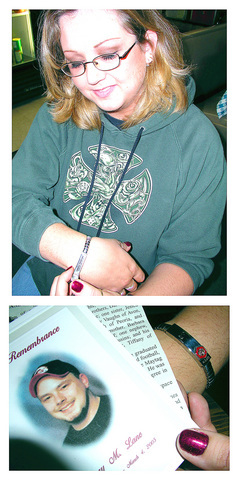
PHOTO: COPLEY NEWS SERVICE
"Am I gonna die?" Joshua Lane wondered loud enough for everyone in the local Canton cafe to hear. "I'm 24. I shouldn't be thinking about stuff like this. I shouldn't have to be dealing with stuff like this. ... I was looking forward to getting older and learning new things about myself. But looking at us now, it doesn't look like that's going to happen. My brother didn't ever reach his 30th birthday."
Hypertrophic cardiomyopathy, or HCM, is diagnosed through the use of an echocardiogram that can reveal the thickening of the walls of the heart that ultimately causes the heart to not function properly. Genetic testing can diagnose the hereditary disease, but not the extent of the symptoms or how severe the 200-some mutations will appear in each individual, according to Robert Bonow, chief of cardiology at Northwestern Memorial Hospital and a professor of medicine at Northwestern University.
Bonow, the former president of the American Heart Association, said the real problem is the disease is tricky. And genetic testing to confirm diagnosis is expensive.
"It can be misdiagnosed," he said. "It can masquerade like a lot of other more common disorders."
Scalf and Zack Lane both had formal diagnoses. Their maternal grandfather also is believed to have died from the disease at 34. Their father has numerous heart conditions, but no formal diagnosis. And Joshua Lane and Scalf's daughter both show numerous warning signs.
HCM can look like a heart attack. It can appear as asthma. It can appear as a typical heart murmur. It is often diagnosed as anxiety disorder or panic attacks, according to the Hypertrophic Cardiomyopathy Association, or HCMA, founded by Lisa Salberg of New Jersey. Salberg, too, has a life-saving pacemaker/defibrillator. Four of her family members have died from HCM, and four other members currently live with it.
"Unfortunately," Bonow said in most cases, "it's not diagnosed at all until something catastrophic happens."
Bonow said the disease affects less than 1 percent of the population, however, busy cardiologists see it frequently. "Lots of the stories you hear of young athletes dying on the playing field are dying from this condition."
And most of the time they were misdiagnosed, he said.
Still, the disease has been studied for more than 50 years. Bonow recommends if any family has had a member die unexpectedly from a heart condition under the age of 55, the entire family needs to be checked for HCM. If there is any family history, "I would recommend the family get screened."
Bonow said most cardiologists require two of the major risk factors for sudden death before implanting a pacemaker device. Those factors include: family history, cardiac arrhythmia, massive thickness (a septum measuring more than 3mm), adverse blood pressure response or prior cardiac arrest. Some doctors are very comfortable with diagnosing someone with only one of these risk factors, he said.
This is where Scalf said her family is frustrated. Her eight-year-old daughter Samantha has all the warning signs, numerous symptoms and the all-important family history. Yet, Scalf feels her cardiologists aren't taking the situation seriously enough.
"She'll be sitting at the table, she'll grab her chest and her heart will just start racing," Scalf said of her youngster. "It's just the same as me." Scalf also has a five-year-old son. That age is typically too young to exhibit major symptoms, but Scalf wants aggressive testing as he gets older.
Even with years of study, Bonow admits there are areas throughout the country with less awareness of the disease. People who suspect they have the disease need to see a specialist.
While genetic testing can reveal up to 10 different genes that can mutate to cause the disease, Salberg said it's not until puberty when the thickening of the heart walls begins to show up and can be revealed on an echocardiogram. According to Scalf, doctors told the family Zack's HCM wasn't serious enough to warrant a pacemaker.
"They told my mother that the form Zack had was non-life threatening," Scalf said, adding now they've cremated his remains and worry about his children. The family could hardly find a picture of the former Maytag worker, turned college student, without one or both of his girls in his arms.
"I believe if he had a pacemaker, he'd still be alive today," Joshua Lane said.
The death of her sister and the same lack of awareness of the disease brought Salberg to form HCMA in 1996.
The problem is the disease is so variable, she explains, agreeing that an affected family can have one member with the genes but no symptoms and another family member completely debilitated with the disease.
"We don't know why it's so debilitating in some and in others so nonchalant," Salberg said. Basically, with HCM the cell structure in the heart is improper, Salberg said. There are 10 different genes with more than 200 different mutations that cause the same disease. And just because someone has the gene doesn't mean they will exhibit the disease. Carriers have a 50-50 chance of passing the disease on to their children.
"There is a misunderstanding in the medical community," Salberg said of the disease, which is more common than cystic fibrosis or muscular dystrophy. "We don't understand all the risk factors well enough to determine the risk of sudden death."

In late October of 1873 the government of Japan decided against sending a military expedition to Korea to force that nation to open trade relations. Across the government supporters of the expedition resigned immediately. The spectacle of revolt by disaffected samurai began to loom over Japanese politics. In January of 1874 disaffected samurai attacked a senior minister in Tokyo. A month later, a group of pro-Korea expedition and anti-foreign elements from Saga prefecture in Kyushu revolted, driven in part by high food prices stemming from poor harvests. Their leader, according to Edward Drea’s classic Japan’s Imperial Army, was a samurai

Approaching her mid-30s, Xiong Yidan reckons that most of her friends are on to their second or even third babies. But Xiong has more than a dozen. There is Lucky, the street dog from Bangkok who jumped into a taxi with her and never left. There is Sophie and Ben, sibling geese, who honk from morning to night. Boop and Pan, both goats, are romantically involved. Dumpling the hedgehog enjoys a belly rub from time to time. The list goes on. Xiong nurtures her brood from her 8,000 square meter farm in Chiang Dao, a mountainous district in northern Thailand’s

Located down a sideroad in old Wanhua District (萬華區), Waley Art (水谷藝術) has an established reputation for curating some of the more provocative indie art exhibitions in Taipei. And this month is no exception. Beyond the innocuous facade of a shophouse, the full three stories of the gallery space (including the basement) have been taken over by photographs, installation videos and abstract images courtesy of two creatives who hail from the opposite ends of the earth, Taiwan’s Hsu Yi-ting (許懿婷) and Germany’s Benjamin Janzen. “In 2019, I had an art residency in Europe,” Hsu says. “I met Benjamin in the lobby
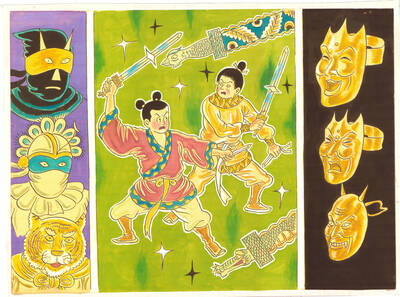
April 22 to April 28 The true identity of the mastermind behind the Demon Gang (魔鬼黨) was undoubtedly on the minds of countless schoolchildren in late 1958. In the days leading up to the big reveal, more than 10,000 guesses were sent to Ta Hwa Publishing Co (大華文化社) for a chance to win prizes. The smash success of the comic series Great Battle Against the Demon Gang (大戰魔鬼黨) came as a surprise to author Yeh Hung-chia (葉宏甲), who had long given up on his dream after being jailed for 10 months in 1947 over political cartoons. Protagonist


 RSS
RSS