


As a government-funded program intended to bring art-house films to a wider audience, POP Cinema (國民戲院) begins this year's screening series with the Taiwan vs. South Europe Film Festival (台灣VS.南歐影展). The six-week event features 26 films from Italy, Greece and Portugal, along with four local films focusing on women.
The festival comprises five programs, two of which are retrospectives of films made by the Greek master Theo Angelopulos and veteran Portuguese filmmaker Joao Cesar Monteiro. Apart from the works of these two heavyweight film masters, programmer Chang Chu-ti (張筑悌) said the festival aims to put more emphasis on films adapted from literary works, especially those from southern European countries.
"I'd like to introduce to Taiwanese audiences more great films that blossom from the rich and fascinating world of literature," Chang said.

PHOTO COURTESY OF SPOT TAIPEI FILM HOUSEN
These include several award-winning films, with stories of love, passion and lust, and also of friendship, human affinity, maternal love and a nostalgic longing for the lost innocence of childhood.
The festival started yesterday and will continue through May 27 at SPOT -- Taipei Film House (光點台北). The festival will then tour the country, stopping at the Performance Hall at the Taoyuan County Government building, Hsinchu Municipal Image Museum (新竹影像博物館), Taichung Universal Cinema City (台中市環球影城), and the Kao-hsiung Film Archive (高雄電影圖書館).
Theo Angelopulos has carved an important place for himself among the greatest auteurs of world cinema, and has, without a doubt, won the hearts of Taiwanese art-house moviegoers with his signature long-takes, picturesque compositions, fluid camera movements and poetic and philosophical reflections on the history and spirit of his homeland, Greece. The festival will showcase seven of his works to represent the artist's evolution as a filmmaker.
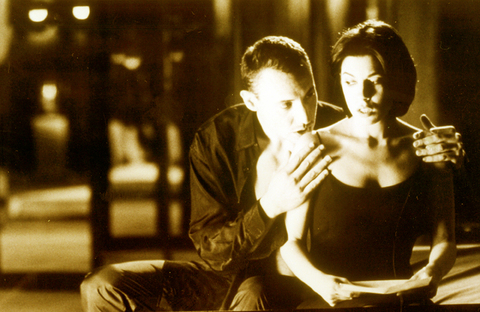
PHOTO COURTESY OF SPOT TAIPEI FILM HOUSE
One of Angelopulos' early works, The Traveling Players (1975) tells of the troubled modern history of Greece, from the Nazi occupation of World War II to the devastating civil war. The story centers around an acting troupe traveling through rural Greek villages, attempting to perform, only to be interrupted by air raids, gunfire, murder and arrests.
Landscape in the Mist (1988) is a road movie telling the story of a 14-year-old girl named Voula and her little brother, Alexander, on a journey in search of their father. As the story unfolds, film begins to stray farther from the reality and into the world of metaphor and allegory. It is about an existential voyage searching for the unattainable.
As one of the director's recent works, Eternity and a Day, won the Palme d'Or at the Cannes film festival in 1998 and is about a dying poet who gains a better understanding of his alienation as a troubled observer of Greece through his friendship with an Albanian child refugee.
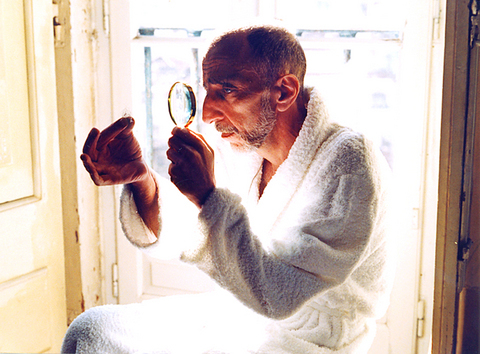
PHOTO COURTESY OF SPOT TAIPEI FILM HOUSE
The Taiwan festival chose the lastest Angelopulos movie to be its opening film. Trilogy: The Weeping Meadow is the first part of the filmmaker's grand new trilogy, which aims to depict the history of Greece from the early years of the last century to the present. This film signals a return to the vast stage of The Traveling Players, in which individuality gives way to the biblical force of history. It is a departure from his recent works, in which historical and political events are reflected through the experience and fabled odyssey of a single individual.
Even though the late Portuguese director made only seven films in his entire life, Joao Cesar Monteiro made himself an important figure in the world cinema, and has been hailed as one of the most original and provocative filmmakers of all time.
Monteiro performed in all his works, usually as the main character. Some said his real self was indistinguishable from his on-screen persona, Joao de Deus (meaning "of God" in Portuguese), a character in his 1999 work The Spousals of God. In the film, Joao de Deus is visited by an envoy of God and embarks on a surrealist voyage through life.
The Taiwan festival will showcase four of his films, including Venice Film Festival winners Recollections of the Yellow House, God's Comedy and his last work, Come and Go, completed in 2003 right before his death.
The selected movies in the Taiwanese Literature: Women Image program are adapted from successful literary works by female novelists. Osmanthus Alley (桂花巷) is adapted from the book of the same title written by Hsiao Li-hung (蕭麗紅), and Kuei-Mei, A Woman (我這樣過了一生) is adapted from the novel Home of Xia Fei (霞飛之家) by Hsiao Sa (蕭颯). All of the films depict the lives and struggles of women against a repressive male-dominated society and are set amid turbulent social changes.
The closing film is Autumn Tempest (落山風), directed by veteran female filmmaker Huang Yu-shan (黃玉珊). As a pioneering Taiwanese female artist, Huang has dedicated herself to organizing women's film festivals and making films, documentaries and TV series. All of her works explore the issues of gender inequality, female desire and a woman's perception of her body.
In addition to the screenings, the festival also invites the audience to participate in panel discussions with the filmmaker Huang Yu-shan (黃玉珊), film critic Lee Tayi (李達義), female author Yang Nan-quian (楊南倩) and actress Lu Yi-jing (陸奕靜). Themes for discussion will include the issue of female figures represented in movies made by male and female directors, the works by Angelopulos and Monteiro, and the intimate relationship between literature and cinema.
The upcoming screenings series for POP Cinema this year is to include a selection of Latin American independent films and a mini-festival of movies adapted from the literary works of Russian masters Mikhail Sholokhov and Leo Tolstoy.
To further encourage moviegoers, POP cinema has a low-price policy, with ticket prices ranging from free to NT$150. For more program information, visit www.twfilm.org/southeurope or call SPOT at (02)2511 7786.

Last week Joseph Nye, the well-known China scholar, wrote on the Australian Strategic Policy Institute’s website about how war over Taiwan might be averted. He noted that years ago he was on a team that met with then-president Chen Shui-bian (陳水扁), “whose previous ‘unofficial’ visit to the US had caused a crisis in which China fired missiles into the sea and the US deployed carriers off the coast of Taiwan.” Yes, that’s right, mighty Chen caused that crisis all by himself. Neither the US nor the People’s Republic of China (PRC) exercised any agency. Nye then nostalgically invoked the comical specter

April 15 to April 21 Yang Kui (楊逵) was horrified as he drove past trucks, oxcarts and trolleys loaded with coffins on his way to Tuntzechiao (屯子腳), which he heard had been completely destroyed. The friend he came to check on was safe, but most residents were suffering in the town hit the hardest by the 7.1-magnitude Hsinchu-Taichung Earthquake on April 21, 1935. It remains the deadliest in Taiwan’s recorded history, claiming around 3,300 lives and injuring nearly 12,000. The disaster completely flattened roughly 18,000 houses and damaged countless more. The social activist and

Over the course of former President Ma Ying-jeou’s (馬英九) 11-day trip to China that included a meeting with Chinese Communist Party (CCP) leader Xi Jinping (習近平) a surprising number of people commented that the former president was now “irrelevant.” Upon reflection, it became apparent that these comments were coming from pro-Taiwan, pan-green supporters and they were expressing what they hoped was the case, rather than the reality. Ma’s ideology is so pro-China (read: deep blue) and controversial that many in his own Chinese Nationalist Party (KMT) hope he retires quickly, or at least refrains from speaking on some subjects. Regardless

Approaching her mid-30s, Xiong Yidan reckons that most of her friends are on to their second or even third babies. But Xiong has more than a dozen. There is Lucky, the street dog from Bangkok who jumped into a taxi with her and never left. There is Sophie and Ben, sibling geese, who honk from morning to night. Boop and Pan, both goats, are romantically involved. Dumpling the hedgehog enjoys a belly rub from time to time. The list goes on. Xiong nurtures her brood from her 8,000 square meter farm in Chiang Dao, a mountainous district in northern Thailand’s


 RSS
RSS