


Art is like poetry in that you usually don't get it on the first try. As there are many levels of meaning and metaphors just in one word of a well-written poem, it takes several readings to decode the meaning, much like decoding a riddle. Even though, deciphering the meaning of poetry and visual art is challenging, it can be extremely fun to figure out what its creator had in mind. However, if you're not in the mood for any cerebral exercise and are looking for something less challenging to see this weekend, you're in luck.
The World Press Photo 2005 exhibition currently on view at the Eslite Bookstore, B2 until May 29th gives you all the information you need, as there are no metaphors or hidden meanings here. In other words: what you see is what you get.
This is a display of the best in photojournalism of the past year, of documentation of powerful events that have happened, such as war, sickness, drug abuse, disasters and destruction, interspersed with several human-interest photos to create some levity in the midst of such stark and sometimes depressing images.

PHOTO COURTESY OF WORLD PRESS PHOTO
The World Press Photo was founded in 1955 in Amsterdam as a non-profit organization to educate and promote the field of photojournalism. Every year, they hold an international contest, which culminates in a traveling exhibition of the award-winning photos that are shown in 40 countries.
Many of the images would be familiar to those who regularly look at newspapers, magazines and on-line news. The categories for awards are spot news, general news, people in the news, sports action, sports features, contemporary issues, daily life, portrait, arts and entertainment and nature.
Arko Datta won the World Press Photo 2004 for his photo of a prostrate woman grieving the loss of her loved one in tsunami-destroyed Tamil Nadu, India.
PHOTO COURTESY OF WORLD PRESS PHOTO
The first prize for people in the news went to Kristen Ashburn's photo of a murdered Palestinian wrapped in a blood-soaked sheet in the morgue, a very harsh image to look at.
J.F. Diorio's image of a fire raging through a Sao Paulo favela won first prize for general news, while John Moore won third prize for his image of a detainee in a cage, or what is referred to as an outdoor solitary confinement cell outside of Abu Ghraib Prison.
To counterbalance all the blood and gore on view, the award-winning sports photos are delightful and atypical. Bob Martin won first prize for the Sports Action Singles with a visually-striking image of a paralympic swimmer diving into a pool while his prosthetic legs rest nearby.

PHOTO COURTESY OF WORLD PRESS PHOTO
Daniel Silva Yoshisato documented the indigenous community of Churubamba, Peru, 3,850m above sea level where the women avidly play soccer. David Burnett's images of the Olympics make the players look like miniature toys. For pure entertainment, Joe O'Shaughnessy shot the Strange Fruit theater company whose costumed members stand on 4m-high poles at twilight.
If stark photographic reality is too much to handle, then wander down the hall to the Eslite Gallery to see Liu Xiaogong's (
Titled The New Eighteen Arhats, Liu painted nine soldiers in China and then nine in Kinmen. These paintings were originally shown at the Bunker Museum of Contemporary Art in Kinmen in September last year and now are showing for the first time in Taipei.
Liu's painterly canvases restore identity to these nameless young men and show they are united as brothers, though divided by political ideologies. And like the Arhats who were instructed by Buddha to help guide people to Enlightenment, he hopes these soldiers will stop being war machines and instead become emissaries of peace.
What: The Eslite bookstore gallery showcases the winners of one of the world's top photojournalism competitions from 2004
When: The exhibit runs until May 29. Open daily from 11am to 10pm. Closed Mondays.
Where: B2, 245 Dunhua S Rd, Sec 1, Taipei (
What: Paintings by Liu Xiaodong (
Where: The Eslite Gallery
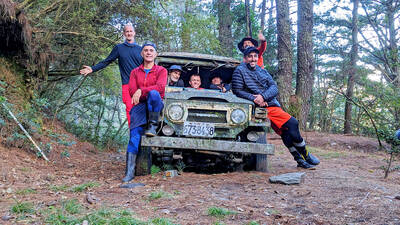
The year was 1991. A Toyota Land Cruiser set out on a 67km journey up the Junda Forest Road (郡大林道) toward an old loggers’ camp, at which point the hikers inside would get out and begin their ascent of Jade Mountain (玉山). Little did they know, they would be the last group of hikers to ever enjoy this shortcut into the mountains. An approaching typhoon soon wiped out the road behind them, trapping the vehicle on the mountain and forever changing the approach to Jade Mountain. THE CONTEMPORARY ROUTE Nowadays, the approach to Jade Mountain from the north side takes an

Relations between Taiwan and the Czech Republic have flourished in recent years. However, not everyone is pleased about the growing friendship between the two countries. Last month, an incident involving a Chinese diplomat tailing the car of vice president-elect Hsiao Bi-khim (蕭美琴) in Prague, drew public attention to the People’s Republic of China’s (PRC) operations to undermine Taiwan overseas. The trip was not Hsiao’s first visit to the Central European country. It was meant to be low-key, a chance to meet with local academics and politicians, until her police escort noticed a car was tailing her through the Czech capital. The

Last week Joseph Nye, the well-known China scholar, wrote on the Australian Strategic Policy Institute’s website about how war over Taiwan might be averted. He noted that years ago he was on a team that met with then-president Chen Shui-bian (陳水扁), “whose previous ‘unofficial’ visit to the US had caused a crisis in which China fired missiles into the sea and the US deployed carriers off the coast of Taiwan.” Yes, that’s right, mighty Chen caused that crisis all by himself. Neither the US nor the People’s Republic of China (PRC) exercised any agency. Nye then nostalgically invoked the comical specter
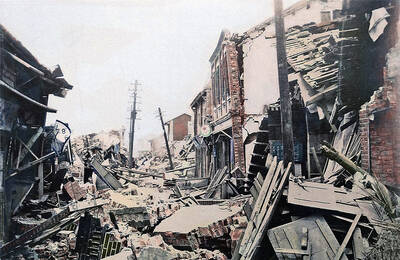
April 15 to April 21 Yang Kui (楊逵) was horrified as he drove past trucks, oxcarts and trolleys loaded with coffins on his way to Tuntzechiao (屯子腳), which he heard had been completely destroyed. The friend he came to check on was safe, but most residents were suffering in the town hit the hardest by the 7.1-magnitude Hsinchu-Taichung Earthquake on April 21, 1935. It remains the deadliest in Taiwan’s recorded history, claiming around 3,300 lives and injuring nearly 12,000. The disaster completely flattened roughly 18,000 houses and damaged countless more. The social activist and


 RSS
RSS