


"Coming from a world clogged with congestion," writes Nick Middleton, "I'd found it refreshing to traverse such vast tracts of physical geography, expanses of the natural world that remain largely untamed." Elsewhere he reasons: "Given we live in an age still obsessed with communications and the exchange of ideas ... the world's oldest superhighway might make a good theme for a journey of discovery."
Middleton is a geography professor at Oxford but is also an experienced travel writer and TV personality. Titles such as The Last Disco in Outer Mongolia and Ice Tea and Elvis: A Saunter through the Southern States suggest his enthusiasm for giving the flavor of geography as it manifests itself in the comic and the bizarre.
Extremes Along the Silk Road also aims to display its rather self-consciously doughty author caught up in what are frequently absurd situations.
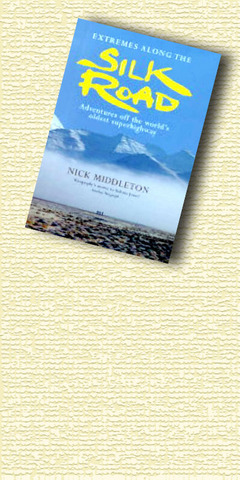
As a trade route, the Silk Road has been less a single highway and more a network of overland routes linking Europe with Asia, making trade possible between those with a passion for silk, horses and exotic fauna and flora. Just about every transaction imaginable has occurred along its many trails over the centuries.
Middleton's particular passion consists of exposing himself to nature's vicissitudes -- getting sand-blasted among the giant dunes of the Gobi Desert, sleeping on hot rocks to counteract extremes of temperature, facing oxygen starvation in Tibet as he climbs towards the "navel of the universe," and finally risking contamination from anthrax spores on what has been ironically named "Rebirth Island," a place devoted by the Soviets to designer diseases such as the plague and small-pox, but also Q-fever, botulineum Venezuelan equine encephalitis, "to complete a lethal bill of fare."
Hence the emphasis never strays from what is arduous about the journey. He's an adventurer, but at heart more a meticulous academic than a daredevil. Ever cautious in his research, he sometimes gives the impression of being an irritable hedgehog (notably in photos in his fur-trimmed Mongolian hat), complaining about the litter, and muttering and fretting as he moves towards his next destination.
Researching the different forms of altitude sickness he is alarmed to discover it can lead to swelling of the brain or to the lungs slowly filling with fluid. He nonetheless decides to embark on the "kora," or ciricumambulation of the base of the holy Mount Kailas. He's impressed by the profusion of Buddhist prayer-flags everywhere strung in the trees, and by the willingness of the pilgrims to prostrate themselves up to 1,000 times a day.
Having no religious inclinations himself, he begins to speculate on Tibetan Buddhism as a prerequisite for survival at such an altitude, yet makes the classic Western error of putting bodily discipline before mental striving. Later on, almost defeated by exhaustion, he is told by a fellow-traveler, Norbu, "Nobody can help you. You are on your own. You must believe inside." For his pains he's given a pebble, its dark color intended to reflect his less-than-spotless karma.
His pilgrimages now complete, he's attracted to Kazakhstan, partly for its fabled "heavenly horses" but more importantly for its vanished Aral Sea, now thought of as a scene of ecological catastrophe. The sea "has been gradually disappearing since the mid-twentieth century as thirsty Central Asian irrigation schemes, established during Soviet times, have resulted in a dramatic decline in the volume of water entering from its two tributaries." An addict of the bleak scenario, his account of the defunct harbor, with its rotting ships nestling in silt, is nonetheless unanswerable testimony to Soviet profligacy.
For light relief, he spends some time with the Khazak nomads and their celestial steeds, and is inveigled into a game of kokpar, played on horseback with a decapitated goat as prize. This game can at times be so frenzied that it's essential to keep your distance in order to avoid being wounded in the crush, but Middleton nevertheless sees it as reflecting the nature of the nomads, who have long aspired to live independently, and pays tribute to them for giving him the "primeval thrill" of life on the steppe.
Approaching his date with destiny at Rebirth Island, Middleton has serious misgivings about exposing himself to the horrors that await him -- chiefly anthrax spores -- and doubts the efficacy of the equipment he's brought along. Before approaching the "laboratories," however, he notes the absence of any sounds whatever. "No birds, just an eerie silence. It was truly a deathly hush."
On an island dedicated to the development of lethal biological warfare, this is his personal journey into the heart of darkness, and he emerges in somber mood.
"Of all the sagas of survival in extreme environments that I'd come across in my travels," he writes, the plight of anyone coming into contact with these evils "had to be placed at the lowest point on the scale. To brave the dangers of Rebirth Island took a very special blend of courage and desperation."
This account of the Silk Road, with its contrasts and exotic detail, certainly chronicles the challenges and hardships Middleton faced. But if he'd sacrificed some of the sense of his own heroism, and introduced instead more of a sense of wonder or of the absurd, the book would have proved a more entertaining read.
As it is, it constitutes at best a stop-gap for those who can't get enough of Asian travel narratives. It has little of the equanimity of Peter Fleming's classic News from Tartary (which covered some of the same territory and was also not without its comic episodes), none of the farcical brilliance of Eric Newby's A Short Walk in the Hindu Kush, and absolutely none of the personal elan and lightly-worn scholarship of Redmond O'Hanlon, these days the man to beat in the arduous-yet-hilarious travel genre.

In late October of 1873 the government of Japan decided against sending a military expedition to Korea to force that nation to open trade relations. Across the government supporters of the expedition resigned immediately. The spectacle of revolt by disaffected samurai began to loom over Japanese politics. In January of 1874 disaffected samurai attacked a senior minister in Tokyo. A month later, a group of pro-Korea expedition and anti-foreign elements from Saga prefecture in Kyushu revolted, driven in part by high food prices stemming from poor harvests. Their leader, according to Edward Drea’s classic Japan’s Imperial Army, was a samurai

Located down a sideroad in old Wanhua District (萬華區), Waley Art (水谷藝術) has an established reputation for curating some of the more provocative indie art exhibitions in Taipei. And this month is no exception. Beyond the innocuous facade of a shophouse, the full three stories of the gallery space (including the basement) have been taken over by photographs, installation videos and abstract images courtesy of two creatives who hail from the opposite ends of the earth, Taiwan’s Hsu Yi-ting (許懿婷) and Germany’s Benjamin Janzen. “In 2019, I had an art residency in Europe,” Hsu says. “I met Benjamin in the lobby

April 22 to April 28 The true identity of the mastermind behind the Demon Gang (魔鬼黨) was undoubtedly on the minds of countless schoolchildren in late 1958. In the days leading up to the big reveal, more than 10,000 guesses were sent to Ta Hwa Publishing Co (大華文化社) for a chance to win prizes. The smash success of the comic series Great Battle Against the Demon Gang (大戰魔鬼黨) came as a surprise to author Yeh Hung-chia (葉宏甲), who had long given up on his dream after being jailed for 10 months in 1947 over political cartoons. Protagonist

A fossil jawbone found by a British girl and her father on a beach in Somerset, England belongs to a gigantic marine reptile dating to 202 million years ago that appears to have been among the largest animals ever on Earth. Researchers said on Wednesday the bone, called a surangular, was from a type of ocean-going reptile called an ichthyosaur. Based on its dimensions compared to the same bone in closely related ichthyosaurs, the researchers estimated that the Triassic Period creature, which they named Ichthyotitan severnensis, was between 22-26 meters long. That would make it perhaps the largest-known marine reptile and would


 RSS
RSS