


The industry that launched Jackie Chan (
Once a powerhouse that churned out 300 movies a year and had box-office takings of more than a billion Hong Kong dollars annually in the mid-1990s, the industry is now just a shade of its past glory.
In 2004, Hong Kong produced a measly 64 features and took HK$445 million (US$57 million) at the box office.
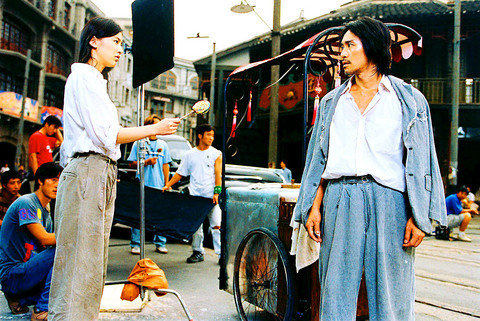
PHOTO:REUTERS
"You can't even call it an industry," said Woody Tsung, chief executive of the Hong Kong, Kowloon & New Territories Motion Picture Industry
Association.
Industry insiders blame video-disc piracy -- widespread in Asia -- and the rise of computer download services for siphoning off profits and spooking movie

PHOTO: AP
investors.
Hong Kong moviemakers are now turning to China's market, co-productions with foreigners and new forms of film financing to try to mount a recovery. They're also pressing the government for better protection of intellectual property.
China recently removed quota restrictions on Hong Kong films under a free-trade deal. But there are just three Chinese distributors authorized to import movies from the territory, making it tough to get a good prices for distribution rights.
"If those three companies don't buy the film, then there's nothing to talk about," Tsung said. "Our bargaining power is much smaller."
While China's market of 1.3 billion potential viewers is mouthwatering, it remains largely untapped, Hong Kong industry official say, because it only has about 2,000 screens and movie watching isn't widespread.
Some analysts say one way to expand the industry may be to form greater ties with mainland China.
Film critic Law Kar envisions an industry that has China providing the backdrops and Hong Kong supplying experienced work crews, business savvy and an established global distribution network.
"The Hong Kong spirit is constantly adapting with flexibility," he said.
Law's vision of an integrated greater-Chinese movie industry has already demonstrated its potential in the Oscar-winning martial arts movie Crouching Tiger, Hidden Dragon (
Crouching Tiger cracked the coveted US market despite its non-English dialogue, grossing more than US$130 million and becoming the most popular foreign-language film in American history.
Breaking into mainstream Western markets is critical to the Hong Kong industry's success, said Tsung, the movie industry association head. In the past, Hong Kong stars like Lee and Chan have moved to America to try to make the big time.
"In the past, Hong Kong and Chinese films were looking at the Chinatown market," he said. "Not any more. Now we're talking about the mainstream market. We want national releases. Even foreigners have to watch them."
Comedian Stephen Chow's (
The movie shattered Hong Kong box office records this year, won six Hong Kong Film Awards, including best film, and reached No. 5 at the US weekend box office.
The Hong Kong government has stepped in to help, setting up a HK$50 million (US$6.4 million) fund aimed at encouraging banks in this global financial center to back movies. The fund guarantees bank loans to movie productions and so far has been used in several productions.
Tsung said the burgeoning use of Internet file-sharing software is becoming a bigger problem than illegal copying of movies onto video discs.
One recent Hong Kong release, House of Fury (精武家庭), has been downloaded one million times worldwide, Tsung said, without saying how the figure was reached.
Authorities have cracked down on copyright violations in Hong Kong -- they recently prosecuted a man who allegedly uploaded movies using the BitTorrent file-sharing program. But piracy is very difficult to police across borders.
Sammo Hung, star of the US TV series Martial Law, worries that Hong Kong has run out of ideas because movie makers went into creative overdrive during their more prolific days.
"The backdrop of Hong Kong is small. Our thinking is narrower," Hung said. "Hong Kong exhausted all its movie ideas years ago."

In late October of 1873 the government of Japan decided against sending a military expedition to Korea to force that nation to open trade relations. Across the government supporters of the expedition resigned immediately. The spectacle of revolt by disaffected samurai began to loom over Japanese politics. In January of 1874 disaffected samurai attacked a senior minister in Tokyo. A month later, a group of pro-Korea expedition and anti-foreign elements from Saga prefecture in Kyushu revolted, driven in part by high food prices stemming from poor harvests. Their leader, according to Edward Drea’s classic Japan’s Imperial Army, was a samurai

Located down a sideroad in old Wanhua District (萬華區), Waley Art (水谷藝術) has an established reputation for curating some of the more provocative indie art exhibitions in Taipei. And this month is no exception. Beyond the innocuous facade of a shophouse, the full three stories of the gallery space (including the basement) have been taken over by photographs, installation videos and abstract images courtesy of two creatives who hail from the opposite ends of the earth, Taiwan’s Hsu Yi-ting (許懿婷) and Germany’s Benjamin Janzen. “In 2019, I had an art residency in Europe,” Hsu says. “I met Benjamin in the lobby
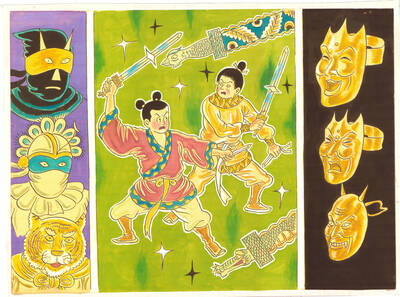
April 22 to April 28 The true identity of the mastermind behind the Demon Gang (魔鬼黨) was undoubtedly on the minds of countless schoolchildren in late 1958. In the days leading up to the big reveal, more than 10,000 guesses were sent to Ta Hwa Publishing Co (大華文化社) for a chance to win prizes. The smash success of the comic series Great Battle Against the Demon Gang (大戰魔鬼黨) came as a surprise to author Yeh Hung-chia (葉宏甲), who had long given up on his dream after being jailed for 10 months in 1947 over political cartoons. Protagonist

A fossil jawbone found by a British girl and her father on a beach in Somerset, England belongs to a gigantic marine reptile dating to 202 million years ago that appears to have been among the largest animals ever on Earth. Researchers said on Wednesday the bone, called a surangular, was from a type of ocean-going reptile called an ichthyosaur. Based on its dimensions compared to the same bone in closely related ichthyosaurs, the researchers estimated that the Triassic Period creature, which they named Ichthyotitan severnensis, was between 22-26 meters long. That would make it perhaps the largest-known marine reptile and would


 RSS
RSS