


"It doesn't just sound good -- it looks good, too."
That's what we're told on the bill advertising the Taipei Philharmonic's Paradiso (天堂王國), its new Broadway-styled musical scheduled to tread the boards of the Sun Yat-sen Memorial Hall this coming Thursday then move on to Kaohsiung in the first weekend of June.
As a selling point it's true enough. The voices of principal cast members Na Wei-xun (那維勳), Zhou Ming-yu (周明宇) and Lin Xin-yi (林欣誼) alone are entertaining. Dress them in costumes lavishly designed by Golden Horse award-winner Lai Wei-gui (
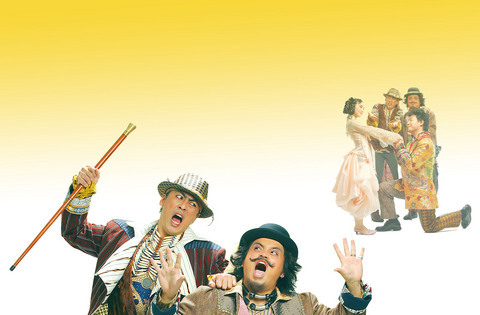
But as the Taipei Times discovered in a sneak preview of the show earlier this week, sounding good and looking good go only so far. The music, the performer's voices and Lai's eye-candy costumes don't compensate for a show built around stock choreography and a pedestrian plot. Given a more mature story -- and the mature acting it would require -- Paradiso might indeed be heavenly.
The story is a fairy-tale farce about love and politics on Paradise Island. The island's golden-hearted and golden-voiced prince, played by Zhou, is in love with a beautiful and innocent commoner named Yun-yun, played by the equally golden-voiced Lin. But the king has arranged for his son to marry the ugly princess of Paradise Island's giant neighbor, a hegemonic country with plans to annex the little island.
The political paradigm is, of course, no coincidence. Writer and director Zhong Xin-zhi's (鍾欣志) script is informed by cross-strait politics. But rather than venture into that minefield of material to make a more explosive story, Zhong and writing partner Kuo Yi-hong (郭議鴻) have opted to focus on the fairly-tale love story.
While foregoing what could be a more intriguing plot, their choice does have arguably more entertainment value. Audiences get to hear more of Zhou and Lin's considerable voices, and, in the scenes between Lin and the ugly princess, are treated to Paradiso's funniest moments.
The princess is hilariously played by a cross-dressing Lee Yung-jie (李泳杰), who steals the show and proves distracting to his fellow cast members every time he/she steps on stage. His is the falsetto foil to Lin's lilting soprano in their song about who the prince belongs to.
What political intrigue is in the show is provided by the island's conniving major, played by Na, and his right-hand man who is played by Wang Jing-guan (王鏡冠). Wang's daughter is the innocent girl with whom the prince is in love.
The problem is that the prince has been less than honest with her, masquerading as a music teacher to win her heart. When finally he does divulge his true identity, Yun-yun is frightened off and refuses to speak with him. It's up to her father to either do his boss' bidding or make his daughter happy.
Wang's turn as the henchman and big-hearted father falls flat for the plot's insistence on telling the lover's tale. When the kingdom's crisis reaches critical mass at the climax of the show, there's little empathy for the plight of the people and even less suspense in what action Wang takes. But at least it's all fun to watch.
Paradiso succeeds as a lighthearted romp that delivers laughs in all the right places, but does so at the expense of telling a more nuanced story that might have the audience thinking between the laughs.
For more information in Chinese, visit the Taipei Philharmonic Foundation's Web site at http://www.tpf.org.tw.
Performance notes:
Where: Taipei Sun Yet-sen Mrmorial Hall (國父紀念館)
When: Thursday, May 12, Friday, May 13 at 7:30pm. Saturday, May 14 Sunday, May 15 at 2:30 pm and 7:30pm.
Where: Kaohsiung's Chite Hall (高雄至德堂)
When: Sunday, June 5 at 7:30pm
Tickets: From NY$500 to NT$2000 in Taipei and NT$400 to NT$1500 in Kaohsiung and can be reserved by calling (02) 2773 3691 or online at http://www.artsticket.com.tw

The year was 1991. A Toyota Land Cruiser set out on a 67km journey up the Junda Forest Road (郡大林道) toward an old loggers’ camp, at which point the hikers inside would get out and begin their ascent of Jade Mountain (玉山). Little did they know, they would be the last group of hikers to ever enjoy this shortcut into the mountains. An approaching typhoon soon wiped out the road behind them, trapping the vehicle on the mountain and forever changing the approach to Jade Mountain. THE CONTEMPORARY ROUTE Nowadays, the approach to Jade Mountain from the north side takes an

Relations between Taiwan and the Czech Republic have flourished in recent years. However, not everyone is pleased about the growing friendship between the two countries. Last month, an incident involving a Chinese diplomat tailing the car of vice president-elect Hsiao Bi-khim (蕭美琴) in Prague, drew public attention to the People’s Republic of China’s (PRC) operations to undermine Taiwan overseas. The trip was not Hsiao’s first visit to the Central European country. It was meant to be low-key, a chance to meet with local academics and politicians, until her police escort noticed a car was tailing her through the Czech capital. The

Last week Joseph Nye, the well-known China scholar, wrote on the Australian Strategic Policy Institute’s website about how war over Taiwan might be averted. He noted that years ago he was on a team that met with then-president Chen Shui-bian (陳水扁), “whose previous ‘unofficial’ visit to the US had caused a crisis in which China fired missiles into the sea and the US deployed carriers off the coast of Taiwan.” Yes, that’s right, mighty Chen caused that crisis all by himself. Neither the US nor the People’s Republic of China (PRC) exercised any agency. Nye then nostalgically invoked the comical specter

Katsu, donburi and onigiri are among 23 Japanese words added to the Oxford English Dictionary (OED) in its latest update. More than half of the borrowed words relate to food or cooking. Santoku, a knife with a short, flat blade that curves down at the tip, and okonomiyaki, a type of savory pancake, were both added. Okonomiyaki is derived from okonomi, meaning “what you like,” combined with yaki, meaning “to fry, to sear.” Katsu — a piece of meat, seafood or vegetable, coated with flour, egg and panko breadcrumbs, deep-fried, and cut into strips — is considered a boomerang word,


 RSS
RSS