


Scott Simon is in the process of becoming a veteran Taiwan-watcher. Two years ago he published Sweet and Sour: Life-worlds of Taipei Women Entrepreneurs (reviewed in Taipei Times Jan. 4, 2004) and he contributed an article on gay identities in Taiwan to Taiwan: The Minor Arts of Daily Life (reviewed in Taipei Times Aug. 1, 2004).
Now comes Tanners of Taiwan, ostensibly about the leather industry in the Tainan area. Simon studied this in the 1990s in association with his PhD thesis, and indeed he announces that this new book "began as my PhD dissertation," but "in its original incarnation." It so happens that we have been able to trace this dissertation (so eager are authors to list their own works in their bibliographies) and it is entitled Not All in the Family: Class, Gender and Nation in the Industrialization of Taiwan (McGill University, Montreal, 1998). So Taiwan's tanners clearly took second place eventually, and from Tanners of Taiwan it's easy to see why.
The book begins, ends and often comes back to not so much the labors of Tainan's leather workers but the politics of nationhood here in Taiwan. Scott Simon is at pains to point out that his current students in Ottawa understand little about Taiwan's history or present political situation. In this book, therefore, Simon is keen to set the record straight. So we have a long introductory chapter on Taiwan's history and a concluding one that looks at last year's presidential election, complete with charts showing the swing of votes from the 2000 contest and so on. Tanners? Well, they do make an appearance in the central chapters of this short book, but it is clear that, in the same way they didn't in the event have sufficient interest to sustain his PhD thesis, they don't now have enough to fill even this relatively short book.
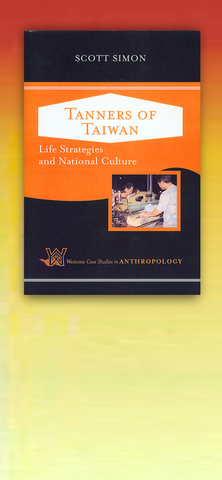
This isn't especially surprising. The bosses of the leather-curing establishments he met were by and large a dispirited lot. Some had moved their operations to China to take advantage once again of cheap labor and lax anti-pollution laws (the chemicals used in leather tanning wreak havoc with the run-off water that has to go somewhere and so soon enters the river systems). Others bemoaned the stalemate party-political situation, and asked Simon to tell the world about Taiwan's woes in his research papers.
This, of course, fits in well with Simon's desire to inform his readers where and what Taiwan is, and especially what it is not -- in other words, part of China. Leather tanning, after all, for the most part takes place in southern Taiwan and, as he is eager to explain, there the DPP are the dominant political force, and the influence of the culturally Chinese "mainlanders" at its weakest.
For instance, Simon arrives at his first tanning factory and surprises the owner and his family by addressing them in Mandarin, explaining he is researching the relationship between Chinese
culture and industrialization. "Then you will have to go to China," retorts the owner laughing, turning to chat to his friends in Taiwanese. "There are no Chinese here."
Once again, when writing about the history of Taiwan labor relations, Simon is quick to opt for a distinctively Taiwanese perspective. He has to credit the KMT with their land-reform program, which began in 1951 and redistributed land to agricultural workers. This, claims Simon, was on the one hand an anti-Communist move, and on the other a way of taking land off those who had acquired it by working with the Japanese during the 1895 to 1945 occupation.
He also looks at the labor problems of the tanning industry today. The work is dirty, smelly, arduous, and poses possible heath problems. The need, therefore, is -- unsurprisingly -- to find a "docile" labor force. His study covered 72 tannery owners and 4,300 tannery workers (leather tanning factories are not, on the whole, large-scale operations), and the tactics followed to find the required docility were fairly uniform.
First, rural workers were used rather than urban ones. Secondly, older workers were felt to be less likely to complain. Thirdly, women were more often employed than men. And lastly, foreign labor was frequently resorted to.
Scott Simon makes the usual obeisances to Karl Marx, routinely found in academics in the humanities these days although laughably double-faced in a place such as Taiwan. To his credit, however, he admits that Marxist theory sometimes doesn't apply where he's researching. But questions as to whether women are less "class-conscious" than men, and whether the KMT redistributed land in order to prevent the formation of working-class solidarity, are nonetheless raised.
Simon is on much surer ground when he looks at attitudes toward, and of, Taiwan's migrant workers. He claims they were paid between NT$15,800 and NT18,000 a month, plus board and lodging, during the period of his researches, though my less systematic inquiries have encountered stories of as much as two-thirds of this money even today being lost to agents in both Taiwan and the home country, witholding tax, and so on.
He also describes the racial myths adhering to various South-east Asian nations -- Indonesians slow but honest, Thais docile, Filipinos more used to unions and therefore more likely to protest about working conditions. He discounts these, being for the most part on the side of the workers. What he doesn't examine, however, are the equally potent myths prevalent among academics who look to Marx for their guiding principles.
There are paradoxes, however, that Simon doesn't include in his book. One of these is that the KMT and the DPP are both equally vigorously anti-Communist -- not equally anti-China, perhaps, but in both cases anti-Communist to the last man. Even so, there are other, and interesting, comparisons made here, even if in essence this is a book for novices in the study of Taiwanese affairs.
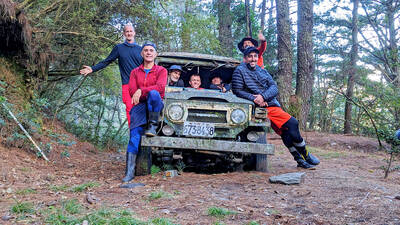
The year was 1991. A Toyota Land Cruiser set out on a 67km journey up the Junda Forest Road (郡大林道) toward an old loggers’ camp, at which point the hikers inside would get out and begin their ascent of Jade Mountain (玉山). Little did they know, they would be the last group of hikers to ever enjoy this shortcut into the mountains. An approaching typhoon soon wiped out the road behind them, trapping the vehicle on the mountain and forever changing the approach to Jade Mountain. THE CONTEMPORARY ROUTE Nowadays, the approach to Jade Mountain from the north side takes an

Last week Joseph Nye, the well-known China scholar, wrote on the Australian Strategic Policy Institute’s website about how war over Taiwan might be averted. He noted that years ago he was on a team that met with then-president Chen Shui-bian (陳水扁), “whose previous ‘unofficial’ visit to the US had caused a crisis in which China fired missiles into the sea and the US deployed carriers off the coast of Taiwan.” Yes, that’s right, mighty Chen caused that crisis all by himself. Neither the US nor the People’s Republic of China (PRC) exercised any agency. Nye then nostalgically invoked the comical specter

Relations between Taiwan and the Czech Republic have flourished in recent years. However, not everyone is pleased about the growing friendship between the two countries. Last month, an incident involving a Chinese diplomat tailing the car of vice president-elect Hsiao Bi-khim (蕭美琴) in Prague, drew public attention to the People’s Republic of China’s (PRC) operations to undermine Taiwan overseas. The trip was not Hsiao’s first visit to the Central European country. It was meant to be low-key, a chance to meet with local academics and politicians, until her police escort noticed a car was tailing her through the Czech capital. The
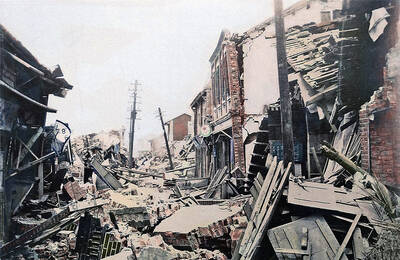
April 15 to April 21 Yang Kui (楊逵) was horrified as he drove past trucks, oxcarts and trolleys loaded with coffins on his way to Tuntzechiao (屯子腳), which he heard had been completely destroyed. The friend he came to check on was safe, but most residents were suffering in the town hit the hardest by the 7.1-magnitude Hsinchu-Taichung Earthquake on April 21, 1935. It remains the deadliest in Taiwan’s recorded history, claiming around 3,300 lives and injuring nearly 12,000. The disaster completely flattened roughly 18,000 houses and damaged countless more. The social activist and


 RSS
RSS