


Strolling through the quiet narrow laneways and along the hiking trials in and around the postcard-like Taipei County township of Jinguashih today it's hard to imagine that anything untoward could ever have taken place in the sleepy little backwater hamlet.
For WWII history buff, Michael Hurst, however, Jinguashih represents a dark side of the nation's past and one that until recently was little but a footnote in history books.
From November 1942 until the surrender of Imperial Japanese Army in Taiwan in August 1945, the township was home to the infamous Kinkaseki "Hell Camp." Over 1,000 British Commonwealth and Allied troops were interned in the camp at one time or another and all were forced to work in the local copper mines.
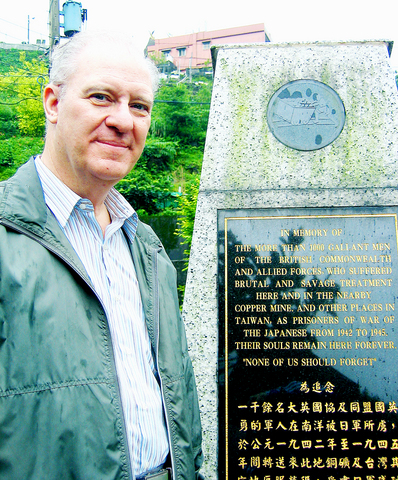
PHOTO: GAVIN PHIPPS, TAIPEI TIMES
The POWs were subject to inhuman treatment, denied the most basic of medical facilities, flogged by their jailers -- some of who were Taiwanese. And many prisoners were, quite literally, worked to death.
Following the surrender of Japan, the surviving POWs were shipped home and the camp's wooden buildings were dismantled piecemeal by the local populace. The only evidence of the once notorious POW camp to survive the looting were several concrete foundations, a half-dozen wall supports and a solitary concrete gatepost.
A visit to the township by Hurst and members of the Canadian Society in late 1996 was to change all this, however, and at the same time prove to be the beginning of an odyssey that would see Hurst traversing the island in search of Taiwan's long forgotten role in WWII.
"People knew all about the Bridge on the River Kwai, but very few knew about Taiwan's POW camps and the suffering endued by the allied prisoners at them," said Hurst. "So, with the help of the Australia New Zealand Business Association and the British Chamber of Commerce we formed the Kinkaseki POW Memorial Association with the goal of honoring the POWs and erecting a plaque at the site of the camp."
A memorial plinth was erected at the site of Kinkaseki in November 1997 and the first memorial service was held that same month. Since this initial service, members of the expat community and many of the ex-POWs and their families now make the pilgrimage to Jinguashih every November to participate in the annual event.
Two months prior to the 1997 service, Hurst set out to thoroughly explore the site of the notorious POW camp. He spent 10 days scratching and digging in the undergrowth at the site of the camp, along the pathways the prisoners used and at the mine entrances.
During this time Hurst unearthed over 100 artifacts, ranging from porcelain coat hooks to medicine vials. The most significant of all his finds were fragments of a white rice bowl bearing the emblem of the Japanese military star. The site of a foreign national didn't go unnoticed by local residents and, whether he liked or not, Hurst and his digging became a bit of a spectacle.
"I was on my hands and knees all day digging and scraping in the ground," he said. "I think people started to refer to me as some kind of Indiana Jones of Taiwan."
While local residents considered Hurst's excavations to be somewhat of an oddity, several of the town's more elderly residents proved to be of great help to Hurst in his search for the past. News of the committee's aims soon spread and it wasn't long before Hurst began receiving phone calls from government agencies, all of which were keen to support the POW project.
"Obviously it started as an expat [venture], but the more we discovered and the more it got publicized the more interested local people became," said Hurst. "I've really got to credit the help of the local people. There has been a lot of cooperation at all levels. Both the national and county governments have been solidly behind our work. They genuinely want Taiwanese to learn more about their past."
The Kinkaseki POW Association was disbanded in late 1997, but Hurst had amassed such a mass of data that he decided to continue his quest. In May 1999, Hurst founded the Taiwan POW Camps Society, which was formed with the aim of researching and locating former POW camps throughout Taiwan.
To date, Hurst has redisco-vered the locations of 14 other POW camps in Taiwan and collected the names of over 4,000 Allied servicemen who were interned in camps in Taiwan at one time or another.
The society has erected memorials at three of the former camps -- Taichu Number 2 in Taichung, Heito in Pingtung and Kukutsu in Taipei. While Hurst was not the first foreigner to seek out the camps, many of the sites had not been studied or surveyed since the end of war.
"US Intelligence studied the camps after WWII and there were records in regard the locations, but they were rough and some of the actual locations, as reported by the US Army at the time, were in fact in correct," said Hurst. "It was a case of taking what information I had to the sites in question and asking local people for help in pinpointing the correct locations."
Although founded with the aim of remembering allied soldiers interned on Taiwan, the society has also unearthed other information reagrding the treatment of POWs in Taiwan. The most startling information was brought to Hurst's attention in 2000 after he received a letter from a US national enquiring about his brother who was executed along with 13 other Americans by Japanese troops in Taipei in June 1945.
The surviving six members of a crew of a PB4Y-1 Liberator aircraft, which included the US national's brother, were, along with nine other captured US servicemen brought before a Japanese tribunal, found guilty of war crimes and summarily executed by firing squad. Two of the Japanese offices responsible for the execution of the US POWs were themselves executed by an US Army firing squad after the war.
"The Japanese kept very good records. From these I managed to track them down and found that it was most likely that the men were interned in Mosak Camp Number Five," said Hurst. "It's probable that they spent there final days in that camp before being sentenced at a mock trial and executed."
In keeping with the society's aims the Taiwan POW Memorial Society will hold the first ever memorial service in honor of the 14 executed US airmen on June 19 at the remains of the old north wall of the former Taipei prison.
As well as housing Allied POWs, the island was also a favored port of call for the numerous "hellships" that transported captured Allied prisoners to Japan. Earlier this year Hurst's society organized the first memorial to commemorate the bombing of the hellship Enoura Maru on which 300 Allied POWs died after it was crippled by US navy aircraft while moored in Koahsiung harbor on Jan. 9, 1945.
Hurst is currently working closely with the Hellships Memorial project, which plans to construct a memorial to honor all the POWs who were transported on these ships. The memorial, which is to be located at Subic Bay in The Philippines, is set to be unveiled in January next year.
As for the more immediate future, Hurst and the society are looking at one of their busiest years yet. Along with the holding of memorial services in Taipei and Koahsiung, Hurst is also busy organizing a 60th anniversary memorial of the evacuation of POWs from Taiwan and this year's Remembrance Day memorial in November.
He also plans to continue to sift through recently declassified archive records and, if needs be, dig and scrape his way through even more top soil in search of artifacts. And as if all this isn't enough to keep Hurst busy he also plans to finish a book about the POWs who were interned in Taiwan.
"It is a very busy year. But it's very important to keep the project going," said Hurst. "It's important for Taiwan, the families of the POWs and, of course, the ex-POWs themselves. We're doing it to remember those who survived the camps as well as their mates who didn't."

In late October of 1873 the government of Japan decided against sending a military expedition to Korea to force that nation to open trade relations. Across the government supporters of the expedition resigned immediately. The spectacle of revolt by disaffected samurai began to loom over Japanese politics. In January of 1874 disaffected samurai attacked a senior minister in Tokyo. A month later, a group of pro-Korea expedition and anti-foreign elements from Saga prefecture in Kyushu revolted, driven in part by high food prices stemming from poor harvests. Their leader, according to Edward Drea’s classic Japan’s Imperial Army, was a samurai

Approaching her mid-30s, Xiong Yidan reckons that most of her friends are on to their second or even third babies. But Xiong has more than a dozen. There is Lucky, the street dog from Bangkok who jumped into a taxi with her and never left. There is Sophie and Ben, sibling geese, who honk from morning to night. Boop and Pan, both goats, are romantically involved. Dumpling the hedgehog enjoys a belly rub from time to time. The list goes on. Xiong nurtures her brood from her 8,000 square meter farm in Chiang Dao, a mountainous district in northern Thailand’s
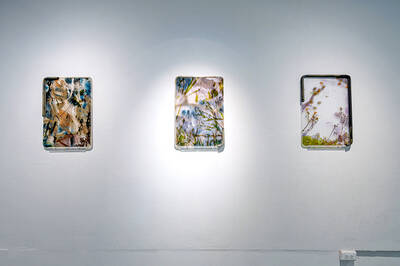
Located down a sideroad in old Wanhua District (萬華區), Waley Art (水谷藝術) has an established reputation for curating some of the more provocative indie art exhibitions in Taipei. And this month is no exception. Beyond the innocuous facade of a shophouse, the full three stories of the gallery space (including the basement) have been taken over by photographs, installation videos and abstract images courtesy of two creatives who hail from the opposite ends of the earth, Taiwan’s Hsu Yi-ting (許懿婷) and Germany’s Benjamin Janzen. “In 2019, I had an art residency in Europe,” Hsu says. “I met Benjamin in the lobby
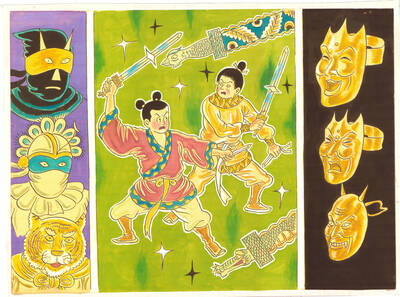
April 22 to April 28 The true identity of the mastermind behind the Demon Gang (魔鬼黨) was undoubtedly on the minds of countless schoolchildren in late 1958. In the days leading up to the big reveal, more than 10,000 guesses were sent to Ta Hwa Publishing Co (大華文化社) for a chance to win prizes. The smash success of the comic series Great Battle Against the Demon Gang (大戰魔鬼黨) came as a surprise to author Yeh Hung-chia (葉宏甲), who had long given up on his dream after being jailed for 10 months in 1947 over political cartoons. Protagonist


 RSS
RSS