


I'm not a gamer and haven't bothered playing one since trying, and failing, to clear the third screen of Ms. Pac Man. That said, Sony's new PSP, or Play Station Portable, might be cool enough to convert even game-hating grinches like me.
If not for the fun of the games themselves, then for the fact that the PSP plays movies and music, can present your photos in slide-show fashion and connects to other PSPs via wireless Wi-Fi. That last feature also gives it the potential to do a lot more. Rumors on the Web say it will eventually be able to download music and possibly be used as a telephone via VoIP, or Voice Over Internet Protocol -- rumors that Sony has done nothing to squelch.
The problem with the PSP, however, is the same one that plagues so many other Sony products and makes the company the hegemon of high-tech hardware manufacturers: proprietary formatting. Yes, you can watch a movie on the PSP. But it had better be stored on a Universal Media Disk, or UMD, a format the company created that resembles a Mini-Disk and which is anything but "universal."
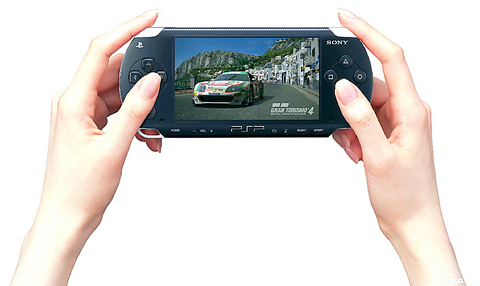
PHOTO COURTESY OF SONY
I wonder how many of the Chinese youths who recently took to the streets in anger at Japan were actually upset about ATRAC, Sony's proprietary digital music format. Now another new format? Sony, it would seem, needs to "face up to its history" and "have deep and profound reflections" on the issue if it wishes to be an industry leader.
Youths in Taiwan, however, seem unperturbed. To test drive a PSP -- literally, playing Ridge Racer -- I had to elbow into a mob of a different kind gathered around a demo model at a store in Taipei's Guanghua Market. If the reaction of that crowd is any indication, the PSP will enjoy here the same kind of sales it has had in the US since its release there last month, moving more than a half million units in its first two days on store shelves, generating over US$150 million in first-week sales and
setting an industry record.
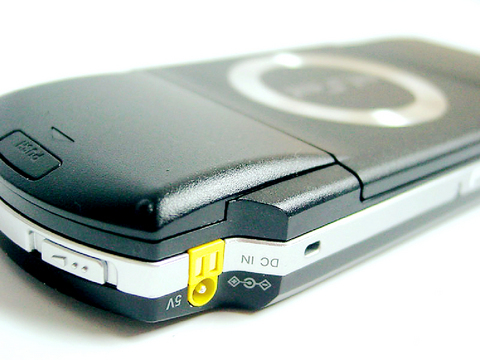
PHOTO COURTESY OF SONY
It has enjoyed hype that started early last year as the most anticipated product of this year and hasn't disappointed consumers who have gotten their hands on a model. CNN's Porter Anderson, in a review of the device, even predicted that it will be ensconced in the New York Museum of Modern Art's collection of iconic everyday items, alongside Apple's iPod.
What!? The PSP is out barely a month and already being compared to an iPod? I didn't believe the hype until I elbowed the demo device away from a group of high school boys.
Hold it and you understand. It quite literally puts the action in your hands, in a sleek design that feels solid-state. A gift tossed to earth by the gaming gods, meant to occupy adolescent boys who might otherwise take up smoking. And with a screen that demands to be looked at, stared at.
That screen is a 4.3-inch TFT LCD display with a 16:9 wide-screen aspect ratio. It displays over 16 million colors in 480 x 272 pixel resolution. That would be clear enough to see the sweat dripping off the faces of Nintendo executives, whose own portable gaming device has only 256 x192 pixel resolution and 260,000 colors.
Here's the problem with that screen: In order to watch a movie that isn't on a UMD, you need to connect the PSP to your computer via USB (the PSP is equipped with a USB port, but doesn't ship with a USB cable, for reasons that become clear when you get it out of the box). Drag and drop the music files from your computer to the PSP's flash media card (The PSP ships with a 32MB card, but you'll need a bigger one for storing movies) then create a ROOT_MP directory on the memory card and use a combination of image
converters to change the file into something more PSP-palatable. A US$10 image converter is among the many things Sony says is in the PSP pipeline.
Why the hassle? Sony would rather you stick to buying video content on their UMD format, of course, which they've priced the same as DVDs.
Listening to music is easier. And the fact that the PSP will play more than just Sony's ATRAC files is a relief. Just drag and drop your music from your computer to the PSP via USB cable and it shows up on the device. However, that's about the limit of the PSP's music-playing capabilities; no operable equalizer, no bells and whistles and, worst of all, no listening to Judas Priest's Turbo Lover and playing Ridge Runner at the same time. Equally abhorrent is the lack of volume you get from music files. Games play at a louder volume than music.
Sony says the PSP has up to five-and-a-half hours of battery life and Internet-based reviews support this claim. What's more, the company has outfitted the device with lithium-ion batteries that can be swapped out (if you have another battery), eliminating the need to plug in the device to charge it.
What may eventually be really cool is the "so much more" that Sony says the PSP is (read: may become). Much of this centers on the device's Wi-Fi capability. Currently, the PSP is only set up to game with other PSPs over a local wireless network, but already the device has been hacked to surf the Internet. The next logical step is for Sony to use this wireless capability for firmware upgrades or downloading music from their online music store Label Gate, or any number of other applications.
The hardware is there for the device to do a lot and even find an audience outside the gaming community. What remains to be seen is what direction Sony will take it.
Bottom line: Unless you're among the gotta-have-it crowd, hold onto your game tokens for the upgrade.

In late October of 1873 the government of Japan decided against sending a military expedition to Korea to force that nation to open trade relations. Across the government supporters of the expedition resigned immediately. The spectacle of revolt by disaffected samurai began to loom over Japanese politics. In January of 1874 disaffected samurai attacked a senior minister in Tokyo. A month later, a group of pro-Korea expedition and anti-foreign elements from Saga prefecture in Kyushu revolted, driven in part by high food prices stemming from poor harvests. Their leader, according to Edward Drea’s classic Japan’s Imperial Army, was a samurai

Located down a sideroad in old Wanhua District (萬華區), Waley Art (水谷藝術) has an established reputation for curating some of the more provocative indie art exhibitions in Taipei. And this month is no exception. Beyond the innocuous facade of a shophouse, the full three stories of the gallery space (including the basement) have been taken over by photographs, installation videos and abstract images courtesy of two creatives who hail from the opposite ends of the earth, Taiwan’s Hsu Yi-ting (許懿婷) and Germany’s Benjamin Janzen. “In 2019, I had an art residency in Europe,” Hsu says. “I met Benjamin in the lobby
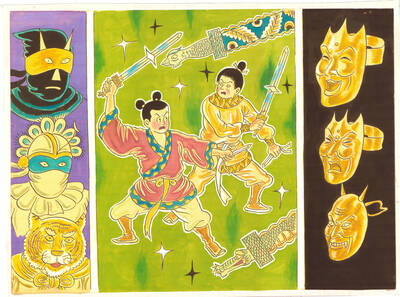
April 22 to April 28 The true identity of the mastermind behind the Demon Gang (魔鬼黨) was undoubtedly on the minds of countless schoolchildren in late 1958. In the days leading up to the big reveal, more than 10,000 guesses were sent to Ta Hwa Publishing Co (大華文化社) for a chance to win prizes. The smash success of the comic series Great Battle Against the Demon Gang (大戰魔鬼黨) came as a surprise to author Yeh Hung-chia (葉宏甲), who had long given up on his dream after being jailed for 10 months in 1947 over political cartoons. Protagonist

A fossil jawbone found by a British girl and her father on a beach in Somerset, England belongs to a gigantic marine reptile dating to 202 million years ago that appears to have been among the largest animals ever on Earth. Researchers said on Wednesday the bone, called a surangular, was from a type of ocean-going reptile called an ichthyosaur. Based on its dimensions compared to the same bone in closely related ichthyosaurs, the researchers estimated that the Triassic Period creature, which they named Ichthyotitan severnensis, was between 22-26 meters long. That would make it perhaps the largest-known marine reptile and would


 RSS
RSS