


From the jazz-clubs of "Black Montmartre" to the scene of the first Pan African Congress and the house on the Champs-Elysees where Thomas Jefferson lived with his slave Sally Hemings: the French capital is rich in associations for African-Americans.
But until recently it was impossible for a visitor to gain more than a fleeting impression of how important Paris has been over the last two centuries in the cultural and political development of black US citizens.
Now a new form of tourism in the city has emerged thanks to growing demand from the African-American middle-class.
Guides are offering culturally-specific tours to open up the rich heritage of Josephine Baker, James Baldwin, Richard Wright, Sidney Bechet and the scores of others who saw the city of light as a haven from the suffocating restrictions back home.
And despite a hard knock from the 9/11 aftermath, business is beginning to boom.
"Cultural tourism is a big deal for African-Americans. Many of them travel to west Africa or Brazil in search of their history -- but we are seeing more and more coming to Paris too," says Ricki Stevenson, a former television journalist from California who runs Black Paris Tours.
Stevenson's circuit begins on the Arc de Triomphe which the abolitionist leader William Wells Brown climbed in 1849 and later told audiences in the US that from the top "you could look out over a city where you are finally free, even from bounty hunters and fugitive slave laws."
Beneath the arch extends the Champs Elysees where at number 92 -- then the US embassy -- Jefferson and Hemings in 1787 began the relationship that for many African-Americans stakes their first claim for admission into official US history.
Stevenson is convinced that the future US president fathered the first of seven children by Hemings here -- though academic debate rages over whether they actually had a sexual affair.
It was also down the Champs Elysees that the Harlem Hellfighters and other black regiments from the US army paraded at the end of World War I -- an episode which marked a turning-point in the love affair between African-Americans and France.
"Black soldiers were despised by their own white commanders, who refused to let them see action. But the French saw them completely differently and the Hellfighters ended up fighting as a unit in the French army. Blacks were treated as human beings in France and they never forgot it," says Stevenson.
Musicians attached to black units in World War I such as Louis Mitchell and James Europe introduced Paris to jazz, which has been a passion in the city ever since. The first ever jazz concert there probably took place at the Casino de Paris in the Pigalle area in 1917.
If few landmarks from the time remain, visitors can still wander the streets of lower Montmartre and recall the thriving black club scene of the 1920s, where characters such as Ada "Bricktop" Smith, Adelaide Hall and -- of course -- Josephine Baker surfed the craze known as "negrophilie."
Writers followed. Members of the so-called Harlem Renaissance like Langston Hughes hung out in 1920s Montparnasse, and after World War II a new generation of African-Americans took advantage of the G.I. Bill to live out the bohemian -- and unsegregated -- Paris life: Richard Wright, Chester Himes and James Baldwin are only the best-known.
"African-American history is everywhere in Paris but impossible to see unless you have someone to point it out," says Monique Wells, who devises walking itineraries for her clients at Discover Paris.
"Take the Louvre. You would not think there was any link with black Americans. But the father of African-American painting Henry O. Tanner studied in Paris, and some of his pictures were hung in the gallery.
"Or the Luxembourg gardens. This was where the African-American pianist Philippa Schuyler would come for walks with Gaston Monnerville -- the black president of the French Senate -- in the 1960s. If you dig, there is always some connection to our past," she says.
Other spots include the Madeleine church, where the funeral of Josephine Baker took place in great pomp in 1975; the Grand Hotel on the Place de l'Opera where W.E.B. Dubois organized the first Pan African Congress in 1919 on the sidelines of the post-war peace talks; and Haynes restaurant, opened by an African-American in 1949 and still going strong.
The unifying theme of the tours is the vision harbored by generations of black Americans that France was a country where they could more easily be themselves -- free from the obstacles and assumptions that so circumscribed their lives in the US.

In late October of 1873 the government of Japan decided against sending a military expedition to Korea to force that nation to open trade relations. Across the government supporters of the expedition resigned immediately. The spectacle of revolt by disaffected samurai began to loom over Japanese politics. In January of 1874 disaffected samurai attacked a senior minister in Tokyo. A month later, a group of pro-Korea expedition and anti-foreign elements from Saga prefecture in Kyushu revolted, driven in part by high food prices stemming from poor harvests. Their leader, according to Edward Drea’s classic Japan’s Imperial Army, was a samurai
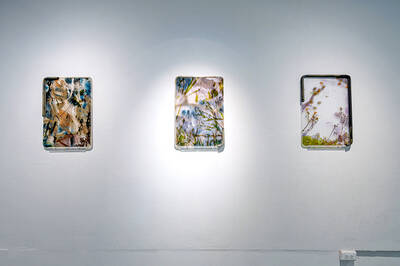
Located down a sideroad in old Wanhua District (萬華區), Waley Art (水谷藝術) has an established reputation for curating some of the more provocative indie art exhibitions in Taipei. And this month is no exception. Beyond the innocuous facade of a shophouse, the full three stories of the gallery space (including the basement) have been taken over by photographs, installation videos and abstract images courtesy of two creatives who hail from the opposite ends of the earth, Taiwan’s Hsu Yi-ting (許懿婷) and Germany’s Benjamin Janzen. “In 2019, I had an art residency in Europe,” Hsu says. “I met Benjamin in the lobby
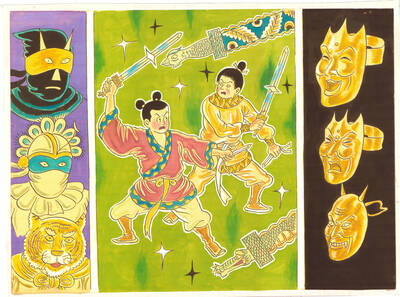
April 22 to April 28 The true identity of the mastermind behind the Demon Gang (魔鬼黨) was undoubtedly on the minds of countless schoolchildren in late 1958. In the days leading up to the big reveal, more than 10,000 guesses were sent to Ta Hwa Publishing Co (大華文化社) for a chance to win prizes. The smash success of the comic series Great Battle Against the Demon Gang (大戰魔鬼黨) came as a surprise to author Yeh Hung-chia (葉宏甲), who had long given up on his dream after being jailed for 10 months in 1947 over political cartoons. Protagonist

The following three paragraphs are just some of what the local Chinese-language press is reporting on breathlessly and following every twist and turn with the eagerness of a soap opera fan. For many English-language readers, it probably comes across as incomprehensibly opaque, so bear with me briefly dear reader: To the surprise of many, former pop singer and Democratic Progressive Party (DPP) ex-lawmaker Yu Tien (余天) of the Taiwan Normal Country Promotion Association (TNCPA) at the last minute dropped out of the running for committee chair of the DPP’s New Taipei City chapter, paving the way for DPP legislator Su


 RSS
RSS