


At the end of a long hallway in a corner of the Huei-Ming School and Home for Blind Children (
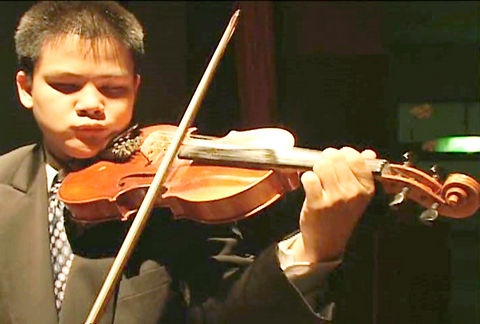
When the song was over, he smiled and shook his head and joked about the dissonance, clearly exasperated in a good-natured way at his classmates, none of whom share his talent to listen to a song once or twice and be able to play it back on a variety of instruments.
Wen-kuei has what is known as savant syndrome, a rare condition, congenital in his case, in which the person has prodigious talents in certain specific fields -- usually music, art or extreme memory capacity -- contrasting markedly with the severity of his or her other disabilities.
Wen-kuei, for example, is blind, mentally retarded and autistic, but has a repertoire stored in his mind of hundreds of songs that he can play on a flute, piano, violin or almost any other instrument he's taught to use.
The unusual combination of severe disabilities and savant syndrome in Wen-kuei has made him one of three subjects of a documentary film titled Chasing Dreams in the Dark (黑暗中追夢) released earlier this week by the National Science Council and being distributed through the Huei-Ming School. The film is the fruit of a two-year research project into the educational potential of children with multiple disabilities carried out by Professor Wan Ming-mei (萬明美) of Changhua Normal University.
In the dark
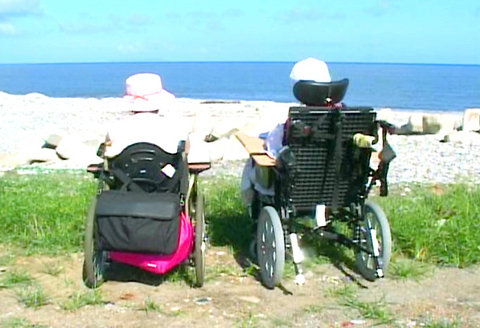
Photos courtesy of national science council
"The main priorities for improving the situation for disabled students are expanding educational opportunities, improving the hardware to cater to their specific needs and training professionals to work in the field," Wan said. "A lot has been done, but there's always room for improvement."
The struggle to reach out to these children and in some cases discover their islands of unique talent falls mostly on families and the staff at institutions like the Huei-Ming School, or the scores of regular public schools that take on students with disabilities.
The Huei-ming School, with an enrollment of over 200 resident students, is the largest and only private institution in Taiwan offering full-time curricula for students aged 3 to 25 with multiple disabilities. The school was founded with a grant by the Christian Children's Fund in 1956, but currently operates mostly on donations raised domestically. About 20 percent of the school's annual budget is provided by the Ministry of Education.
The school's principal Chen Lee-yu (
"The government has never thought these children are worth investing many resources in," she said, despite a strong teacher-to-student ratio in special education programs in Taiwan of approximately one to four. The Huei-Ming school maintains approximately a one-to-two ratio of teachers to students.
Disabled children are required to attend some form of classes, but current structures to help the children acquire skills applicable to a money-earning job and a life of relative independence are incomplete and require greater numbers of dedicated professionals, Chen said.
The majority of blind children nationally attend regular schools, and there are only three schools that cater specifically to blind children. Only the Huei-Ming School has a section dedicated to education of children with multiple disabilities.
The concentrated effort in specialized schools, Chen said, was more likely to achieve success in educating disabled children to the best of their potential.
Chen pointed to the case of Wen-kuei, whose musical skills may have been overlooked were it not for constant oversight at the school by its staff. Now, after almost 10 years of musical training, the school has formulated a post-graduation plan that entails him remaining at the school as a paid music instructor.
"Long-term care of these children increases the likelihood that we'll achieve a breakthrough in communication with them and then be able to train them to perform certain productive tasks that are crucial in boosting their self-confidence," Chen said.
Also at the school and featured in the documentary is Lin Wei-chih (
Chasing Dreams in the Dark does not try to make a case for Wei-chih being able to perform productive work later in life, but provides evidence of his own awareness of progress he makes and his desire to continue learning, which are key elements, Chen said, to providing a fuller life for students with disabilities.
Wei-chih himself said: "I like to be here at school. I get to play a lot of music here."
Long road to school
The need to find creative ways to accommodate students with special needs is highlighted most poignantly in the movie by its third subject Chuang Fu-hua (
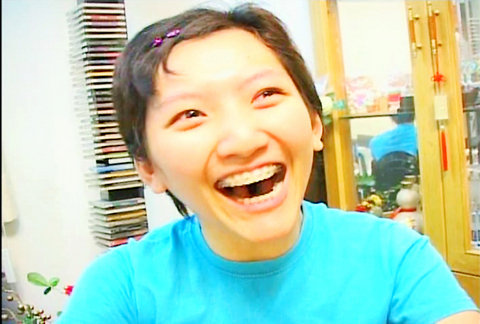
In a meeting with Fu-hua and her family this week at their home in Taichung, it was evident that her mental faculties were left intact after the fire and that the past 11 years for her family have been spent desperately trying to improve communication with her.
Fu-hua, whose only remaining communicative sense is her hearing, has learned to speak with the aid of a custom-designed computer, which she taps with her head to enter Morse code or phoneticized Chinese.
She communicates most fluently, however, through her mother, who prompts Fu-hua with bo-po-mo-fo and helps her construct full sentences.
Together, the mother and daughter can hold slow, but fully coherent conversations. In fact, Fu-hua often teaches her mother certain things, such as how to cook dishes for which she heard recipes on the TV or style tips on accessorizing clothes. She is also a published poet.
Having retained her mental capacities, Fu-hua dreams of attending university to study contemporary literature. But Taiwan's rigid system of entrance examinations means that she must pass timed exams in subjects such as mathematics, science and English, for which she is at an obvious disadvantage without the benefit of sight. As a result, she has failed previous rounds of entrance exams and is currently preparing for a fresh round in late May.
"Exams," she said, "put me in a bad mood."
Studying, however, makes her happy, which is why her family and Professor Wan have been struggling for so long to pry open the doors to institutions of higher education.
"Because of her paralysis, people mistake her for being retarded. And there's a cultural aversion among older people to getting too near to someone with disabilities. There's a kind of superstitious belief that there's something wrong with them," Fu-hua's mother said.
Then there's the absurdity of the entrance-exam system, to which her parents could only shrug their shoulders. "That's not something that will change any time soon," her father said.
For now, the struggle is all-encompassing to prevent Fu-hua from slipping into depression, as she was prone to do when she first woke from her 4-month coma and could not yet communicate. Her mother said that Fu-hua would sometimes lay in her room crying inconsolably through the night, and even years later, after they had begun working together to build complete sentences, she would sometimes write out: "I want to die."
The point made in the film, though, is that Fu-hua is not only exceptional for her physical and mental state, but she has also become something of a role model to other disabled people and their families for her optimism. She is also an eloquent spokeswoman for the educational rights of the disabled, saying that through literature, she wants to "spread love to every corner of the world."
"Hopefully, with Chasing Dreams in the Dark, we can gather some momentum behind a movement to allow greater flexibility for entering university in cases like Fu-hua's, or for improving the education of Wen-kuei and Wei-chih," Wan said.
To purchase a copy of Chasing Dreams in the Dark, contact the Huei-Ming School and Home for Blind Children at (04) 2566 1024. Proceeds will be donated to the school.

Last week Joseph Nye, the well-known China scholar, wrote on the Australian Strategic Policy Institute’s website about how war over Taiwan might be averted. He noted that years ago he was on a team that met with then-president Chen Shui-bian (陳水扁), “whose previous ‘unofficial’ visit to the US had caused a crisis in which China fired missiles into the sea and the US deployed carriers off the coast of Taiwan.” Yes, that’s right, mighty Chen caused that crisis all by himself. Neither the US nor the People’s Republic of China (PRC) exercised any agency. Nye then nostalgically invoked the comical specter

April 15 to April 21 Yang Kui (楊逵) was horrified as he drove past trucks, oxcarts and trolleys loaded with coffins on his way to Tuntzechiao (屯子腳), which he heard had been completely destroyed. The friend he came to check on was safe, but most residents were suffering in the town hit the hardest by the 7.1-magnitude Hsinchu-Taichung Earthquake on April 21, 1935. It remains the deadliest in Taiwan’s recorded history, claiming around 3,300 lives and injuring nearly 12,000. The disaster completely flattened roughly 18,000 houses and damaged countless more. The social activist and

Over the course of former President Ma Ying-jeou’s (馬英九) 11-day trip to China that included a meeting with Chinese Communist Party (CCP) leader Xi Jinping (習近平) a surprising number of people commented that the former president was now “irrelevant.” Upon reflection, it became apparent that these comments were coming from pro-Taiwan, pan-green supporters and they were expressing what they hoped was the case, rather than the reality. Ma’s ideology is so pro-China (read: deep blue) and controversial that many in his own Chinese Nationalist Party (KMT) hope he retires quickly, or at least refrains from speaking on some subjects. Regardless

Approaching her mid-30s, Xiong Yidan reckons that most of her friends are on to their second or even third babies. But Xiong has more than a dozen. There is Lucky, the street dog from Bangkok who jumped into a taxi with her and never left. There is Sophie and Ben, sibling geese, who honk from morning to night. Boop and Pan, both goats, are romantically involved. Dumpling the hedgehog enjoys a belly rub from time to time. The list goes on. Xiong nurtures her brood from her 8,000 square meter farm in Chiang Dao, a mountainous district in northern Thailand’s


 RSS
RSS