


When it comes to airing our dirty laundry, we wonder why the laundry services we pay for always do a better job than we can at home. With the help of "professional" washing machines, laundry services simply do a cleaner job. Professional laundry services count on front-loading
washers to impress the customers, while most Taiwanese households still stick with the conventional top-loading washers to get the dirty job done.
In the past, front-loading washers in Taiwan were so prohibitively expensive that only professional cleaners or laundromats could afford them. In recent years, to satisfy Asian customers, washing-machine manufacturers have been doing their best to develop inexpensive front-loaders that can still get clothes cleaner, save more water and electricity and use less detergent than top-loaders.
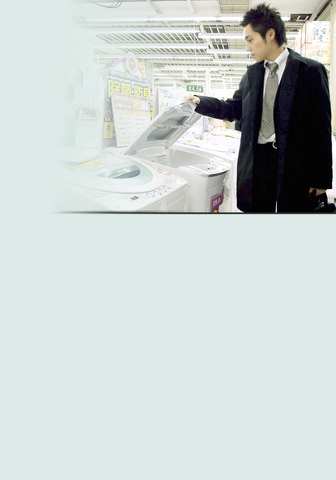
Moreover, the trendy aspect of nano-technology used in the latest washers is sure to please tech-savvy users.
More importantly, the overall price of a front-loader has now plunged to somewhere between NT$25,000 and NT$30,000, depending on loading capacity.
Huang Shih-liang (
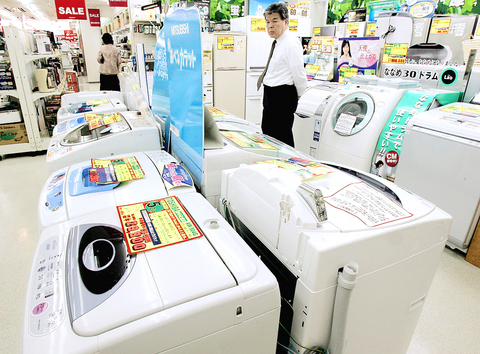
PHOTO: AP
Taipei times: What is the front-loading washing machine?
Huang Shih-liang: This type of efficient washing machine has a door in the front instead of an opening on top of the machine. Clothes are placed in a horizontally-oriented stainless-steel drum instead of a conventional tub with central agitator.
TT: In terms of the operation, what is the difference between the the top-loading washer and the front-loading washer?
HSL: The top-loading washer is built on a vertical axis and uses more water to fully immerse clothes in the tub and scrub them clean with agitation. The front-loading washing machine, however, is built on a horizontal-axis and does not have an agitator that is used in a top-loading vertical-axis washing machine. With a more advanced structure, the front-loader generally uses less water, electricity and detergent.
TT: Why does the front-loading washing machine use less water and save more money?
HSL: A front-loader with the loading capacity of up to 10kg will consume 70 liters to100l of water in one load of laundry. Meanwhile, a top-loader with the same capacity will take 180l to 240l liters of water. Clearly a front-loader reduces water consumption by at least half and the amount of detergent used is also reduced in the process.
TT: If equipped with the same loading capacity, why does the tumble of the front-loader look smaller than that of the top-loader?
HSL: In a front-loader, the clothes are lifted and dropped into a more concentrated solution of water and detergent. The reversing tumble action kneads the water and detergent deeply into the fabric fibers. Since the washer never fills above the bottom of the washer door, much less water is used and less space is needed.
TT: Some front-loaders use warm water and nano-technology to do the laundry. Why do they do this?
HSL: Some front-loaders can automatically heat water up to 40?C to 60?C, which further reduces detergent use and helps tackle smelly clothing. Some manufacturers have even incorporated what they call "silver nano-technology" to enhance the anti-bacteria function. This is even more effective than the use of warm water for washing.
TT: What else do we have to keep in mind while using a front-loader?
HSL: First, the front-loader usually uses the foam produced by the detergent to gauge the cleaning process. Putting excessive detergent in the wash may cause front-loaders to wash clothing for excessive periods of time.
Second, as elderly or people with restricted movement sometimes find it difficult to bend to fill front-loaders, new designs are now emerging in which the performance advantages of front-loaders are coupled with the convenience of a top-loading design.
-- Translated by Daniel Cheng

In late October of 1873 the government of Japan decided against sending a military expedition to Korea to force that nation to open trade relations. Across the government supporters of the expedition resigned immediately. The spectacle of revolt by disaffected samurai began to loom over Japanese politics. In January of 1874 disaffected samurai attacked a senior minister in Tokyo. A month later, a group of pro-Korea expedition and anti-foreign elements from Saga prefecture in Kyushu revolted, driven in part by high food prices stemming from poor harvests. Their leader, according to Edward Drea’s classic Japan’s Imperial Army, was a samurai

Located down a sideroad in old Wanhua District (萬華區), Waley Art (水谷藝術) has an established reputation for curating some of the more provocative indie art exhibitions in Taipei. And this month is no exception. Beyond the innocuous facade of a shophouse, the full three stories of the gallery space (including the basement) have been taken over by photographs, installation videos and abstract images courtesy of two creatives who hail from the opposite ends of the earth, Taiwan’s Hsu Yi-ting (許懿婷) and Germany’s Benjamin Janzen. “In 2019, I had an art residency in Europe,” Hsu says. “I met Benjamin in the lobby

April 22 to April 28 The true identity of the mastermind behind the Demon Gang (魔鬼黨) was undoubtedly on the minds of countless schoolchildren in late 1958. In the days leading up to the big reveal, more than 10,000 guesses were sent to Ta Hwa Publishing Co (大華文化社) for a chance to win prizes. The smash success of the comic series Great Battle Against the Demon Gang (大戰魔鬼黨) came as a surprise to author Yeh Hung-chia (葉宏甲), who had long given up on his dream after being jailed for 10 months in 1947 over political cartoons. Protagonist

Peter Brighton was amazed when he found the giant jackfruit. He had been watching it grow on his farm in far north Queensland, and when it came time to pick it from the tree, it was so heavy it needed two people to do the job. “I was surprised when we cut it off and felt how heavy it was,” he says. “I grabbed it and my wife cut it — couldn’t do it by myself, it took two of us.” Weighing in at 45 kilograms, it is the heaviest jackfruit that Brighton has ever grown on his tropical fruit farm, located


 RSS
RSS