


Using his camera and an Oxford English Dictionary, Sheu Jer-yu (
Using a projector, he superimposes the definition onto an object before documenting the scene with his camera. The words themselves blend into the background, almost to the point where they appear as a natural part of the setting. The meanings of the definitions, however, do not always meld so easily with what you see in the picture.
The Market, for example, reads "a gathering for the sale of goods or livestock." The photo, of a closed market, is empty of people, goods, and livestock; no one is gathered and nothing is being sold.
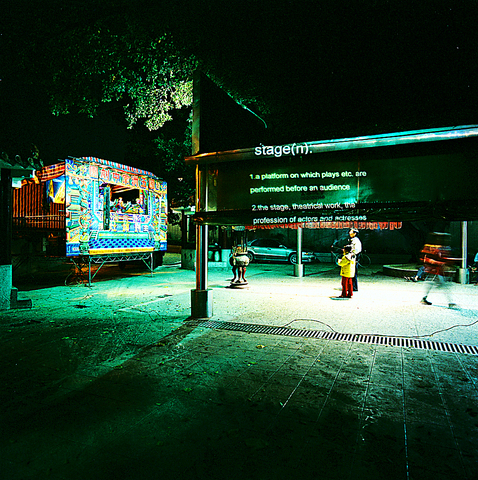
PHOTO COURTESY OF TFAM
In an article written by the artist he explained the addition of dictionary definitions in his work as a way of allowing them to become "an obvious and visible prejudice that is suspended in space. The photographer and the viewer can then compare this prejudice with the object being photographed in order to give both the photographer and viewer the same basis for viewing the object and, ultimately to ascertain the true essence of the object in the photograph."
Although it's his intention to establish a sense of objectivity for the viewers, a few of the photos have an underlying commentary that is not so easily ignored.
A photograph of two scarcely dressed girls sitting inside a beetle-nut stand has "Stall" written across the top with a definition that references a stand where goods are displayed for sale. The placing of the women behind the glass wall combined with the words makes it difficult to distinguish what is for sale and implies that those in professions such as this are objectified and treated as merchandise.
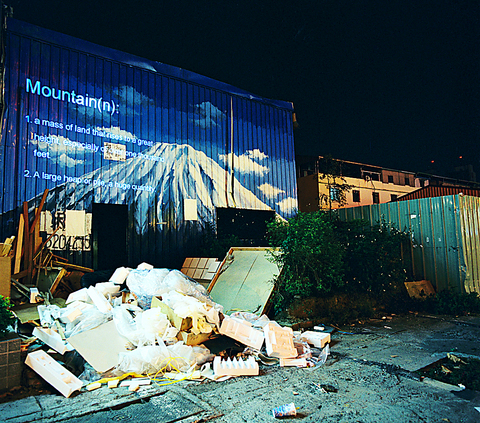
PHOTO COURTESY OF TFAM
Considering all the photos taken are of man-made environments with credible dictionary definitions, it's also interesting to wonder how both have evolved over time, and how our own biases (including the photographer's) might produce different reflections on the various images.
Opposing views of modernization might emerge from the contrast of Playground 1 with Playground 2. The former is of an old playground in a park that looks as though it hasn't been used in years, while the latter is a video arcade with a partly filled milk-tea cup sitting near one game. Both use the same definition: "A favorite place for recreation."
While some might view the abandoned playground equipment as the natural result of technology and available entertainment, others might see the preference for video games as a loss of human interaction and regression of human civilization.
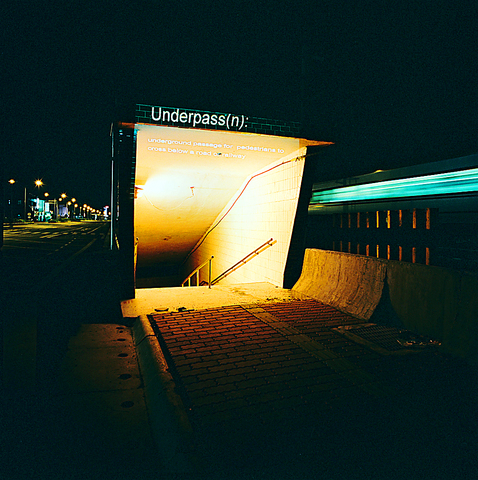
PHOTO COURTESY OF TFAM
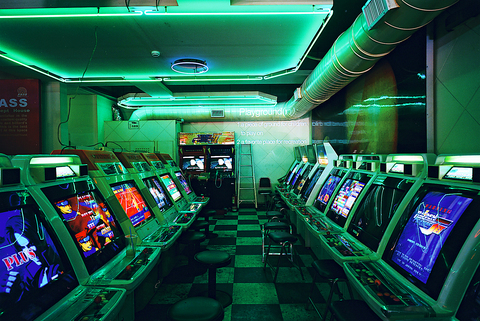
PHOTO COURTESY OF TFAM

Last week Joseph Nye, the well-known China scholar, wrote on the Australian Strategic Policy Institute’s website about how war over Taiwan might be averted. He noted that years ago he was on a team that met with then-president Chen Shui-bian (陳水扁), “whose previous ‘unofficial’ visit to the US had caused a crisis in which China fired missiles into the sea and the US deployed carriers off the coast of Taiwan.” Yes, that’s right, mighty Chen caused that crisis all by himself. Neither the US nor the People’s Republic of China (PRC) exercised any agency. Nye then nostalgically invoked the comical specter
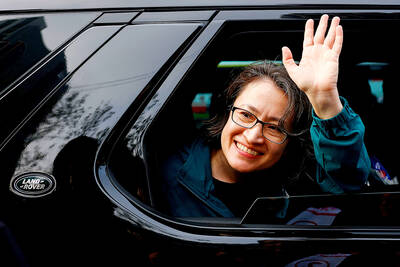
Relations between Taiwan and the Czech Republic have flourished in recent years. However, not everyone is pleased about the growing friendship between the two countries. Last month, an incident involving a Chinese diplomat tailing the car of vice president-elect Hsiao Bi-khim (蕭美琴) in Prague, drew public attention to the People’s Republic of China’s (PRC) operations to undermine Taiwan overseas. The trip was not Hsiao’s first visit to the Central European country. It was meant to be low-key, a chance to meet with local academics and politicians, until her police escort noticed a car was tailing her through the Czech capital. The
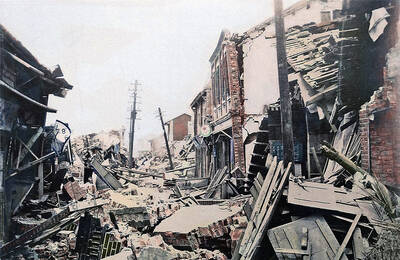
April 15 to April 21 Yang Kui (楊逵) was horrified as he drove past trucks, oxcarts and trolleys loaded with coffins on his way to Tuntzechiao (屯子腳), which he heard had been completely destroyed. The friend he came to check on was safe, but most residents were suffering in the town hit the hardest by the 7.1-magnitude Hsinchu-Taichung Earthquake on April 21, 1935. It remains the deadliest in Taiwan’s recorded history, claiming around 3,300 lives and injuring nearly 12,000. The disaster completely flattened roughly 18,000 houses and damaged countless more. The social activist and

Over the course of former President Ma Ying-jeou’s (馬英九) 11-day trip to China that included a meeting with Chinese Communist Party (CCP) leader Xi Jinping (習近平) a surprising number of people commented that the former president was now “irrelevant.” Upon reflection, it became apparent that these comments were coming from pro-Taiwan, pan-green supporters and they were expressing what they hoped was the case, rather than the reality. Ma’s ideology is so pro-China (read: deep blue) and controversial that many in his own Chinese Nationalist Party (KMT) hope he retires quickly, or at least refrains from speaking on some subjects. Regardless


 RSS
RSS