


Recently in Taipei there is a trend in contemporary art exhibitions of barely matching up to the stated intentions of the curator. Trading Place: Contemporary Art Museum, currently on view at MOCA until May 22, is one of these.
In the show, curator Kao Chien-hui (
This exhibition does raise necessary and provocative questions, such as what are the functions of art, the institution, the curator and the audience? Kao, who is based in Chicago, brings a perspective of institutional critique that has been going on in the US since the 1980s, but which is a fairly new idea to Taiwan.
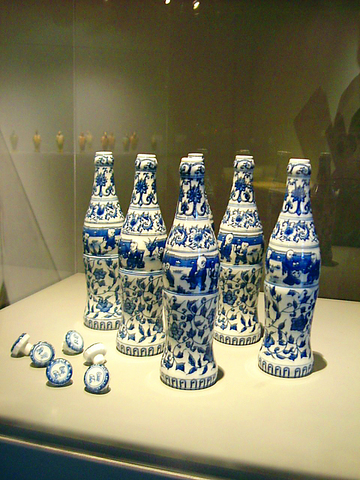
PHOTOS COURTESY OF SUSAN KENDZULAK
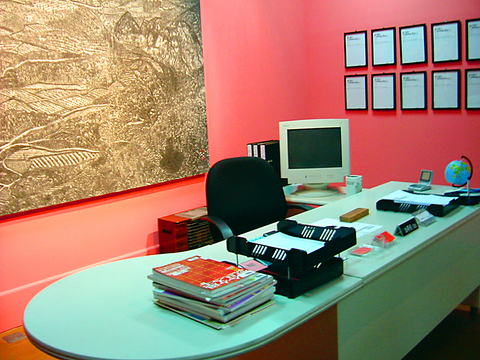
As artists are becoming curators, curators are also becoming artists. One of the first rooms of the exhibition wasn't created by an artist, but was created by Kao and is called The Acting Director in Contemporary Art Museum.
Decorated and furnished like the office of a Taiwanese museum director appointed by the government, the viewer is invited to sit at the desk and write down new plans on how to run the institution. Here, Kao touches on a crucial nerve. Institutional museum policy is rarely if ever decided by the masses and here she provides a space for people to air their views. Though a symbolic gesture, it is a start in the right direction for a cultural debate.
Another room shows objects that have special significance to the curators who donated them to the exhibition. Here one sees Sean Hu's credit card that helped him finance an exhibition and a set of drums that inspires Huang Hai-ming.
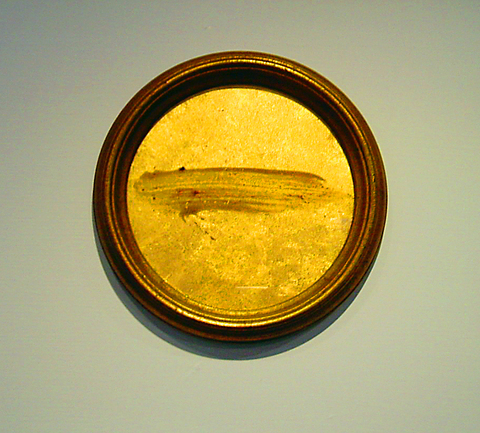
Yet, instead of being informative to the general audience about curatorship, this room reeks of cliquishness and seems gratuitous rather than insightful.
Beijing-based artist Qiu Zhijie (
Cai Guo-qiang (
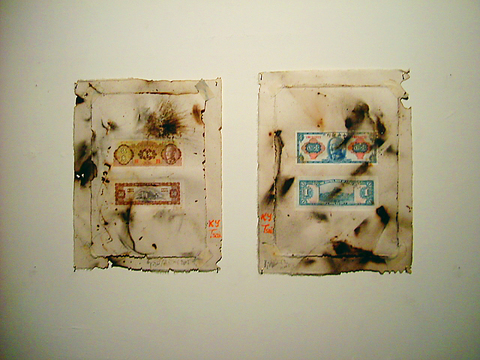
Tu Wei-cheng's (
One theme that emerges is a short history lesson of art: both Western and Chinese. Zhang Hongtu (
Mei Dean-E (梅丁衍) shows a brilliant piece. Redoing Joseph Kosuth's One and Three Chairs semiotic piece, which is considered the seminal work of Western conceptual art, and which consisted of a wall text of a dictionary definition of a chair, a photo of a chair and an actual chair, Mei recreates the piece using all Chinese elements: Chinese text and a Chinese chair. This clever recontextualizing of art history speaks volumes about Western and Chinese art.
Works that stand well on their own but do not engage with the show's premise include Lin Jiun-shian's (
With so many provocative women artists working in Asia it is quite surprising that there is only one included in the exhibition. Liu Shihfen's (
Astute in some parts, the exhibition feels overall like an inside joke made especially for those working in the arts, and is not particularly generous to the general audience. As a result, the show backfires, as some intelligent ideas may be interpreted by some viewers as elitist.
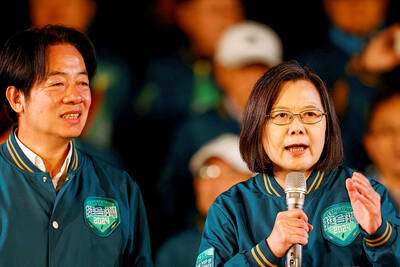
Last week Joseph Nye, the well-known China scholar, wrote on the Australian Strategic Policy Institute’s website about how war over Taiwan might be averted. He noted that years ago he was on a team that met with then-president Chen Shui-bian (陳水扁), “whose previous ‘unofficial’ visit to the US had caused a crisis in which China fired missiles into the sea and the US deployed carriers off the coast of Taiwan.” Yes, that’s right, mighty Chen caused that crisis all by himself. Neither the US nor the People’s Republic of China (PRC) exercised any agency. Nye then nostalgically invoked the comical specter
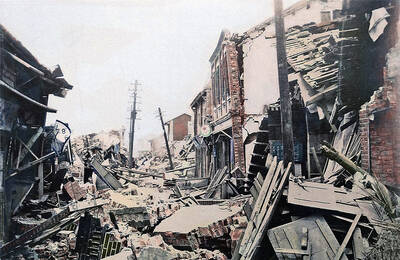
April 15 to April 21 Yang Kui (楊逵) was horrified as he drove past trucks, oxcarts and trolleys loaded with coffins on his way to Tuntzechiao (屯子腳), which he heard had been completely destroyed. The friend he came to check on was safe, but most residents were suffering in the town hit the hardest by the 7.1-magnitude Hsinchu-Taichung Earthquake on April 21, 1935. It remains the deadliest in Taiwan’s recorded history, claiming around 3,300 lives and injuring nearly 12,000. The disaster completely flattened roughly 18,000 houses and damaged countless more. The social activist and

Over the course of former President Ma Ying-jeou’s (馬英九) 11-day trip to China that included a meeting with Chinese Communist Party (CCP) leader Xi Jinping (習近平) a surprising number of people commented that the former president was now “irrelevant.” Upon reflection, it became apparent that these comments were coming from pro-Taiwan, pan-green supporters and they were expressing what they hoped was the case, rather than the reality. Ma’s ideology is so pro-China (read: deep blue) and controversial that many in his own Chinese Nationalist Party (KMT) hope he retires quickly, or at least refrains from speaking on some subjects. Regardless

Approaching her mid-30s, Xiong Yidan reckons that most of her friends are on to their second or even third babies. But Xiong has more than a dozen. There is Lucky, the street dog from Bangkok who jumped into a taxi with her and never left. There is Sophie and Ben, sibling geese, who honk from morning to night. Boop and Pan, both goats, are romantically involved. Dumpling the hedgehog enjoys a belly rub from time to time. The list goes on. Xiong nurtures her brood from her 8,000 square meter farm in Chiang Dao, a mountainous district in northern Thailand’s


 RSS
RSS