


It's Tomb Sweeping Day and Wang Bao-hua (王保華) and his wife had just returned from paying their respects at his father's cemetery and decided to stop at their local BMW dealership in Taipei.
"We have two daughters whose college educations are now paid for," Wang said. "Now we can finally spend some money on ourselves.
"We've driven Toyotas for years, but, when we got married we said we'd work hard to afford a comfortable retirement. So I'm here to show my wife how comfortable a BMW is!" he said with a laugh.
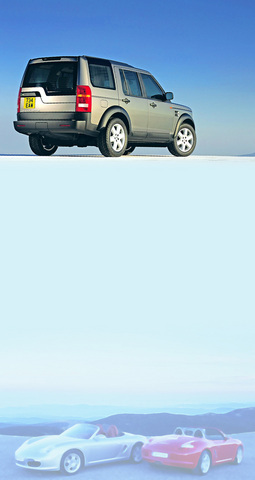
Like the Wang family, an increasing number of Taiwanese are looking to make the jump to a luxury car when they purchase their next vehicle. And like the majority of Taiwanese who do, they're looking at BMW and Mercedes-Benz models.
It's a prospect that thrills Huang Bang-chi (
Huang estimates that BMW Group, which sells both its flagship fleet of cars as well as Mini Cooper models, sold about 5,000 cars in Taiwan last year.
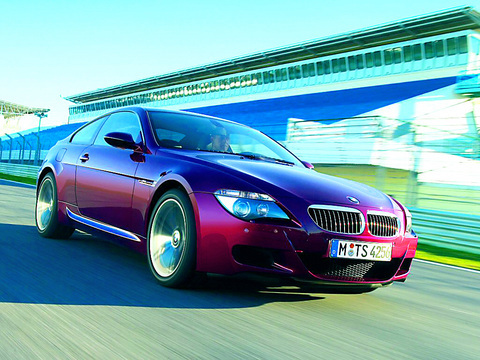
"Our sales have gotten better every year," he said.
Indeed they have. According to statistics compiled by the Taiwan Transportation Vehicle Manufacturers Association, the local car market experienced 16.7 percent growth in 2004 over the previous year. While the market for luxury automobiles remains at 7 percent of the total market, that number has grown incrementally for several years, and even continued to rise during the Asian financial crisis.
There are other indicators -- or at least a lot of optimism -- that the market will continue to grow. In 2002, four years after the two auto manufacturers merged, DaimlerChrysler established a local subsidiary to sell its Mercedes-Benz fleet of cars, infusing it with NT$1.7 billion in capital. The company now has 25 showrooms throughout the island and claims to sell an average of 7,000 cars per year. Their best has been 10,000 units in a single year.
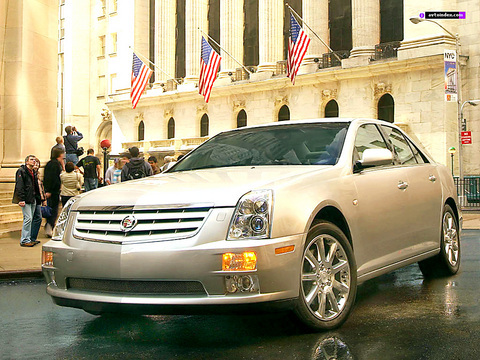
By comparison, DaimlerChrysler Taiwan claims to sell some 500 Jeeps and Chryslers locally each year, showing that the company's focus has been on moving luxury cars off the lot.
"We've also sold two or three Maybachs every year since 2002," said a DaimlerChrysler representative named Rao, referring to the uber-luxury liner that lists at NT$20 million and can quickly go up to NT$30 million depending on what amenities the buyer selects. The difference in price between a bare-bones Maybach and a fully loaded one is five Lexus RX 330s, which list at NT$2 million.
One of the top-selling luxury automobiles in any other market, Lexus has nonetheless had a hard time making inroads into the Taiwan market compared with its success in the US, Europe or Japan.
This would seem an odd situation for the car's manufacturer, Toyota. The company boasts the best passenger car sales in the nation. Its Toyota Corolla alone accounted for 11.2 percent of all passenger cars sold last year, according to the Wards World Motor Vehicle Data annual of global car sales.
"Toyota has of course had a lot of success in Taiwan," said He Ji-yu (
Asked why Taiwanese look first to German manufacturers, He compared local taste in luxury cars with taste in wine and liquor.
"Before, the only wine we had to drink was Kaoliang and rice wine," He said. "Then in the 1980s, when people had more money and some people had a lot more money, the drink of choice became cognac. No one cared to try a better brand of rice wine."
Likewise, he believes, now that they can finally afford to eye the luxury car market.
Wang and his wife are no exception. In the BMW showroom near the campus of National Taiwan University, the couple was waiting to test drive a silver 520i. Wang's wife seemed more taken with the X3 sports utility model and had been admiring a line of BWM apparel and accessories under glass; NT$8,000 sunglasses and a NT$12,000 BMW bag.
Wang himself wanted nothing to do with bags and glasses and seemed intent on dissuading his wife from wanting a sports utility vehicle.
"We've talked about a sedan all along and now she sees the X3 and likes it more," he said with a hint of exasperation. "She's only saying that because she would rather we were looking at Mercedes."
"If you want a nice car, Mercedes are nicer," she said in a near whisper.
But Wang wants a car that's nice to drive and the BMW, he says repeating the company's slogan, is the "ultimate driving machine."
Nonsense, his wife says, whatever they buy they'll be sitting in traffic a lot more than racing down the highway. "We have one afternoon of driving home in nice weather without a lot of traffic and he thinks he needs an ultimate driving machine!'"
Being able to afford the sticker price, it would seem, doesn't make buying the car a luxury.

In late October of 1873 the government of Japan decided against sending a military expedition to Korea to force that nation to open trade relations. Across the government supporters of the expedition resigned immediately. The spectacle of revolt by disaffected samurai began to loom over Japanese politics. In January of 1874 disaffected samurai attacked a senior minister in Tokyo. A month later, a group of pro-Korea expedition and anti-foreign elements from Saga prefecture in Kyushu revolted, driven in part by high food prices stemming from poor harvests. Their leader, according to Edward Drea’s classic Japan’s Imperial Army, was a samurai

Located down a sideroad in old Wanhua District (萬華區), Waley Art (水谷藝術) has an established reputation for curating some of the more provocative indie art exhibitions in Taipei. And this month is no exception. Beyond the innocuous facade of a shophouse, the full three stories of the gallery space (including the basement) have been taken over by photographs, installation videos and abstract images courtesy of two creatives who hail from the opposite ends of the earth, Taiwan’s Hsu Yi-ting (許懿婷) and Germany’s Benjamin Janzen. “In 2019, I had an art residency in Europe,” Hsu says. “I met Benjamin in the lobby
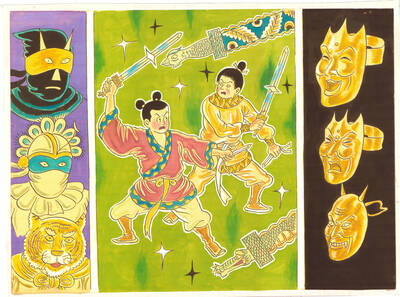
April 22 to April 28 The true identity of the mastermind behind the Demon Gang (魔鬼黨) was undoubtedly on the minds of countless schoolchildren in late 1958. In the days leading up to the big reveal, more than 10,000 guesses were sent to Ta Hwa Publishing Co (大華文化社) for a chance to win prizes. The smash success of the comic series Great Battle Against the Demon Gang (大戰魔鬼黨) came as a surprise to author Yeh Hung-chia (葉宏甲), who had long given up on his dream after being jailed for 10 months in 1947 over political cartoons. Protagonist

A fossil jawbone found by a British girl and her father on a beach in Somerset, England belongs to a gigantic marine reptile dating to 202 million years ago that appears to have been among the largest animals ever on Earth. Researchers said on Wednesday the bone, called a surangular, was from a type of ocean-going reptile called an ichthyosaur. Based on its dimensions compared to the same bone in closely related ichthyosaurs, the researchers estimated that the Triassic Period creature, which they named Ichthyotitan severnensis, was between 22-26 meters long. That would make it perhaps the largest-known marine reptile and would


 RSS
RSS