


Did you know that elephants have a sour tooth or that they like daily, hour-long massages, preferably done in a circular motion with a pumice stone? If you own an elephant and don't know how to keep it happy, you could learn a few lessons from Parbati Barua, Asia's only female mahout, or elephant handler, who recently taught 150 mahouts in the northwestern desert state of Rajasthan about elephant management. The talk was sponsored by the government's tourism department and the animal-welfare group Help In Suffering (HIS) in Jaipur.
Barua, 53 years old and barely 150cm, knows her elephants well. She lassoed her first wild elephant at the age of 14.
"You need a little luck and the instinct to read the animal's mind. Catching an elephant is not about strength," she said.
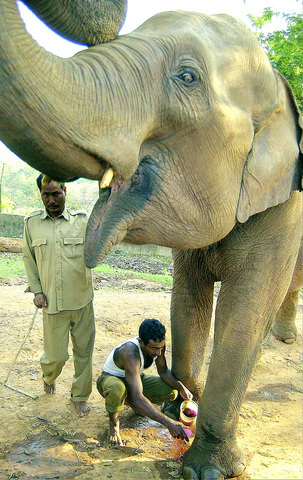
PHOTO: AP
Barua's lessons were given at Amber Fort, an architectural marvel built by Hindu Rajput kings in the 16th century on a hillside that overlooks a lake. Few tourists opt for the 10-minute walk up to the fort -- most enjoy making a grand entrance on elephant back.
Amber Fort employs 103 elephants, with a one-way trip of four people per elephant costing 450 rupees (NT$315). For working eight hours a day, the elephant only gets 20 rupees for its welfare fund.
In a city where temperatures average 40?C through most of the year, the animals suffer from dehydration, upset stomachs, sunburn, foot sores, ulcers, cracked nails from walking on hot asphalt and blindness caused by poor nutrition.
"Captive elephants live longer than those in the wild, with a life span of 60 to 70 years. Most start working at 25 and retire at 55, so it's important to keep them healthy," said HIS veterinarian Madhulal. HIS holds regular elephant health camps at Amber Fort and even has an elephant ambulance.
"Mahouts need training on how to keep their elephants fit, how to ride them, how to use the `ankush' [spear-like device to control the elephant] and `gear' [cotton ropes tied around the elephant's neck to control its movements]," said Pavan Jain, assistant director of the tourism department.
Barua said, "An elephant is a very loving animal. We bring them up like our children: We love them, hit them and shout at them. But, no matter how long we keep an elephant with us, in its heart it is a wild animal and some of that wildness remains. We must always remember this and be careful of it. An elephant can't be domesticated."
Barua gave lessons in tying a howdah, or seat on which the tourists sit, and the most humane way of using the kilawa, or gear.
"They are nocturnal animals and it is cruel to make them work long hours during the day. It's not that we shouldn't entertain tourists, because it's a question of livelihood and survival for the mahouts, but we should treat the animals better," Barua said.
Shahid Khan, a mahout with five elephants, said: "Our family has been in the elephant business for generations. The training was good because we got to share our problems."
Barua said the mahout-elephant bond is based on unconditional trust and understanding. "Elephants are sensitive and cultured. They are my only family."

In late October of 1873 the government of Japan decided against sending a military expedition to Korea to force that nation to open trade relations. Across the government supporters of the expedition resigned immediately. The spectacle of revolt by disaffected samurai began to loom over Japanese politics. In January of 1874 disaffected samurai attacked a senior minister in Tokyo. A month later, a group of pro-Korea expedition and anti-foreign elements from Saga prefecture in Kyushu revolted, driven in part by high food prices stemming from poor harvests. Their leader, according to Edward Drea’s classic Japan’s Imperial Army, was a samurai

Located down a sideroad in old Wanhua District (萬華區), Waley Art (水谷藝術) has an established reputation for curating some of the more provocative indie art exhibitions in Taipei. And this month is no exception. Beyond the innocuous facade of a shophouse, the full three stories of the gallery space (including the basement) have been taken over by photographs, installation videos and abstract images courtesy of two creatives who hail from the opposite ends of the earth, Taiwan’s Hsu Yi-ting (許懿婷) and Germany’s Benjamin Janzen. “In 2019, I had an art residency in Europe,” Hsu says. “I met Benjamin in the lobby

April 22 to April 28 The true identity of the mastermind behind the Demon Gang (魔鬼黨) was undoubtedly on the minds of countless schoolchildren in late 1958. In the days leading up to the big reveal, more than 10,000 guesses were sent to Ta Hwa Publishing Co (大華文化社) for a chance to win prizes. The smash success of the comic series Great Battle Against the Demon Gang (大戰魔鬼黨) came as a surprise to author Yeh Hung-chia (葉宏甲), who had long given up on his dream after being jailed for 10 months in 1947 over political cartoons. Protagonist

A fossil jawbone found by a British girl and her father on a beach in Somerset, England belongs to a gigantic marine reptile dating to 202 million years ago that appears to have been among the largest animals ever on Earth. Researchers said on Wednesday the bone, called a surangular, was from a type of ocean-going reptile called an ichthyosaur. Based on its dimensions compared to the same bone in closely related ichthyosaurs, the researchers estimated that the Triassic Period creature, which they named Ichthyotitan severnensis, was between 22-26 meters long. That would make it perhaps the largest-known marine reptile and would


 RSS
RSS