


Memory is an elusive thing that borders on the edge of reality -- was it a dream or was it for real? Even though it can be difficult to recall accurately, much less record, memory is a popular theme in all forms of art, literature and film. And like memory, conceptual art, too, straddles the realms of experienced life and imagined realities. Conceptual art requires effort by the viewer: It is a philosophical practice and requires contemplation to decode and understand it.
Artist Tang Huang-chen (
I Go Traveling V -- a Postcard with Scenery currently on view at IT Park until April 23.
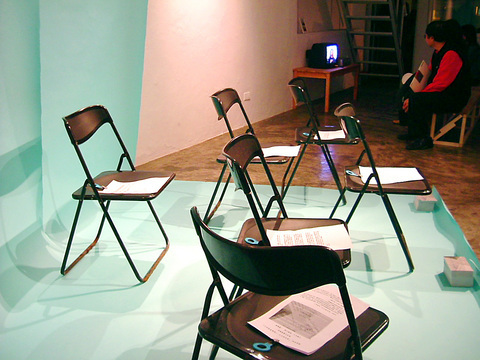
PHOTO: SUSAN KENDZULAK, TAIPEI TIMES
The V is in the title because it's the fifth installment of Tang's long-term project in which she explores themes of travel, contact and communication.
For this project, she sent out an e-mail to artistic friends, inviting those interested to accompany her on a trip to the seaside, but because the trip was scheduled in March when the weather was cold and drizzly, it wasn't exactly to be a day at the beach.
Planning the itinerary, the number of traveling companions, arranging the transportation and collecting souvenirs were part of Tang's project. Once at the beach, Tang also photographed and videotaped the small gathering of friends. The documentation is not the main part of the exhibition but is rather a platform to help you think about why travel is such an important activity in this century. Tang questions why we expend so much of our energy to make travel convenient and fast, and why travel is such a coveted goal for many people.
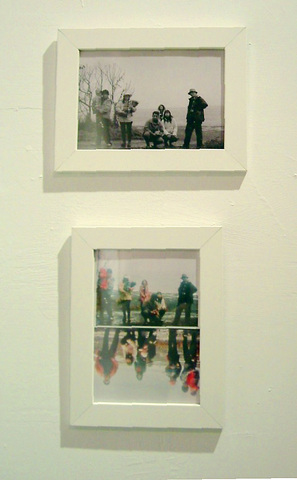
Besides travel, Tang explores the constructs of memory and asks if memory can be fabricated and staged like in a script for theater. Can one's memory be constructed out of other people's experiences? Can we share other people's memories?
Upon entering the two-story exhibition space, the video that was shot at the beach of the eight people is projected on the wall. Tang frequently comes into view and like a movie director rearranges the people in the framed shot. There is no plot to the video, just the passage of real time. Some people stand, one smokes, a child waves his arms. The image seems grainy like an old home-movie and its large projection makes you feel like you are part of the scene; thus, this image becomes part of your memory.
Upstairs, eight folding chairs symbolizing the eight beach travelers are arranged on a blue photo backdrop. On each chair is a piece of paper, a recording of each participant's memory of the trip. At the opening, different people read from the paper as a way to question who owns memory. Is it possible to experience somebody else's memory?
This exploration of the specifics of travel is also a metaphorical musing on the passage of time. We've always so busy rushing about, having to be other places, or dreaming to be in other places that we overlook and under-appreciate the present moment. Tang delays that sense of travel through her work to help us slow down in our own frenetic activities.
In her previous work, Tang would set up mazes and games, all intended to frustrate and delay the viewer as there was often an obstacle in the way. And that is the biggest metaphor of her work. Like our individual lives, our paths are not so easily defined and we each have to forge our own ways in spite of all the overwhelming obstacles that lay ahead. Art can act as a detailed map to lead us in the right direction.
Exhibition Notes :
Where: IT Park, (
When: Tuesday to Saturday, 1pm to 10pm
Tel: (886) 2-2507-7243

In late October of 1873 the government of Japan decided against sending a military expedition to Korea to force that nation to open trade relations. Across the government supporters of the expedition resigned immediately. The spectacle of revolt by disaffected samurai began to loom over Japanese politics. In January of 1874 disaffected samurai attacked a senior minister in Tokyo. A month later, a group of pro-Korea expedition and anti-foreign elements from Saga prefecture in Kyushu revolted, driven in part by high food prices stemming from poor harvests. Their leader, according to Edward Drea’s classic Japan’s Imperial Army, was a samurai

The following three paragraphs are just some of what the local Chinese-language press is reporting on breathlessly and following every twist and turn with the eagerness of a soap opera fan. For many English-language readers, it probably comes across as incomprehensibly opaque, so bear with me briefly dear reader: To the surprise of many, former pop singer and Democratic Progressive Party (DPP) ex-lawmaker Yu Tien (余天) of the Taiwan Normal Country Promotion Association (TNCPA) at the last minute dropped out of the running for committee chair of the DPP’s New Taipei City chapter, paving the way for DPP legislator Su
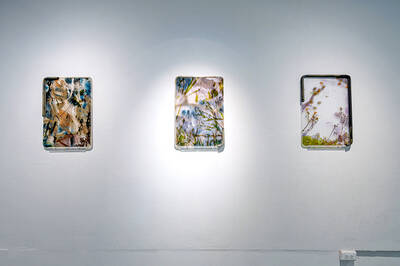
Located down a sideroad in old Wanhua District (萬華區), Waley Art (水谷藝術) has an established reputation for curating some of the more provocative indie art exhibitions in Taipei. And this month is no exception. Beyond the innocuous facade of a shophouse, the full three stories of the gallery space (including the basement) have been taken over by photographs, installation videos and abstract images courtesy of two creatives who hail from the opposite ends of the earth, Taiwan’s Hsu Yi-ting (許懿婷) and Germany’s Benjamin Janzen. “In 2019, I had an art residency in Europe,” Hsu says. “I met Benjamin in the lobby
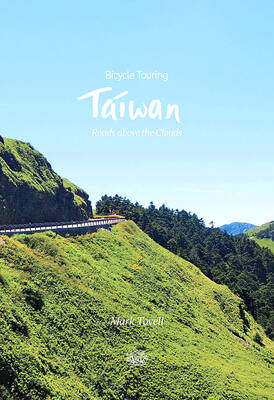
It’s hard to know where to begin with Mark Tovell’s Taiwan: Roads Above the Clouds. Having published a travelogue myself, as well as having contributed to several guidebooks, at first glance Tovell’s book appears to inhabit a middle ground — the kind of hard-to-sell nowheresville publishers detest. Leaf through the pages and you’ll find them suffuse with the purple prose best associated with travel literature: “When the sun is low on a warm, clear morning, and with the heat already rising, we stand at the riverside bike path leading south from Sanxia’s old cobble streets.” Hardly the stuff of your


 RSS
RSS