


Orchid cultivation can be difficult. From pollination to bloom, the growth process generally takes two-and-a-half years. Yet there are many orchid enthusiasts and tradition deems the long wait to be worth it. The oval-shaped phalaenopsis amabilis -- or moth orchid (
Orchids nowadays are of many hues and patterns and some of the favorites are white, yellow and orange-to-dark brown. Others have striped patterns or large and small dots. The most popular orchid in Taiwan, however, is the native phalaenopsis amabilis var Formosana (
The late Dr Chiba Masaaki (
It grows in remote areas of the country, in counties south of the Tropic of Cancer, according to Professor Shen Rong-show (
Taking advantage of the favorable natural orchid-growing environment in Chiayi, Professor Shen and four of his colleagues are setting up and maintaining greenhouses for research purposes. Every greenhouse is constantly monitored and controlled by computers that keep an electronic eye on lighting intensity, air moisture, ventilation, temperatures (between 24?C and 25?C during the day and between 18?C and 19?C at night).
Assisted by a group of dedicated graduate students, gorgeous new prize-winning orchids are produced by hybridization. The university's latest creation is derived from a genus of orchids called the violocea. It is currently called HT107 and does not have an official name yet, but it has a subtle and delightful fragrance. Among the world's orchid species, only two kinds are known to yield a fragrance and HT107 is one of them, said Professor Lily Chien (
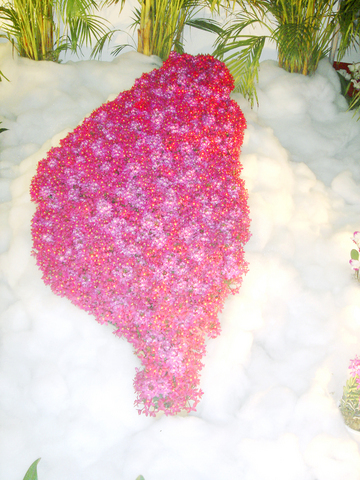
The HT107 is currently the shining star at the International Orchid Show, running until April 10 in Hobi (
At least one local business group has shown interest in reproducing this exquisite orchid scent for commercial purposes.
Chiayi University is the only higher-education establishment to conduct academic research on orchid breeding, propagation, preservation and the stocking of endemic orchid species worldwide. It is something of a brain trust in the worldwide orchid industry.
Another one of its achievements is a fruitful cooperation with I-Hsin Biotec Inc (
I-Hsin is one of the biggest orchid companies in Taiwan and is run by the Jian family, whose members are mostly graduates from Chiayi university's department of horticulture. The company has stolen the show at the Tainan International Orchid Show with a range of high-tech products that produce large and multi-flowering types of white- and red-flowered phalaenopsis. The company is also well-known for producing high-quality dendrobiums (
Traditionally, Japan and the US have been Taiwan's two major orchid-export markets, netting NT$391 million and NT$221 million from these two countries, respectively, last year.
Chiayi University has also set its sights on capturing a greater share of the European orchid market.
Since Europeans by-and-large buy small-sized orchids, Professor Shen and his colleagues are now trying to breed miniature species with smaller blossoms that bear as many flowers as possible on each plant. This should challenge the Dutch growers in Europe.
Good orchids can bear flowers for as long as three months, but nowadays they do not just bloom in spring. Simple regulation techniques in greenhouses can ensure that orchids bloom all year long.
There seems to be no limit to the innovation of the local orchid industry, but it was the Taiwan Sugar Company that initially started orchid research in 1988 at its Wushulin (
Tainan County Commissioner Su Huan-chih (
However, intensifying competition from rival countries such as The Netherlands, Costa Rica and China is worrying local growers. For instance, orchid farmers in China (ironically, many of them are from Taiwan) have been applying low-cost tactics to penetrate the global market for years. Dutch orchid traders can take advantage of their strong international sales networks to push their products. In fact, the commercial orchid battle between Taiwan and Holland has become so intense that neither of them will trade new species any more.
Su predicted all this would happen and four years ago helped win central government support for the industry with a NT$2.06 billion investment in a large-scale industrial park, the Taiwan Orchid Plantation (TOP), which covers an area of 200 hectares in Hobi.
The park includes a permanent exposition hall and trading office complex equipped with greenhouses ranging in size from 1,150m2 to 3,471m2. There are also genetic-modification laboratories, and the academic research center at National Chiayi University.
The TOP project -- expected to be completed in 2008 -- is going smoothly with more than 40 orchid companies committed to move into the park. The International Orchid Show held inside the park this year intends to tell the world that Taiwanese orchid farmers are organizing themselves into large-scale international enterprises, with massive amounts of investment from the government.
Su said TOP is primarily designed to impress international buyers by offering the opportunity for face-to-face contact with Taiwanese orchid farmers so that the buyers can have a close look at the producers' facilities before they conclude business deals.
It is clear both the government and entrepreneurs have high hopes for the orchid industry and intend it to become another commercial success story like the IT industry. But instead of making motherboards the orchid industry produces cash-rich crops in an environmentally friendly way.

In late October of 1873 the government of Japan decided against sending a military expedition to Korea to force that nation to open trade relations. Across the government supporters of the expedition resigned immediately. The spectacle of revolt by disaffected samurai began to loom over Japanese politics. In January of 1874 disaffected samurai attacked a senior minister in Tokyo. A month later, a group of pro-Korea expedition and anti-foreign elements from Saga prefecture in Kyushu revolted, driven in part by high food prices stemming from poor harvests. Their leader, according to Edward Drea’s classic Japan’s Imperial Army, was a samurai

The following three paragraphs are just some of what the local Chinese-language press is reporting on breathlessly and following every twist and turn with the eagerness of a soap opera fan. For many English-language readers, it probably comes across as incomprehensibly opaque, so bear with me briefly dear reader: To the surprise of many, former pop singer and Democratic Progressive Party (DPP) ex-lawmaker Yu Tien (余天) of the Taiwan Normal Country Promotion Association (TNCPA) at the last minute dropped out of the running for committee chair of the DPP’s New Taipei City chapter, paving the way for DPP legislator Su
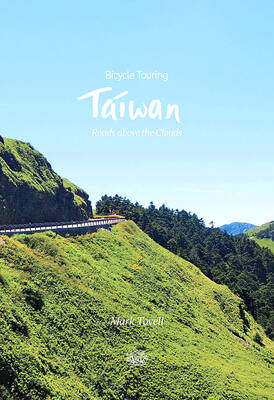
It’s hard to know where to begin with Mark Tovell’s Taiwan: Roads Above the Clouds. Having published a travelogue myself, as well as having contributed to several guidebooks, at first glance Tovell’s book appears to inhabit a middle ground — the kind of hard-to-sell nowheresville publishers detest. Leaf through the pages and you’ll find them suffuse with the purple prose best associated with travel literature: “When the sun is low on a warm, clear morning, and with the heat already rising, we stand at the riverside bike path leading south from Sanxia’s old cobble streets.” Hardly the stuff of your

Located down a sideroad in old Wanhua District (萬華區), Waley Art (水谷藝術) has an established reputation for curating some of the more provocative indie art exhibitions in Taipei. And this month is no exception. Beyond the innocuous facade of a shophouse, the full three stories of the gallery space (including the basement) have been taken over by photographs, installation videos and abstract images courtesy of two creatives who hail from the opposite ends of the earth, Taiwan’s Hsu Yi-ting (許懿婷) and Germany’s Benjamin Janzen. “In 2019, I had an art residency in Europe,” Hsu says. “I met Benjamin in the lobby


 RSS
RSS