


With steam pouring from their nostrils and hooves pounding the sand, the two prize bulls square off warily, then clash head-on like freight trains.
There is plenty of blood and guts on display in South Korea's own version of bullfighting that draws crowds of thousands to this rural community, the center of the sport in the southeast of the country.
But unlike Spanish bullfighting, there are no matadors, no swords and capes and no killing of any kind.

PHOTOS: AFP
Sinews and muscles bulge as the beasts lock horns for more than 20 minutes while handlers holler at the top of their lungs urging the animals on.
"Go Heryong. Go! Go!" screams Kim Man-keun, a 26-year-old handler whose six-year-old bull, horns spattered with blood, is struggling against the pre-match favorite, Bumyong, a year younger.
"Stab it, Bumyong, stab!' cries the rival's handler as the beasts weighing 750kg clash on the sandy ground ringed by a wooden fence.
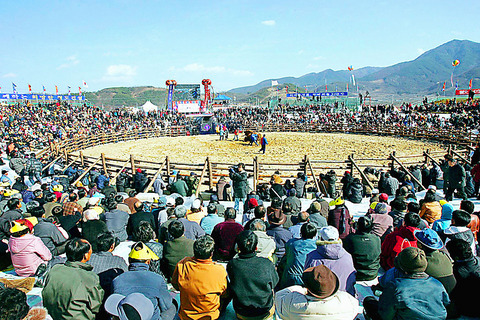
With Bumyong showing signs of exhaustion, panting heavily, and dribbling from his mouth, Heryong swiftly turns sideways and frees its locked horns to lunge freely at the flank of Bumyong.
With a jolt, Bumyong turns tail and speeds away to the cheers of thousands of spectators, bringing the bout to an end and handing a 3 million won (around US$3,000) cash prize to the owner of the winning bull.
Heryong is one of 13 bulls who leaves with a prize from the annual bullfight festival held each March in Cheongdo, a farming village 350km southeast of Seoul.
The South Korean bullfight traces its roots back hundreds of years to farming communities where bulls were the farmer's prize possession and status symbol and fights would decide who should get to use best grazing grounds.
In modern times, the tradition continues in the southeastern provinces of North and South Gyeongsang, and bullfights have been attracting an increasing numbers of spectators.
A total of 104 prize bulls who made it to quarterfinals in other events were invited to the elite Cheongdo tournament.
The winner and his handler are acclaimed by their supporters, all from Heryong's home village of Topyong, who danced to the tune of metal gongs and hourglass-shaped drums of a traditional farmers' dancing band.
"We all came here to cheer Heryong. I'm quite pleased at the victory," says Oh Seung-Gon, 57-year-old chairman of Topyong village council, as other villagers clean the bull's mouth and nose of blood and gore with a can of bubbly soft drink.
It is clear that Heryong knows well enough that he is the winner. Like other champions on display here, he holds his head high and lets rip with ground shaking roars. Losers, heads lowered, generally trundle towards the exits and slip away in silence.
Each match begins when two bulls are led by their handlers to the center of the ring. The beasts are on edge and blow hard from their flared nostrils while stomping the ground.
As the judge wearing a blue and red shirt blows the whistle, the handlers let go of the nose strings and the bulls immediately square off, clash heads and lock horns.
There is no time limit and fights end only when a bull gives up and turns tail. Some matches last an hour or longer but deaths or fatal injuries to the bulls are rare.
For followers of bullfighting, the Cheongdo festival ranks as the national championship.
Only top bulls can take part and they are classified into three weight categories, with Kap class weighing 750kg and above, Ul class between 650kg and 750kg and Byong class below 650kg.
Each class has four or five finalists and there are no play-offs among the winners because they have already fought two contests to reach that stage and more fights would expose them to further risk of injury.
There is no particular breed of prize fighting bull. Competitors are selected from ordinary Korean bulls with light brown hair and short but sturdy horns curving gently forward.
Training includes pulling heavy tyres, climbing up hills, butting against poles and even swimming.
Stamina food is prepared before matches, recipes of which vary in accordance with handlers.
"Some bulls are treated to expensive herb tonics. Others enjoy mudfish and live octopus," an official of Cheongdo County says.
Ringside betting on bullfights used to be illegal but following a strong lobbying effort by bullfight organizers, South Korea's National Assembly in February last year passed a law legalizing the practice.
Now Cheongdo County has started building what it claims is the world's first bullfight arena with a domed roof that can open and close automatically.
However, work was suspended last year when the construction company went belly-up.
"The construction work will resume soon by another company. We expect it to be completed by the end of this year," says a spokesman of Cheongdo County of the US$80 million structure with 12,000 seats.

In late October of 1873 the government of Japan decided against sending a military expedition to Korea to force that nation to open trade relations. Across the government supporters of the expedition resigned immediately. The spectacle of revolt by disaffected samurai began to loom over Japanese politics. In January of 1874 disaffected samurai attacked a senior minister in Tokyo. A month later, a group of pro-Korea expedition and anti-foreign elements from Saga prefecture in Kyushu revolted, driven in part by high food prices stemming from poor harvests. Their leader, according to Edward Drea’s classic Japan’s Imperial Army, was a samurai

Located down a sideroad in old Wanhua District (萬華區), Waley Art (水谷藝術) has an established reputation for curating some of the more provocative indie art exhibitions in Taipei. And this month is no exception. Beyond the innocuous facade of a shophouse, the full three stories of the gallery space (including the basement) have been taken over by photographs, installation videos and abstract images courtesy of two creatives who hail from the opposite ends of the earth, Taiwan’s Hsu Yi-ting (許懿婷) and Germany’s Benjamin Janzen. “In 2019, I had an art residency in Europe,” Hsu says. “I met Benjamin in the lobby
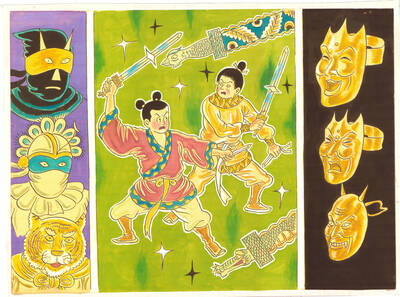
April 22 to April 28 The true identity of the mastermind behind the Demon Gang (魔鬼黨) was undoubtedly on the minds of countless schoolchildren in late 1958. In the days leading up to the big reveal, more than 10,000 guesses were sent to Ta Hwa Publishing Co (大華文化社) for a chance to win prizes. The smash success of the comic series Great Battle Against the Demon Gang (大戰魔鬼黨) came as a surprise to author Yeh Hung-chia (葉宏甲), who had long given up on his dream after being jailed for 10 months in 1947 over political cartoons. Protagonist

Peter Brighton was amazed when he found the giant jackfruit. He had been watching it grow on his farm in far north Queensland, and when it came time to pick it from the tree, it was so heavy it needed two people to do the job. “I was surprised when we cut it off and felt how heavy it was,” he says. “I grabbed it and my wife cut it — couldn’t do it by myself, it took two of us.” Weighing in at 45 kilograms, it is the heaviest jackfruit that Brighton has ever grown on his tropical fruit farm, located


 RSS
RSS