


As Taipei's alternative art spaces are disappearing and many galleries are feeling the pinch from the lackadaisical art market, the Taipei Fine Arts Museum proves to be the only place in town that consistently holds art exhibitions that are provocative, informative, educational and entertaining.
One such show is the in-house exhibition titled Depictions in Line and Form that combines its collection of Western and Eastern artwork on view until May 1.
Looking at the works from a distance, it is impossible to tell who had the larger influence. Were Western artists embracing Asian calligraphic styles when they were creating Modernist works or were Asian artists emulating European and American styles of painting? Instead of trying to resolve this conundrum, this display of paintings, prints and a few sculptures from the museum's vast collection provides a wonderful opportunity to see pure line and form in art.
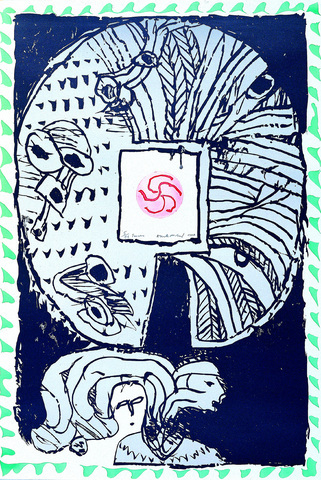
PHOTO COURTESY OF TFAM
In most of the works, the artist's energy and vitality is expressed through the line that is hand-drawn, etched, brushed or sculpted in the various media. The line in all its various permutations -- curvy, biomorphic, angular, thick, thin, geometric or sketchy -- conveys emotional intensity and may inspire the viewer to return home and pick up a brush.
Often, categories of art seem arbitrary. For didactic purposes, the exhibition is divided into four categories: "Tumultuous Worlds," "Traces in Time and Space," "Primal Nature" and "Urban Energy." The categories are a way to help the viewer decipher and try to understand the abstract lines and shapes on view.
Tumultuous Worlds
Grouped under the theme "Tumultuous Worlds," a set of four small-framed woodcuts by Jean Hans Arp sets the tone for the Modernist-style works that are arranged in the cavernous space. Arp's white curvy lines dance on a black background, creating a piece that is simultaneously playful, intimate and sensuous.
Renowned Taiwanese artist Max Liu (
Pierre Alechinsky's series of lithographs titled Fenetre really stand out in the exhibition. As lithography is a slow process entailing several steps, this work is noteworthy in that the artist's hand-drawn lines with a dark grease pencil still seem immediate and freshly made. It is a work where the lusciousness of the material is conveyed very passionately.
Traces in Time and Space
Works that show motion are grouped under the theme "Traces in Time and Space." The famous Chinese artist Hsia Yang's (
Italian artist Lucio Fontana is known for his reductive canvases made in the early 1960s in which he slashed the surfaces with a knife, thus creating cut-away lines. It was controversial at the time to treat such a sacred surface as the artist's canvas with such violent gestural aggression.
Primal Nature
More of the calligraphic and loosely painted works are grouped under the theme "Primal Nature." Kaoshiung-based artist Lu Ming-te (盧明德) shows Tatu Mountain, a collage of paint and twigs on fabric. A marble sculpture of a mythic beast that is half lion and half female by Pierre Sz'kely exemplifies the theme.
Urban Energy
Works whose combinations of lines create a strong vortex of feeling are grouped under "Urban Energy." Michell Hwang's Dignity is an acrylic painting on a cut-out piece of wooden board that resembles a winter sled designed especially for the Abstract Expressionist painter, as curvy, expressive lines and bright color lend a lot of energy to the oddly-shaped piece.
Swallow Lin's (
Exhibition notes:
What: Depictions in Line and Form at the Taipei Fine Arts Museum
Where: Taipei Fine Arts Museum, 181, Zhongshan N Rd, Sec 3, Taipei (
When: Until May 22; Tuesdays to Sundays, 9:30am to 5:30pm

In late October of 1873 the government of Japan decided against sending a military expedition to Korea to force that nation to open trade relations. Across the government supporters of the expedition resigned immediately. The spectacle of revolt by disaffected samurai began to loom over Japanese politics. In January of 1874 disaffected samurai attacked a senior minister in Tokyo. A month later, a group of pro-Korea expedition and anti-foreign elements from Saga prefecture in Kyushu revolted, driven in part by high food prices stemming from poor harvests. Their leader, according to Edward Drea’s classic Japan’s Imperial Army, was a samurai
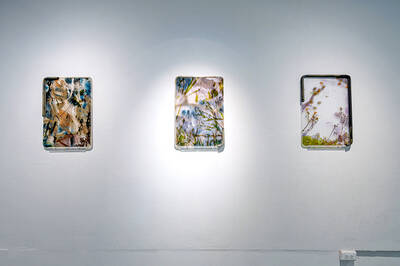
Located down a sideroad in old Wanhua District (萬華區), Waley Art (水谷藝術) has an established reputation for curating some of the more provocative indie art exhibitions in Taipei. And this month is no exception. Beyond the innocuous facade of a shophouse, the full three stories of the gallery space (including the basement) have been taken over by photographs, installation videos and abstract images courtesy of two creatives who hail from the opposite ends of the earth, Taiwan’s Hsu Yi-ting (許懿婷) and Germany’s Benjamin Janzen. “In 2019, I had an art residency in Europe,” Hsu says. “I met Benjamin in the lobby
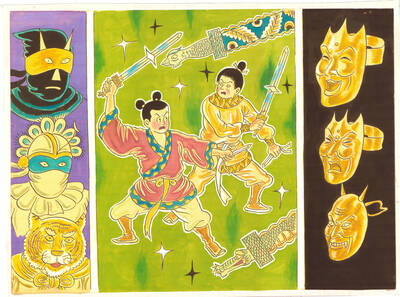
April 22 to April 28 The true identity of the mastermind behind the Demon Gang (魔鬼黨) was undoubtedly on the minds of countless schoolchildren in late 1958. In the days leading up to the big reveal, more than 10,000 guesses were sent to Ta Hwa Publishing Co (大華文化社) for a chance to win prizes. The smash success of the comic series Great Battle Against the Demon Gang (大戰魔鬼黨) came as a surprise to author Yeh Hung-chia (葉宏甲), who had long given up on his dream after being jailed for 10 months in 1947 over political cartoons. Protagonist

A fossil jawbone found by a British girl and her father on a beach in Somerset, England belongs to a gigantic marine reptile dating to 202 million years ago that appears to have been among the largest animals ever on Earth. Researchers said on Wednesday the bone, called a surangular, was from a type of ocean-going reptile called an ichthyosaur. Based on its dimensions compared to the same bone in closely related ichthyosaurs, the researchers estimated that the Triassic Period creature, which they named Ichthyotitan severnensis, was between 22-26 meters long. That would make it perhaps the largest-known marine reptile and would


 RSS
RSS