


In the 1970s Kimbo, or Tuko Mackaruwane in his native Puyuma language, was known as Taiwan's Bob Dylan, blending Taiwanese Aboriginal sounds into his poetry and folk music.
Named Hu Defu (
Produced by Cheng Chieh-ren (
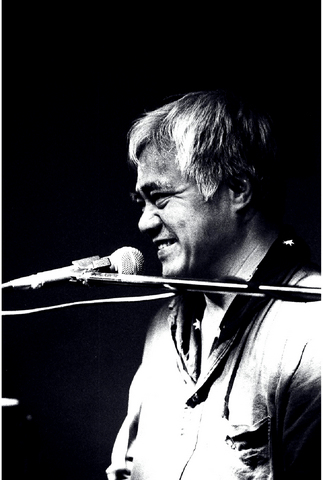
"It's hard not to be touched by Hu's natural yet powerful voice," said Lee Kun-yao (
Back then, Kimbo was Taiwan's highest paid folk singer, earning up to NT$25,000 a month -- at a time when the monthly salary of a Cabinet minister was NT$7,000 per month.
"Maybe my songs were too heavy for the market or to package for commercial record companies. They were written not for publishing purposes in the first place," Kimbo said in a cafe in Taipei, a cigarette constantly in one hand.
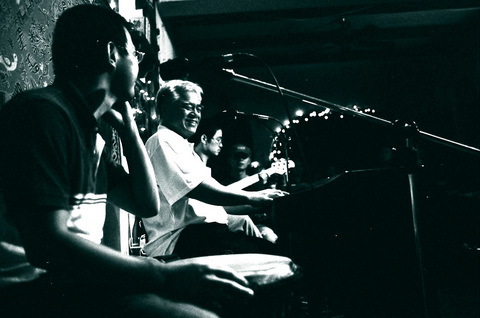
PHOTOS COURTESY OF IGNITE FIRE
Kimbo said he is not a prolific songwriter. He writes about one song a year, each one written, he said, after the pain in his body, heart and soul had reached a cresting point.
"If a song cannot move me to an unbearable degree, I would not publish the song," he said.
The blues he feels is from his 30-year involvement in Taiwan's political, social and Aboriginal movements. In all of these upheavals over the years, Kimbo's role hasn't been that merely of the protest singer, but rather he has been the frontman and organizer of many demonstrations.
In the 1980s Kimbo was a member of the tangwai (
Hu was among the first to talk about reclaiming land from Han Chinese-owned businesses and from the government, preserving Aboriginal names and raising the issue of Aboriginal girls being forced into prostitution.
Even in 1999, a decade after the peak of Taiwan's political and social movements, when the 921 earthquake devastated 90 percent of Aboriginal villages in central Taiwan, Kimbo emerged again, leading clashes with police over unfair treatment of Aboriginal villagers.
When Lien Chan (
All these actions and sentiments have been accumulated and encapsulated in his songs.
The Longest Road (
Darter, Clouded Leopard, The Basin Of Taipei (
Kimbo also wrote folk songs, such as The Boy On The Buffalo's Back (
Kimbo's singing talent took root in his high school years at Taipei's Tam-kang High School, a religious school set up by the missionary George Leslie Mackay. Students were trained to sing psalms and choral songs every morning and to play rugby every afternoon.
"I remember all the boys who loved to sing formed quartets and competed with each other every morning," Kimbo said.
He recalled a nun named Ms Taylor, who introduced Scottish folk songs and American Southern spirituals to the boys.
"I was naturally drawn to the rhythm of blues and spirituals and was gradually influenced by these vocal styles," Kimbo said.
"Little by little, I began to understand the content of spirituals and found lots of similarities with Taiwanese Aboriginal music. The repeating patterns of the blues are very similar to some music styles in Puyuma Paiwan music.
"The lyrics of Aboriginal folk music, like spirituals, tell about suffering. But I feel there is more praise to nature in Taiwanese Aboriginal music, instead of just telling about the pain," Kimbo said.
Romanticism and spontaneity seem to always drive Kimbo, making him a pioneer in many other businesses outside his folk music and social-movement activism.
He and friends opened Taiwan's first teppanyaki restaurant in Taipei in 1970. He was also once a partner in Taiwan's leading toy business. But these businesses were all flash-in-the-pan affairs, like many of the short-lived protest campaigns.
His free-spirited style demonstrates Kimbo's talent, but it is also sometimes a source of trouble for his producers. For instance, he never sings the same lyrics twice. Two years ago, it took him two hours to shoot a 20-second music video clip because he could not sing the same lyrics in front of the camera.
"I've sung that song tens of thousands of times. None of the times have I sung the same lyrics," he said.
Now Kimbo has decided to redirect his focus toward music, his one passion.
"I decided that this time I would lay down everything else and start to treat my music, especially Aboriginal music, with respect," Kimbo said.
As Time Flashes is meant to be a summing-up of his past musical career so that he can begin pursuing his new musical passions.
"I want to systematically explore the heritage of Aboriginal music, especially the abundant use in Aboriginal music of words like ho hai yan which don't actually have any meaning. I want to explore the beauty of these words and blend their usage into my own music,"
He will also work more closely with young Aboriginal musicians and music producers to help develop new talent.
"There are so many beautiful voices among the younger generation Aboriginal musicians. Unlike me. Only my heart still rocks," Kimbo said with a laugh.

In late October of 1873 the government of Japan decided against sending a military expedition to Korea to force that nation to open trade relations. Across the government supporters of the expedition resigned immediately. The spectacle of revolt by disaffected samurai began to loom over Japanese politics. In January of 1874 disaffected samurai attacked a senior minister in Tokyo. A month later, a group of pro-Korea expedition and anti-foreign elements from Saga prefecture in Kyushu revolted, driven in part by high food prices stemming from poor harvests. Their leader, according to Edward Drea’s classic Japan’s Imperial Army, was a samurai

Located down a sideroad in old Wanhua District (萬華區), Waley Art (水谷藝術) has an established reputation for curating some of the more provocative indie art exhibitions in Taipei. And this month is no exception. Beyond the innocuous facade of a shophouse, the full three stories of the gallery space (including the basement) have been taken over by photographs, installation videos and abstract images courtesy of two creatives who hail from the opposite ends of the earth, Taiwan’s Hsu Yi-ting (許懿婷) and Germany’s Benjamin Janzen. “In 2019, I had an art residency in Europe,” Hsu says. “I met Benjamin in the lobby
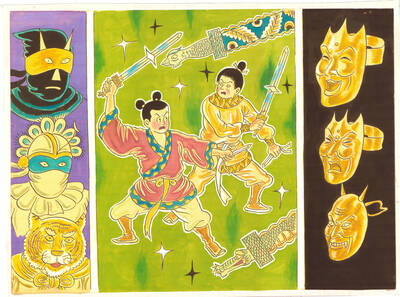
April 22 to April 28 The true identity of the mastermind behind the Demon Gang (魔鬼黨) was undoubtedly on the minds of countless schoolchildren in late 1958. In the days leading up to the big reveal, more than 10,000 guesses were sent to Ta Hwa Publishing Co (大華文化社) for a chance to win prizes. The smash success of the comic series Great Battle Against the Demon Gang (大戰魔鬼黨) came as a surprise to author Yeh Hung-chia (葉宏甲), who had long given up on his dream after being jailed for 10 months in 1947 over political cartoons. Protagonist

Peter Brighton was amazed when he found the giant jackfruit. He had been watching it grow on his farm in far north Queensland, and when it came time to pick it from the tree, it was so heavy it needed two people to do the job. “I was surprised when we cut it off and felt how heavy it was,” he says. “I grabbed it and my wife cut it — couldn’t do it by myself, it took two of us.” Weighing in at 45 kilograms, it is the heaviest jackfruit that Brighton has ever grown on his tropical fruit farm, located


 RSS
RSS