


Ask anyone on the street their views regarding the need for animal welfare and chances are a vast majority will, on moral or religious grounds, have strong opinions in favor of treating animals with the same respect as humans. Despite this, animal abuse remains an unavoidable fact of life in Taiwan.
Chickens are inhumanely slaughtered in public at wet markets, the sale of dog meat continues, traditional Chinese medicine stores continue to sell parts of endangered animals, and take a stroll down Taipei's infamous Snake Alley on any given day and the sight of snakes awaiting their slaughter is inescapable.
With such widespread abuse, the public could be forgiven for supposing the nation is void of any laws governing the welfare of the nation's non-human inhabitants. In reality, however, Taiwan has some of the world's most comprehensive laws governing the treatment of animals.

When the government implemented the Animal Protection Law in November 1998, Taiwan became only the 54th country to introduce laws pertaining to the welfare of animals.
The Animal Protection Law covers the treatment of all animals, domestic, wild and livestock. Laws cover everything from maltreatment and abandonment to the use of animals in gambling and even the age of those who can legally be held responsible for the well being of a domestic animal. Fines against those who flout the rules range from NT$2,000 to NT$2500,000, and in certain cases abuses can lead to imprisonment.
Yet while Taiwan has such comprehensive laws, many of them only exist on paper. The actual enforcement of the laws is another matter entirely. The Council of Agriculture (COA,
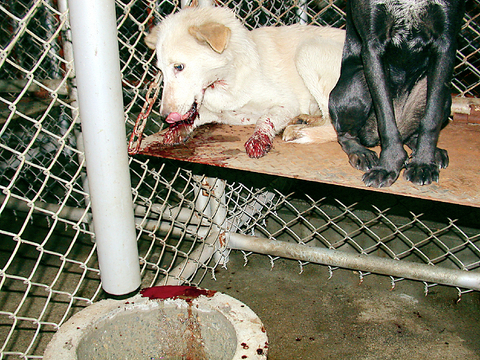
PHOTOS COURTESY OF LCA
"They have some of the best laws in the world, but they simply don't enforce them and there are certainly not enough inspectors to do the job," said the International Primate Protection League's (IPPL) Taiwan field representative, Charles Shuttleworth. "When the police do act they do a very a good job indeed, but they could do a lot more."
One of the first foreign nationals to take a vocal interest in animal welfare in Taiwan, Shuttleworth has been at the forefront of animal conservation since 1969. And while he feels that a lot more could be done to ensure that animals are protected, he has seen some remarkable changes over the past 30 years.
"It used to be terrible. People would chop limbs off animals while they were still alive. People would put monkeys in cages and leave them out in the sun because they believed it would make [monkeys] smaller and cuter," he said. "I even saw a man put a tube up a crocodile's [anus], blow air into it and then jump on the creature so it would make what he considered to be a funny sound."

PHOTO: GAVIN PHIPPS, TAIPEI TIMES
Horrific abuses such as these may still take place, but they are kept a long way from the public's gaze. Like Shuttleworth, veterinary surgeon and Secretary General of the Animal Protection Association of the Republic of China (APA,
"I remember when animal rights first became an issue in the 1960s. It all started with the water buffalo. Farmers were so fed up with their cattle roaming onto roads only to be hit by cars that they petitioned the government to dig ditches at the sides of roads to stop their cattle from being killed," Huang said.
According to Huang, there are so many loopholes in the laws that individuals who harm animals are rarely, if ever, prosecuted for the correct reasons.
"You could kill a dog, dump the body in the street, and chances are you'd be charged with the unlawful disposal of garbage rather than the killing of a domestic animal," said Huang. "And you only have to look at the huge number of feral dogs roaming the streets to realize that fines for abandonment don't work at all."
The issue of feral dogs has long been the most publicized of all animal-welfare issues. The law currently states than any dog found without a collar or identification chip should be held in a shelter for 10 days. If the animal remains unclaimed after this period it can then be legally put to sleep by lethal injection. Some pounds ignore this regulation, however, and for financial reasons put dogs down after only four or five days.
Animal rights groups like the Life Conservationist Association (LCA,
"The dog pounds contract out the task of injecting the dogs to private contractors. Sure, there might be a trained vet among them, but this is not always the case," said the LCA's Hank Lee (
"A lot of dogs get injected in the incorrect part of their anatomy by inexperienced handlers. Instead of a relatively painless and quick death these dogs often suffer horrendously before finally dying."
While the feral-dog problem continues to cause debate and will, according to the LCA's Lee, "quite possibly get worse before it gets better," one of the most vocal of all of Taiwan's animal rights groups, the Environment and Animal Society of Taiwan (EAST,
Every year 300 million chickens, 31 million ducks, 10 million pigs, 6 million geese, 364,000 turkeys, 260,000 goats and roughly 40,000 cows are slaughtered in order to satisfy the nation's craving for meat. A majority of these animals are slaughtered in one of the 80 carefully monitored government-run abattoirs, but others are not so lucky and are killed at private slaughterhouses that still practice inhumane methods of animal slaughter.
"Until four years ago nearly every slaughterhouse disregarded the law," said EAST's Director, Wu Hung (
"Pigs had their feet bound to stop them from walking in order to make the meat richer. Cows were starved of food and force-fed water for three to four days before slaughter in order to make them heavier and chickens were often put into feathering machines still alive," he said.
On his once-regular visits to abattoirs, Wu not only witnessed pre-slaughter abuse, but also saw the inhumane methods employed by slaughterhouse workers to kill the animals. Pigs, cows, chickens and goats were often slain by having their throats cut and were rarely, if ever stunned and put to sleep beforehand.
EAST's awareness campaign caused such a commotion and had such an effect on the general public that the COA was finally forced to act.
"We were very concerned about the way in which slaughterhouses were being run," said the COA's Andrew Wang (
By law, all abattoirs must now first stun an animal with an electric prod and, when the animal is asleep, fire a single shot from a bolt gun into the beast's head. Slaughterhouses found to employ inhumane practices now face fines from NT$100 to NT$500,000. The COA also has the right to close operations of any slaughterhouse that openly or continually flouts the regulations.
The COA may be confident that it has eradicated inhumane practices of animal slaughter, but EAST is not convinced. Since it's campaign made headline news, the animal-rights group has been denied access to nearly all of the nation's slaughterhouses. And, according to the group, it is quite possible that 60 percent of pigs are still being killed inhumanely.
Local animal-rights groups may remain wary of how the government deals with laws pertaining to the rights of domestic and farm animals, but one area in which the NGOs and the government have successfully worked together is that of outlawing the capture and sale of indigenous wildlife, especially primates.
Until the late 1980s the sight of illegally imported orangutans and local primates was commonplace. But Taiwan's inclusion in the Convention on International Trade in Endangered Species of Wild Fauna and Flora (CITES) has reduced the once-widespread importation of endangered animals.
On a more local scale, the opening of the Pingtung Rescue Center for Endangered and Wild Animals in 1993 enabled authorities to place any illegally imported animal into proper care. Since its opening, the center has rescued more than 1,000 animals and now participates in educational exchange programs with institutes overseas.
"The media attention given to the CITES agreement and the opening of the Pintung Rescue Center have been pivotal in altering people's concepts of how we view and treat endangered animals," said Huang.
"Without them Taiwan would not have made such great inroads in the area of animal welfare," he said.
The sale and importation of primates may have successfully been stemmed, but the plight of the Formosan macaque has now taken center stage. While no longer critically endangered, the Formosan macaque remains, according to the World Conservation Union's (IUCN) Red List of Threatened Animals, at risk of extinction in the wild in the medium-term future. Every year dozens of them are killed or maimed by wire snares and poisons laid out by hunters.
"There is not and never has been a government regulation on the number of macaques that can be caught and moved, and if there was I'm sure the farmers would complain," said Lee Ling-ling (李玲玲) of the Department of Zoology at National Taiwan University (台灣大學動物學系). "Until some kind of legal framework can be settled upon, it's a no-win situation for everybody concerned," Lee added.
Once hunted solely for its bones, which were boiled down into a broth and drunk by young men who believed the concoction would give them everlasting virility, the trapping of macaques was outlawed in 1989. While it is illegal to slaughter macaques, even trespassing ones, farmers can apply for a permit to trap the primates. The unlicensed killing of a macaque is punishable with a lengthy prison sentence or a hefty fine or both, depending on the circumstances.

In late October of 1873 the government of Japan decided against sending a military expedition to Korea to force that nation to open trade relations. Across the government supporters of the expedition resigned immediately. The spectacle of revolt by disaffected samurai began to loom over Japanese politics. In January of 1874 disaffected samurai attacked a senior minister in Tokyo. A month later, a group of pro-Korea expedition and anti-foreign elements from Saga prefecture in Kyushu revolted, driven in part by high food prices stemming from poor harvests. Their leader, according to Edward Drea’s classic Japan’s Imperial Army, was a samurai

Located down a sideroad in old Wanhua District (萬華區), Waley Art (水谷藝術) has an established reputation for curating some of the more provocative indie art exhibitions in Taipei. And this month is no exception. Beyond the innocuous facade of a shophouse, the full three stories of the gallery space (including the basement) have been taken over by photographs, installation videos and abstract images courtesy of two creatives who hail from the opposite ends of the earth, Taiwan’s Hsu Yi-ting (許懿婷) and Germany’s Benjamin Janzen. “In 2019, I had an art residency in Europe,” Hsu says. “I met Benjamin in the lobby

April 22 to April 28 The true identity of the mastermind behind the Demon Gang (魔鬼黨) was undoubtedly on the minds of countless schoolchildren in late 1958. In the days leading up to the big reveal, more than 10,000 guesses were sent to Ta Hwa Publishing Co (大華文化社) for a chance to win prizes. The smash success of the comic series Great Battle Against the Demon Gang (大戰魔鬼黨) came as a surprise to author Yeh Hung-chia (葉宏甲), who had long given up on his dream after being jailed for 10 months in 1947 over political cartoons. Protagonist

A fossil jawbone found by a British girl and her father on a beach in Somerset, England belongs to a gigantic marine reptile dating to 202 million years ago that appears to have been among the largest animals ever on Earth. Researchers said on Wednesday the bone, called a surangular, was from a type of ocean-going reptile called an ichthyosaur. Based on its dimensions compared to the same bone in closely related ichthyosaurs, the researchers estimated that the Triassic Period creature, which they named Ichthyotitan severnensis, was between 22-26 meters long. That would make it perhaps the largest-known marine reptile and would


 RSS
RSS