


The premise on which this book is constructed is curious and interesting, but the tales themselves have a glumness that makes them rather depressing.
Ruth Prawer Jhabvala will probably be known to most people these days as the screenwriter for films of classic novels by E.M.Forster such as Howards End and A Room With a View. But she's also a prolific novelist and short-story writer, and won the UK's Booker Prize in 1975 with her novel Heat and Dust.
My Nine Lives, rather than attributing to the narrator any cat-like persona, instead tells the story of a girl's childhood and adolescence nine times. All the stories are different -- different narrators, different cities, different situations. Yet in a preface the author tells us that they are all in some sense autobiographical. How can this be?
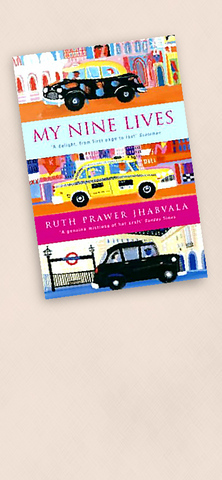
She is "trying out fictional destinies," Ruth Prawer Jhabvala writes, not, as novelists usually do, using fictional characters, but this time constructing unlived destinies for herself. These, then, are youthful lives the author feels she might have lived, or, in the words of the subtitle, "Chapters of a Possible Past."
The real Ruth Prawer Jhabvala was born in Germany of Polish parents in 1927. Presumably because of their Jewish ancestry, the family fled to England in 1939. After studying at London University, the author married an Indian architect by the name of C.S.H. Jhabvala. From 1951 to 1975 -- in other words from the age of 24 to 48 -- she lived in Delhi. Nowadays she and her husband divide their time between London, Delhi and New York.
So the real autobiography of the author shows a childhood spent in Germany, an adolescence spent in London, and an early married life in India. New York is added to the brew later and provides an American dimension.
These nine stories, however, tell of young girls being brought up in India, in London or in New York. The three territories are not rigidly demarked, however -- there are people of Indian ancestry in the American narratives, and non-Indians in the Indian ones, for example. But if the author is to be believed, there is a sense in which the young girls at the center of all nine tales are in each case, and in some way, Ruth Prawer Jhabvala.
There are certain similarities, to be sure. None of the girls are pretty, for example. All of them are interested in art, and are more thoughtful and observant than their parents and siblings. Even so, all are separate creations, with different names, different kinds of parents, and different social backgrounds. These, then, are fantasy autobiographies, fictional dreams of how things might have been.
India is a constant presence. In the opening tale, Life, a retired woman has moved back there from America. In another, Gopis, where the female narrator is a middle-aged New York executive, the focus of interest a young girl, Lucia, who is trying to learn Indian dance and longs to travel in the subcontinent -- an ambition she succeeds in, with less than happy consequences. And in the final story, Pilgrimage, a young girl who has moved to London from Austria teams up with a charismatic lodger in her mother's house, named only C, and with him travels overland to India in search of a guru. By the time the tale ends she is visiting C in a Texas jail.
The penultimate story, Refuge in London, also tells of a refugee child whose mother, having managed to buy a house with money brought into the UK from Germany, lets out rooms to other refugees, people of distinction and even wealth in pre-Nazi Germany who are now experiencing relative poverty in their new circumstances.
The child becomes close to a painter, Kohl, who occupies an attic room. He paints and draws portraits of her, and of anyone else in the house who will sit for him. He has an unsympathetic wife, Marta, and an enemy, Mann, who dislikes his pictures. Things come to a head in a birthday party in the artist's studio, and the story ends with Kohl's paintings becoming famous and filling an entire room in a New York art gallery.
These two final stories, one judges, must surely come closer than most of the others to the real-life experience of the author, in their general situations if not in the details that later emerge.
Two observations can be made about this book. First, it could well be the case that writers become more autobiographical as time goes on. Shakespeare appears to have become so, with situations involving parents and children occurring over and over again in the later plays, memory (perhaps) mixing with dream. If this is true, then Ruth Prawer Jhabvala is merely running true to form in constructing this book of childhoods she both lived and might have lived.
Secondly, refugees and migrants are characteristically insecure about their social position. They want above all else to be fully accepted in their abode of choice, but this is frequently a satisfaction only their children are fated to enjoy. Seeing that Ruth Prawer Jhabvala has been uprooted several times -- born in one country, raised in another, married into a third, and residing later in a fourth -- it's understandable that the desire to nail down a past becomes something of an obsession. "Who am I?" quickly becomes "Who was I?" In these circumstances, the repeated re-working of the past that these stories display becomes more understandable.
All in all, these tales, frequently sad, are less than gripping in themselves. Their interest only grows only when the implications of the author having written such a bizarre collection are fully
considered.

In late October of 1873 the government of Japan decided against sending a military expedition to Korea to force that nation to open trade relations. Across the government supporters of the expedition resigned immediately. The spectacle of revolt by disaffected samurai began to loom over Japanese politics. In January of 1874 disaffected samurai attacked a senior minister in Tokyo. A month later, a group of pro-Korea expedition and anti-foreign elements from Saga prefecture in Kyushu revolted, driven in part by high food prices stemming from poor harvests. Their leader, according to Edward Drea’s classic Japan’s Imperial Army, was a samurai

Located down a sideroad in old Wanhua District (萬華區), Waley Art (水谷藝術) has an established reputation for curating some of the more provocative indie art exhibitions in Taipei. And this month is no exception. Beyond the innocuous facade of a shophouse, the full three stories of the gallery space (including the basement) have been taken over by photographs, installation videos and abstract images courtesy of two creatives who hail from the opposite ends of the earth, Taiwan’s Hsu Yi-ting (許懿婷) and Germany’s Benjamin Janzen. “In 2019, I had an art residency in Europe,” Hsu says. “I met Benjamin in the lobby
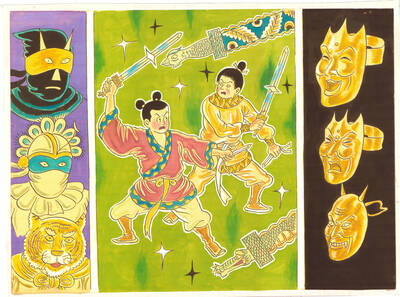
April 22 to April 28 The true identity of the mastermind behind the Demon Gang (魔鬼黨) was undoubtedly on the minds of countless schoolchildren in late 1958. In the days leading up to the big reveal, more than 10,000 guesses were sent to Ta Hwa Publishing Co (大華文化社) for a chance to win prizes. The smash success of the comic series Great Battle Against the Demon Gang (大戰魔鬼黨) came as a surprise to author Yeh Hung-chia (葉宏甲), who had long given up on his dream after being jailed for 10 months in 1947 over political cartoons. Protagonist

A fossil jawbone found by a British girl and her father on a beach in Somerset, England belongs to a gigantic marine reptile dating to 202 million years ago that appears to have been among the largest animals ever on Earth. Researchers said on Wednesday the bone, called a surangular, was from a type of ocean-going reptile called an ichthyosaur. Based on its dimensions compared to the same bone in closely related ichthyosaurs, the researchers estimated that the Triassic Period creature, which they named Ichthyotitan severnensis, was between 22-26 meters long. That would make it perhaps the largest-known marine reptile and would


 RSS
RSS