


Channel surf through the nation's half dozen cable television news networks on any given day at any given time and the chances of catching a news item concerning events outside of Taiwan's borders is very slim.
In an average week the only international items that local cable networks often consider worthy of airtime are those that feature brutally bloody footage of war, terrorism, natural disasters or that old favorite the construction worker who inadvertently got shot in the head with a nail gun. And even then very few, if any, of these items offer any in-depth analysis or insight into the reasons behind the events they portray.
As vice president of ETTV's (
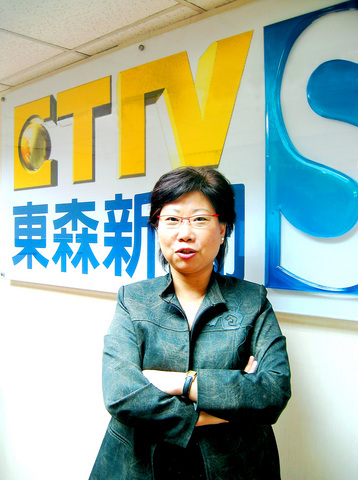
PHOTO COURTESY OF ETA
"Taiwan is so small, has such little international visibility and no influence, yet is so insular that we often forget that there are things of importance happening in the [outside] world," she said. "But if it does not involve prying into somebody's private life, nobody seems to be that interested."
Kao's rise to prominence as one of Taiwan's most trusted and well-known foreign correspondents began by accident in the wake of the death of Generalissimo Chiang Kai-shek in April of 1975. As a young and unknown rookie newsapaper reporter, Kao may have seemed an odd choice to cover the visit to Taiwan by then-US Vice President Nelson Rockefeller, who flew in to attend Chiang's funeral.
Instead of shying away and simply relying on the press releases issued by the Government Information Office (
"He was staying at the Grand Hotel and you couldn't get near him because of the bodyguards. I figured that because of his family's interest in art he would visit the National Palace Museum," Kao said. "So after the funeral I went there and waited."
Kao's shrewd thinking paid dividends and the US Vice President did indeed visit the museum. Moments before Rockefeller stepped into his limousine to return to the airport Kao made her move and managed to ask him a couple questions. The answers to Kao's inquiries may not have been earth-shaking, but they were enough for her newspaper to boast an exclusive interview with the visiting dignitary.
"I'll admit it was a very brief encounter and that all he said were few protocol words before he got into the car," said Kao. "But the newspaper took it as a scoop. I wrote the story and I got my first byline."
Following Kao's brief yet all-important meeting with Rockefeller, she found herself promoted to the position of foreign correspondent-at-large. Kao began to hang out at US-forces officers' clubs and hotel lobbies looking for stories, was a regular face at embassy receptions and became one of the first local reporters to take an interest in and write about Taiwan's foreign community.
While her close ties to the foreign community and its diplomatic corps gave Kao a rare insight into how the world viewed Taiwan in the mid to late 1970s, they by no means prepared her for the events of December 15, 1978 -- the day US President Jimmy Carter announced that the US would cut diplomatic ties with Taipei in favor of Beijing.
"We knew it was going to take place but didn't know the formula, and there had been no official response to any questions we asked," she said. "It was obviously inevitable, but the timing was a surprise to everyone."
The nation may have been politically neglected by the US and dwarfed by China from that day forth, but Kao believes that Taiwan's long-running outsider status shouldn't be mirrored by the mass media. The insular manner in which the nation's cable television news networks handle news is, according to Kao, harmful to both Taiwan's populace as well as to the nation's standing on the global stage.
"People in Taiwan talk about internationalization and globalization, but they certainly don't feel connected to these statements," she said. "The lack of coverage of and information about global events has meant that [Taiwan] is very inward-looking. The furthest people will look is China."
According Kao, when there are no hugely popular look-who's-sleeping-with-who stories topping the hourly news bulletins, Taiwanese news viewers' second choice is to tune into news about China, followed by Japan. US news comes in a distant third and if you're wondering about Europe or the Middle East, well, you'd best forget about it as Kao says neither is considered very newsworthy.
"So many Taiwanese tourists travel to Italy, but if you asked them who the prime minister is they wouldn't know, and the number of those who know who Yasser Arafat was, well, I'd have to say that probably 99.9 percent of people you asked on the street wouldn't know who he was," said Kao.
Since taking up her position at ETTV Kao has attempted to alter the news format by including more international news in bulletins. She will readily admit, however, that such a move could be considered somewhat of a mission impossible.
In the ongoing cable TV news wars, altering current formats to suit Taiwan's minority of more globally minded viewers is tantamount to committing suicide. Ratings rule and global news, it appears, just doesn't cut it with local viewers.
"We do minute-by-minute analysis of our news broadcasts, and at 1:15pm recently we noted that our ratings went down compared to other channels simply because we were broadcasting a speech by US President George W. Bush. People turned away and changed channel," said Kao. "International news is a killer for ratings."
While critical of cable television news networks, including her own, for their lack of coverage of international news, Kao has great admiration for CTi (
"CTi has been much bolder than other networks in the way it has chosen to adopt international news. Sure, ratings dropped for the first six months, but they have bounced back," she said. "This is something that I'm always trying to tell my [boss]."

In late October of 1873 the government of Japan decided against sending a military expedition to Korea to force that nation to open trade relations. Across the government supporters of the expedition resigned immediately. The spectacle of revolt by disaffected samurai began to loom over Japanese politics. In January of 1874 disaffected samurai attacked a senior minister in Tokyo. A month later, a group of pro-Korea expedition and anti-foreign elements from Saga prefecture in Kyushu revolted, driven in part by high food prices stemming from poor harvests. Their leader, according to Edward Drea’s classic Japan’s Imperial Army, was a samurai

Approaching her mid-30s, Xiong Yidan reckons that most of her friends are on to their second or even third babies. But Xiong has more than a dozen. There is Lucky, the street dog from Bangkok who jumped into a taxi with her and never left. There is Sophie and Ben, sibling geese, who honk from morning to night. Boop and Pan, both goats, are romantically involved. Dumpling the hedgehog enjoys a belly rub from time to time. The list goes on. Xiong nurtures her brood from her 8,000 square meter farm in Chiang Dao, a mountainous district in northern Thailand’s
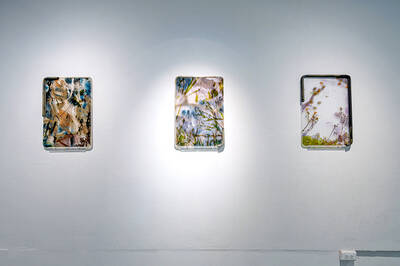
Located down a sideroad in old Wanhua District (萬華區), Waley Art (水谷藝術) has an established reputation for curating some of the more provocative indie art exhibitions in Taipei. And this month is no exception. Beyond the innocuous facade of a shophouse, the full three stories of the gallery space (including the basement) have been taken over by photographs, installation videos and abstract images courtesy of two creatives who hail from the opposite ends of the earth, Taiwan’s Hsu Yi-ting (許懿婷) and Germany’s Benjamin Janzen. “In 2019, I had an art residency in Europe,” Hsu says. “I met Benjamin in the lobby
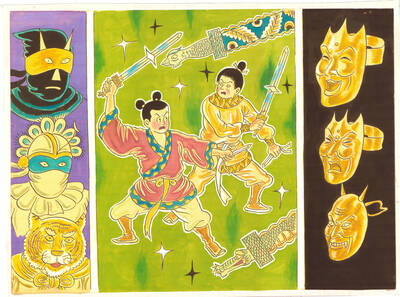
April 22 to April 28 The true identity of the mastermind behind the Demon Gang (魔鬼黨) was undoubtedly on the minds of countless schoolchildren in late 1958. In the days leading up to the big reveal, more than 10,000 guesses were sent to Ta Hwa Publishing Co (大華文化社) for a chance to win prizes. The smash success of the comic series Great Battle Against the Demon Gang (大戰魔鬼黨) came as a surprise to author Yeh Hung-chia (葉宏甲), who had long given up on his dream after being jailed for 10 months in 1947 over political cartoons. Protagonist


 RSS
RSS