


The Sea Inside, the story of a quadriplegic activist fighting for the right to die, struggles to transcend the disease-of-the-week genre to which it belongs. Yet there is no escaping the fact that the true story of Ramon Sampedro, a former ship's mechanic seeking a final exit after three decades of agonizing immobility, is defined by its theme.
The movie avoids becoming a formulaic dialogue that pits religious and secular cheerleaders against one another. Even so, the characters often feel like schematic formulations intended to balance the story.
The deepest philosophical questions posed by euthanasia are only glancingly addressed. The film fails to convey the claustrophobic terror experienced by a man who called his book Letters From Hell.

PHOTO: EPA
Sensitively portrayed by the great Spanish actor Javier Bardem, Ramon regards his life in the wake of a crippling accident in his mid-20s as a cruel, cosmic joke.
In his imagination, he is still as he was before: a Zorba-like force of nature who once sailed the world. Now the only thing sustaining his spirit is his acute mind, which torments him with dreams of a physical life that is just a memory.
Alejandro Amenabar, the gifted 32-year-old director of The Others and Open Your Eyes, is clearly fixated on the shadowy area between life, death and the spirit world.
On Jan 12, 1998, the 55-year-old Sampedro ended his life by drinking cyanide. His assisted suicide involved 10 collaborators, in addition to a cameraman. Each participant in the process contributed without having enough knowledge to be legally indicted for murder. After his death, hundreds of supporters of his cause wrote letters, confessing to having aided and abetted him.
Unambiguously pro-euthanasia on one hand, it shows how Ramon infused many around him with a charged sense of life's possibility.
Bardem, acting above the neck except in brief flashbacks and fantasies, creates a complicated male character.
Members of Ramon's religious farming family slave to keep him alive but refuse to help him in his battle to die with dignity.
And two women enter his life. The first, his lawyer Julia (Belen Rueda), embraces his cause, becomes his soul mate and helps him produce a book of poems. The second, Rosa (Lola Duenas), is a beleaguered single mother who visits Ramon after seeing him on television and falls in love.
In the end, though, the film's suspenseful narrative devices feel contrived when applied to what's supposed to be a true story of life, death and the living hell from which Ramon finally escapes.

In late October of 1873 the government of Japan decided against sending a military expedition to Korea to force that nation to open trade relations. Across the government supporters of the expedition resigned immediately. The spectacle of revolt by disaffected samurai began to loom over Japanese politics. In January of 1874 disaffected samurai attacked a senior minister in Tokyo. A month later, a group of pro-Korea expedition and anti-foreign elements from Saga prefecture in Kyushu revolted, driven in part by high food prices stemming from poor harvests. Their leader, according to Edward Drea’s classic Japan’s Imperial Army, was a samurai

Located down a sideroad in old Wanhua District (萬華區), Waley Art (水谷藝術) has an established reputation for curating some of the more provocative indie art exhibitions in Taipei. And this month is no exception. Beyond the innocuous facade of a shophouse, the full three stories of the gallery space (including the basement) have been taken over by photographs, installation videos and abstract images courtesy of two creatives who hail from the opposite ends of the earth, Taiwan’s Hsu Yi-ting (許懿婷) and Germany’s Benjamin Janzen. “In 2019, I had an art residency in Europe,” Hsu says. “I met Benjamin in the lobby
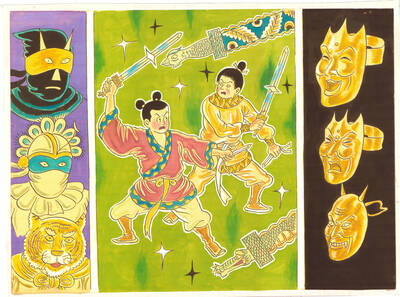
April 22 to April 28 The true identity of the mastermind behind the Demon Gang (魔鬼黨) was undoubtedly on the minds of countless schoolchildren in late 1958. In the days leading up to the big reveal, more than 10,000 guesses were sent to Ta Hwa Publishing Co (大華文化社) for a chance to win prizes. The smash success of the comic series Great Battle Against the Demon Gang (大戰魔鬼黨) came as a surprise to author Yeh Hung-chia (葉宏甲), who had long given up on his dream after being jailed for 10 months in 1947 over political cartoons. Protagonist

Peter Brighton was amazed when he found the giant jackfruit. He had been watching it grow on his farm in far north Queensland, and when it came time to pick it from the tree, it was so heavy it needed two people to do the job. “I was surprised when we cut it off and felt how heavy it was,” he says. “I grabbed it and my wife cut it — couldn’t do it by myself, it took two of us.” Weighing in at 45 kilograms, it is the heaviest jackfruit that Brighton has ever grown on his tropical fruit farm, located


 RSS
RSS