


The images could have come from one of Hieronymus Bosch's nightmarish paintings of hell: dusty roads filled with frightened refugees, many of them already ill, covered in boils and coughing up blood; dogs and rats running wild on deserted streets; fields littered with the bodies of cows and sheep; plague pits filled with the corpses of men, women and children; survivors pointing accusatory fingers at Jews and Muslims and outsiders; others flagellating themselves in an effort to appease the heavens.
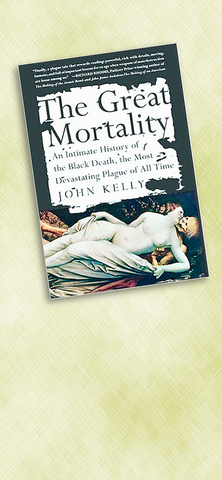
This was Europe in the 1340s, the decade of the advent of the Black Death, and in his harrowing new book, The Great Mortality, John Kelly gives the reader a ferocious, pictorial account of the horrific ravages of that plague.
He notes that on the Foster scale, a kind of Richter scale of human disaster, "the medieval plague is the second-greatest catastrophe in the human record," with only World War II producing "more death, physical destruction and emotional suffering."
He also points out that a Cold War-era study by the US Atomic Energy Commission found that the Black Death comes closest to achieving the cataclysmic results of all-out nuclear war "in its geographical extent, abruptness of onset and scale of casualties."
The author of several earlier books on science and medicine, Kelly was led to tackle the subject of the Black Death by the current AIDS epidemic and by the specter of newly emerging diseases like Ebola fever, Marburg, SARS and avian flu.
His book is heavily indebted to the work of earlier scholars, including such classic works as Johan Huizinga's Waning of the Middle Ages (first English translation, 1924) and more recent books like Norman F. Cantor's In the Wake of the Plague (2001) and David Herlihy's Black Death and the Transformation of the West (1997).
As a result, this volume's chief interest lies in its overview and synthesis of more academic studies and Kelly's ability to turn his research into an emotionally accessible narrative, animated by wrenchingly vivid tableaus and alarming firsthand witness accounts -- accounts that give the reader an intimate sense of day-to-day life in medieval Europe and the terrible ways in which the Black Death disrupted it.
Kelly recounts stories of individual heroism -- people risking their own lives to minister to the ill or ensure a dignified burial -- but his book is filled with far more incidents of cowardice, infamy and inhumanity: pogroms instituted against the Jews, who were scapegoated for spreading the plague; the abdication of responsibility on the part of many officials and community leaders; and the exploitation of the needy and grief-stricken by con men and opportunists.
When it comes to analyzing reactions to the Black Death, Kelly tends to come up with conclusions that are predictable, reductive or obvious -- or all three.
For instance, he argues that different countries reacted differently to the plague: that civic order tended to prevail in England, while "the Black Death seems to have stirred some netherworld deep within the turbulent Teutonic soul," giving birth to pogroms in Central Europe and the bizarre phenomenon of the Flagellants in Germany.
He also makes the sweeping and largely unsubstantiated claim that "London's moral state" fell precipitously in the wake of the plague, and that "a similar moral decline was evident elsewhere in post-plague Europe and the Middle East."
On the tsunami of other social changes wrought by the Black Death, Kelly is more persuasive -- if decidedly derivative, echoing what many scholars before him have observed.
In many parts of Europe, the plague claimed a third of the population (in some areas, as much as 60 percent), and this devastating loss of life, Kelly argues, "may have saved Europe from an indefinite future of subsistence existence," breaking the Malthusian deadlock of rapid demographic growth and rapidly diminishing resources.
The devastation wrought by the Black Death, he goes on, helped "allow the continent to recapture its momentum," resulting in a larger share of resources for survivors and a wave of human ingenuity as people sought technological solutions to an acute labor shortage.
Echoing Cantor, he says that the plague also led to a "privatization" of religion and a deepening disillusionment with the Church -- thereby, perhaps, preparing the groundwork for the Reformation. It led, too, he adds, to innovations in the fields of education and medicine and to the birth of public health programs.
In fact, Kelly concludes his gory chronicle on a remarkably optimistic note: "Horrific as a century of unremitting death had been, Europe emerged from the charnel house of pestilence and epidemic cleansed and renewed -- like the sun after rain."

Last week Joseph Nye, the well-known China scholar, wrote on the Australian Strategic Policy Institute’s website about how war over Taiwan might be averted. He noted that years ago he was on a team that met with then-president Chen Shui-bian (陳水扁), “whose previous ‘unofficial’ visit to the US had caused a crisis in which China fired missiles into the sea and the US deployed carriers off the coast of Taiwan.” Yes, that’s right, mighty Chen caused that crisis all by himself. Neither the US nor the People’s Republic of China (PRC) exercised any agency. Nye then nostalgically invoked the comical specter

Relations between Taiwan and the Czech Republic have flourished in recent years. However, not everyone is pleased about the growing friendship between the two countries. Last month, an incident involving a Chinese diplomat tailing the car of vice president-elect Hsiao Bi-khim (蕭美琴) in Prague, drew public attention to the People’s Republic of China’s (PRC) operations to undermine Taiwan overseas. The trip was not Hsiao’s first visit to the Central European country. It was meant to be low-key, a chance to meet with local academics and politicians, until her police escort noticed a car was tailing her through the Czech capital. The
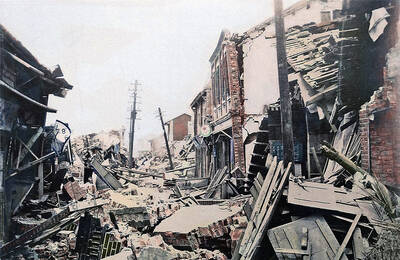
April 15 to April 21 Yang Kui (楊逵) was horrified as he drove past trucks, oxcarts and trolleys loaded with coffins on his way to Tuntzechiao (屯子腳), which he heard had been completely destroyed. The friend he came to check on was safe, but most residents were suffering in the town hit the hardest by the 7.1-magnitude Hsinchu-Taichung Earthquake on April 21, 1935. It remains the deadliest in Taiwan’s recorded history, claiming around 3,300 lives and injuring nearly 12,000. The disaster completely flattened roughly 18,000 houses and damaged countless more. The social activist and

Over the course of former President Ma Ying-jeou’s (馬英九) 11-day trip to China that included a meeting with Chinese Communist Party (CCP) leader Xi Jinping (習近平) a surprising number of people commented that the former president was now “irrelevant.” Upon reflection, it became apparent that these comments were coming from pro-Taiwan, pan-green supporters and they were expressing what they hoped was the case, rather than the reality. Ma’s ideology is so pro-China (read: deep blue) and controversial that many in his own Chinese Nationalist Party (KMT) hope he retires quickly, or at least refrains from speaking on some subjects. Regardless


 RSS
RSS