


In this computer age where digital imagery and video art seem to rule, are painting and sculpture still viable means of contemporary expression?
Two solo shows by young artists -- one sculptor and one painter -- at the Hong-gah Museum, on view until March 20, show that traditional art can still contain the vitality of today's world without looking dated. They prove that a paintbrush and a lump of clay can still do the job.
Sculptor Wang Zhi-wen's (
PHOTOS COURTESY OF SUSAN KENDZULAK
However, in Wang's hands, the manipulations of clay or fiber-reinforced polymer that form the muscle mass, sinewy tendons, etc, also include the emotive feelings of isolated human angst but with a twinge of humor in it, making it a bit Kafka-esque.
In Walker, a white torso leans heavily on a bare tabletop above a path strewn with rocks. The figure looks as if he is pulling himself out of the table like an arthritic genie, as his gesture was modeled on the daily struggle an infirm senior citizen undergoes while maneuvering a walker. Not exactly tragedy of mythic proportions, but tragedy nonetheless.
In a piece suspended from the ceiling, a bust of a man covers his eyes in anguish, while underneath, his doppelganger reflects the same dispiriting activity. But instead of capturing epic woe, the emotion seems to be more at the banal level of the coffee-cup slogan, like having a bad hair day.
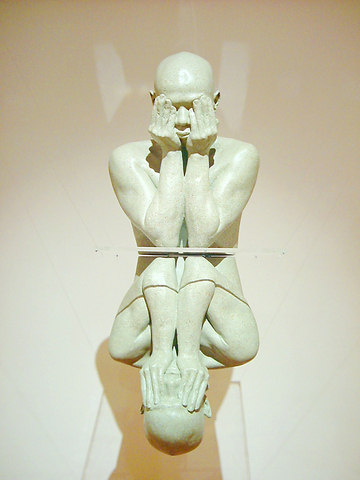
Even though the male figures aren't grappling with the stuff of legend, they do show that the everyday struggle of life is just as heroic.
In his sculptures of the female, Wang chooses a more sensuous approach. A large pair of voluptuous lips have engulfed and formed a protective shield for its resting female inhabitant. In a smaller sculpture, a nude reclining on a sofa seems to be sinking into the cushions becoming part of the furniture as both the figure and sofa merge and are painted a soft speckled green.
By contrast, painter Hua Chien-chiang's (
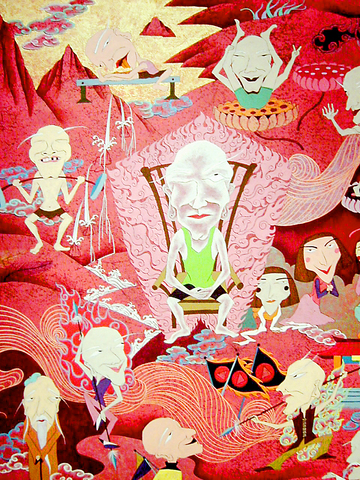
Hua's Chinese scrolls and small paintings are installed on fiery tomato-red walls that dramatically breathe exhilarating life into the exhibition space.
Each painting has its own unique palette of colors, mood and theme, yet each one contains a similar cast of cartoon-like characters that seem to channel the spirit of Bart Simpson and that unite the 31 paintings on view.
Using the vernacular of Buddhist iconographic painting, each scroll has a dominant male figure (think Mr Burns ) ensconced in a lotus-shaped platform. The perspective of the paintings, as in traditional Chinese scroll painting, shifts as there is no fixed horizon line, so that many of the elongated paintings must be looked at from top to bottom.
Using the traditional stylistic format with its mountain peaks, flowering blossoms and swirling clouds, Hua includes modern objects such as scooters, bulldozers, traffic, Walkmans and electrical transformers and makes references to pop culture to gently poke fun at contemporary Chinese life.
Some of the canvas texture looks like batik, and in some areas paint is splattered Pollock-style, showing that Hua is quite adept as a painter.
In Happy Birthday the same character seems to be congratulating and celebrating himself with great frivolity.
Whether tackling the seasons, relationship breakups, family life or the daily commute, Hua also shows that he is an astute observer of human nature as good satirists usually are.
Exhibition notes:
What: Space Imagination of the Human Body and Attain Holiness and Transcend Worldliness at Hong-Gah Museum
Where: 5F, 260 Daye Rd, Taipei (
When: Tuesday to Sunday 10:30am to 5:30pm, free admission. Until March 20th.
Tel: (02) 2595 7656
Information: http://www.hong-gah.org.tw

Last week Joseph Nye, the well-known China scholar, wrote on the Australian Strategic Policy Institute’s website about how war over Taiwan might be averted. He noted that years ago he was on a team that met with then-president Chen Shui-bian (陳水扁), “whose previous ‘unofficial’ visit to the US had caused a crisis in which China fired missiles into the sea and the US deployed carriers off the coast of Taiwan.” Yes, that’s right, mighty Chen caused that crisis all by himself. Neither the US nor the People’s Republic of China (PRC) exercised any agency. Nye then nostalgically invoked the comical specter
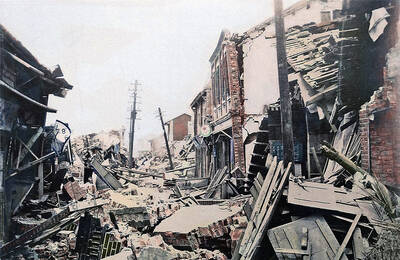
April 15 to April 21 Yang Kui (楊逵) was horrified as he drove past trucks, oxcarts and trolleys loaded with coffins on his way to Tuntzechiao (屯子腳), which he heard had been completely destroyed. The friend he came to check on was safe, but most residents were suffering in the town hit the hardest by the 7.1-magnitude Hsinchu-Taichung Earthquake on April 21, 1935. It remains the deadliest in Taiwan’s recorded history, claiming around 3,300 lives and injuring nearly 12,000. The disaster completely flattened roughly 18,000 houses and damaged countless more. The social activist and

Over the course of former President Ma Ying-jeou’s (馬英九) 11-day trip to China that included a meeting with Chinese Communist Party (CCP) leader Xi Jinping (習近平) a surprising number of people commented that the former president was now “irrelevant.” Upon reflection, it became apparent that these comments were coming from pro-Taiwan, pan-green supporters and they were expressing what they hoped was the case, rather than the reality. Ma’s ideology is so pro-China (read: deep blue) and controversial that many in his own Chinese Nationalist Party (KMT) hope he retires quickly, or at least refrains from speaking on some subjects. Regardless

Approaching her mid-30s, Xiong Yidan reckons that most of her friends are on to their second or even third babies. But Xiong has more than a dozen. There is Lucky, the street dog from Bangkok who jumped into a taxi with her and never left. There is Sophie and Ben, sibling geese, who honk from morning to night. Boop and Pan, both goats, are romantically involved. Dumpling the hedgehog enjoys a belly rub from time to time. The list goes on. Xiong nurtures her brood from her 8,000 square meter farm in Chiang Dao, a mountainous district in northern Thailand’s


 RSS
RSS