


Early last year Taipei Fine Arts Museum (TFAM) director Huang Tsai-lang (
The purpose of the experiment was to produce a contemporary art environment that both the visually impaired and general public could enjoy. In the process, each of the artists created an installation that utilizes smell, sound and touch either alone or in combinations, the results of which are on display in the TFAM Exhibition Hall for the next two months.

PHOTO COURTESY OF TFAM
Lots o'LOTTO: Seen and Unseen combines the effort of five artists organized and sponsored by both the museum and the Lottery Technology Services Corporation. Before beginning their individual projects, the artists collaborated with representatives from the National Blind Association on an underlying concept for the exhibition.
Although each piece is unique to the artist who constructed it, there is a garden theme underlying the show. Astroturf, pink inflatable palm trees and tunnel walkways are used to bridge each work. The end result is that the exhibition resembles a miniature golf course rather than a garden of art. At the entrance of the Exhibition Hall is a dark tunnel that serves as a reminder to sighted visitors to leave behind their dependency on vision in order to appreciate what lies ahead.
Wu Ma-li's (吳瑪俐) Ping Ping Pong Pong is a variation of a table tennis game designed for the visually impaired. It requires sighted visitors to wear eye masks and develop their sense of hearing while playing.
Next to Wu's table game is Chen Kai-huang's (
Sound is explored with a trip down Wang Jun-jieh's (王俊傑) narrow tunnel lined with 20 speakers, each broadcasting a pre-recorded message. The wall of noise is overwhelming upon first entering the tunnel, but is muted as the listener's ears adjust and begin to identify the different sounds. The theme of sound is equally vital to the video-installation titled Do Re Mi Fa So by Chen Cheng-tsai (陳正才). Screened in a Japanese-style tatami room, the hour long documentary focuses on a blind piano tuner.
Throughout the exhibition hall is an overpowering scent of roasting coffee beans, emanating from an installation designed by Wang Te-yu (
First impressions at the opening were slightly disappointing. Although the theme is well explored, it only satisfies one's aesthetic appetite for a short period of time, leaving viewers hungry for something more substantial.
Perhaps it is vision that impedes appreciation of this exhibit. Apart from conceptual art, most mediums rely, at least to some extent, on a viewer actually looking at the work in order to appreciate the concepts being conveyed.
This doesn't assume that the visually impaired are unable to appreciate contemporary art, but that perhaps sighted individuals are incapable of viewing art any other way.
Exhibition notes:
What: Lots o'LOTTO Seen and Unseen (
Where: In the Exhibition Hall of the Taipei Fine Arts Museum (
When: 9:30am to 5:30pm, Tuesday to Sunday (closed Mondays). Until May 1.
Telephone: (02) 2595 7656

In late October of 1873 the government of Japan decided against sending a military expedition to Korea to force that nation to open trade relations. Across the government supporters of the expedition resigned immediately. The spectacle of revolt by disaffected samurai began to loom over Japanese politics. In January of 1874 disaffected samurai attacked a senior minister in Tokyo. A month later, a group of pro-Korea expedition and anti-foreign elements from Saga prefecture in Kyushu revolted, driven in part by high food prices stemming from poor harvests. Their leader, according to Edward Drea’s classic Japan’s Imperial Army, was a samurai

Located down a sideroad in old Wanhua District (萬華區), Waley Art (水谷藝術) has an established reputation for curating some of the more provocative indie art exhibitions in Taipei. And this month is no exception. Beyond the innocuous facade of a shophouse, the full three stories of the gallery space (including the basement) have been taken over by photographs, installation videos and abstract images courtesy of two creatives who hail from the opposite ends of the earth, Taiwan’s Hsu Yi-ting (許懿婷) and Germany’s Benjamin Janzen. “In 2019, I had an art residency in Europe,” Hsu says. “I met Benjamin in the lobby
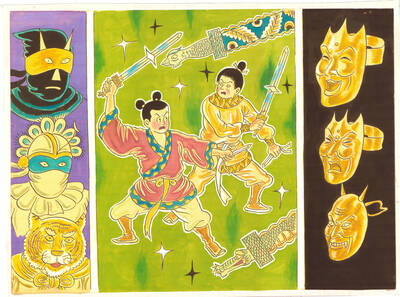
April 22 to April 28 The true identity of the mastermind behind the Demon Gang (魔鬼黨) was undoubtedly on the minds of countless schoolchildren in late 1958. In the days leading up to the big reveal, more than 10,000 guesses were sent to Ta Hwa Publishing Co (大華文化社) for a chance to win prizes. The smash success of the comic series Great Battle Against the Demon Gang (大戰魔鬼黨) came as a surprise to author Yeh Hung-chia (葉宏甲), who had long given up on his dream after being jailed for 10 months in 1947 over political cartoons. Protagonist

Peter Brighton was amazed when he found the giant jackfruit. He had been watching it grow on his farm in far north Queensland, and when it came time to pick it from the tree, it was so heavy it needed two people to do the job. “I was surprised when we cut it off and felt how heavy it was,” he says. “I grabbed it and my wife cut it — couldn’t do it by myself, it took two of us.” Weighing in at 45 kilograms, it is the heaviest jackfruit that Brighton has ever grown on his tropical fruit farm, located


 RSS
RSS