


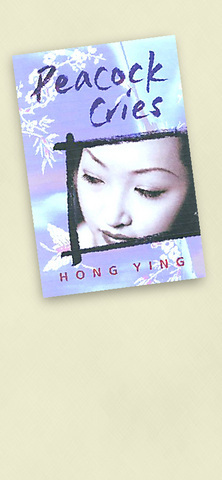
This is the paperback edition of the latest novel by China-born Hong Ying, the young author whose K: The Art of Love, featuring Bloomsbury Group off-shoot Julian Bell's life and loves in 1930s China, was reviewed in Taipei Times on Nov. 21, last year.
Though Hong Ying now spends much of her year in London, Peacock Cries is a unique insider's view of modern China, on psychological, political and even spiritual levels. Set in the context of the gigantic Three Gorges Dam project, its doubts and general angst rumble on until the closing pages, which then finally offer some possibility for peace.
The female narrator, a high-flying geneticist, leads a privileged life, but she also has a troubled marriage to dam project director Li Lusheng. His massive responsibilities provide headaches to accompany his status. Besides the technical aspects of the project -- electricity generation, flood and subsidence prevention -- his remit is also to organize resettlement funds for communities whose homes are to be lost as a result of the flooding of the Yangtze. He is therefore not only a man with little time to spare, he's also more than usually dependent on his wife's support, including her presence at banquets and prestigious conferences.
Initially suspicious of her husband, the narrator disdainfully endures the deference and protocol-observation required by the cadres as she takes in their propaganda in a state of silent disenchantment.
Once in Liang County, site of the project, she notes the contrast between the Old City and the New City, the one filthy and ramshackle, the other modern, pristine and sanitized. Taking in the volume of garbage, much of it already in the Yangtze -- the floating plastic and chunks of foam, even the occasional discarded mattress -- she imagines how much more there will be when the reservoir is finished, and how long it'll remain there before it finds its way to the sea. Feeling that her husband should have done something about this before proclaiming his much vaunted "environmentally friendly beautification" policy, her sense that things in life are not always what they seem starts to seep into every aspect of the book.
The rumor, for instance, that certain officials have been lining their pockets with embezzled dam project funds serves to transform her personal mistrust, plus her insecurity about the future of her marriage, into something more universal -- outrage at the fate of the people whose lives are to undergo such a radical upheaval.
An overnight stay with her mother then yields vital insights into elements of her past. She learns that her mother and Auntie Chen, a family friend, gave birth at around the same time, just as a notorious prostitute, Red Lotus, was found in the act of fornication with a monk and both were executed. Auntie Chen's son, Yueming, is nowadays struggling to make a living as an artist, but his main source of income comes from producing formulaic paintings for the tourist market, whereas his other work, which he does secretly and purely for love, impresses the narrator with its genuine artistic vitality. She experiences a moment of revelation when it strikes her that the executed lovers have perhaps been reincarnated as herself and Yueming.
They meet again, at a time when Yueming is trying to present a petition to an official about provision for the education of resettled families. The animated crowd grows more vocal and before they know it everyone involved is placed under arrest. It's at this point that the narrator's anger finds a new purpose. Now aroused and furious, she demands to know the officials' definition of "troublemakers" and their grounds for beating up such supposed miscreants. When she discovers that the police cell that held them overnight was the same place where the doomed lovers were incarcerated a generation before, she feels there's an even stronger bond between her and Auntie Chen's family.
Both her father and Auntie Chen's husband were, for instance, stripped of their Communist Party rank, and while the narrator's mother fares better than Auntie Chen (her husband was subsequently reinstated), the latter can now barely make ends meet, especially with a husband urgently in need of an operation for stomach cancer. Fueled by concern for the family's future, Yueming's in particular, the narrator pays the hospital for the operation.
By now permanently in a near-visionary state, she achieves a truce of sorts and a deeper sense of peace with her husband. In one last meeting with Yueming on the dam site she asks him what he thinks the area will be like in 2,000 years.
He replies, mysteriously, as follows: "I was just thinking of that beautiful gold peacock lampholder which I was so fortunate to see. Two thousand years old and so exquisite -- and to think that it was made for a practical purpose as well!"
"You mean that we will be peacocks in 2,000 years?" the narrator asks.
"If we're lucky," replies Yueming smiling. "It was almost," the author adds, "as if he could actually see that far-off day." Hong Ying here appears to be toying with the possibility of a real and actual transmigration of souls.
In this spirited account of life on the world's biggest construction site (perceived by ecologists and many others, of course, as a wildly arrogant undertaking), past, present and future are blended together, as are politics and mysticism, personal ambition and collective striving, plus the fate of two families. It's an arena where things usually perceived as contraries meet -- genetics and reincarnation, deference and brutality, anger and forgiveness. In the last analysis it is Hong Ying's vitality -- notably her indignation and her questfulness - -- that infuses this tale, in many other ways so realistic and practical, with a sense, at the close, almost of enlightenment.

In late October of 1873 the government of Japan decided against sending a military expedition to Korea to force that nation to open trade relations. Across the government supporters of the expedition resigned immediately. The spectacle of revolt by disaffected samurai began to loom over Japanese politics. In January of 1874 disaffected samurai attacked a senior minister in Tokyo. A month later, a group of pro-Korea expedition and anti-foreign elements from Saga prefecture in Kyushu revolted, driven in part by high food prices stemming from poor harvests. Their leader, according to Edward Drea’s classic Japan’s Imperial Army, was a samurai

The following three paragraphs are just some of what the local Chinese-language press is reporting on breathlessly and following every twist and turn with the eagerness of a soap opera fan. For many English-language readers, it probably comes across as incomprehensibly opaque, so bear with me briefly dear reader: To the surprise of many, former pop singer and Democratic Progressive Party (DPP) ex-lawmaker Yu Tien (余天) of the Taiwan Normal Country Promotion Association (TNCPA) at the last minute dropped out of the running for committee chair of the DPP’s New Taipei City chapter, paving the way for DPP legislator Su
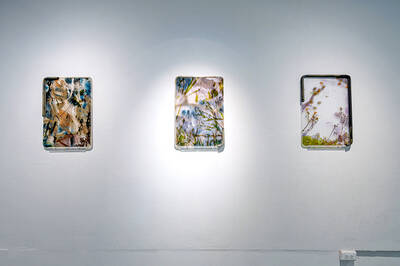
Located down a sideroad in old Wanhua District (萬華區), Waley Art (水谷藝術) has an established reputation for curating some of the more provocative indie art exhibitions in Taipei. And this month is no exception. Beyond the innocuous facade of a shophouse, the full three stories of the gallery space (including the basement) have been taken over by photographs, installation videos and abstract images courtesy of two creatives who hail from the opposite ends of the earth, Taiwan’s Hsu Yi-ting (許懿婷) and Germany’s Benjamin Janzen. “In 2019, I had an art residency in Europe,” Hsu says. “I met Benjamin in the lobby
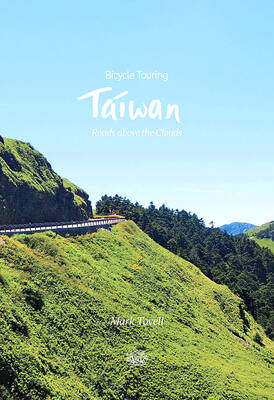
It’s hard to know where to begin with Mark Tovell’s Taiwan: Roads Above the Clouds. Having published a travelogue myself, as well as having contributed to several guidebooks, at first glance Tovell’s book appears to inhabit a middle ground — the kind of hard-to-sell nowheresville publishers detest. Leaf through the pages and you’ll find them suffuse with the purple prose best associated with travel literature: “When the sun is low on a warm, clear morning, and with the heat already rising, we stand at the riverside bike path leading south from Sanxia’s old cobble streets.” Hardly the stuff of your


 RSS
RSS