


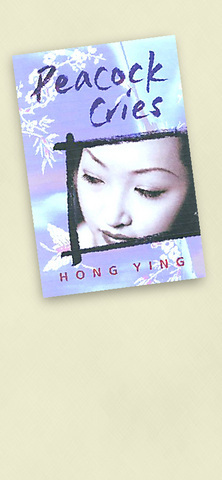
This is the paperback edition of the latest novel by China-born Hong Ying, the young author whose K: The Art of Love, featuring Bloomsbury Group off-shoot Julian Bell's life and loves in 1930s China, was reviewed in Taipei Times on Nov. 21, last year.
Though Hong Ying now spends much of her year in London, Peacock Cries is a unique insider's view of modern China, on psychological, political and even spiritual levels. Set in the context of the gigantic Three Gorges Dam project, its doubts and general angst rumble on until the closing pages, which then finally offer some possibility for peace.
The female narrator, a high-flying geneticist, leads a privileged life, but she also has a troubled marriage to dam project director Li Lusheng. His massive responsibilities provide headaches to accompany his status. Besides the technical aspects of the project -- electricity generation, flood and subsidence prevention -- his remit is also to organize resettlement funds for communities whose homes are to be lost as a result of the flooding of the Yangtze. He is therefore not only a man with little time to spare, he's also more than usually dependent on his wife's support, including her presence at banquets and prestigious conferences.
Initially suspicious of her husband, the narrator disdainfully endures the deference and protocol-observation required by the cadres as she takes in their propaganda in a state of silent disenchantment.
Once in Liang County, site of the project, she notes the contrast between the Old City and the New City, the one filthy and ramshackle, the other modern, pristine and sanitized. Taking in the volume of garbage, much of it already in the Yangtze -- the floating plastic and chunks of foam, even the occasional discarded mattress -- she imagines how much more there will be when the reservoir is finished, and how long it'll remain there before it finds its way to the sea. Feeling that her husband should have done something about this before proclaiming his much vaunted "environmentally friendly beautification" policy, her sense that things in life are not always what they seem starts to seep into every aspect of the book.
The rumor, for instance, that certain officials have been lining their pockets with embezzled dam project funds serves to transform her personal mistrust, plus her insecurity about the future of her marriage, into something more universal -- outrage at the fate of the people whose lives are to undergo such a radical upheaval.
An overnight stay with her mother then yields vital insights into elements of her past. She learns that her mother and Auntie Chen, a family friend, gave birth at around the same time, just as a notorious prostitute, Red Lotus, was found in the act of fornication with a monk and both were executed. Auntie Chen's son, Yueming, is nowadays struggling to make a living as an artist, but his main source of income comes from producing formulaic paintings for the tourist market, whereas his other work, which he does secretly and purely for love, impresses the narrator with its genuine artistic vitality. She experiences a moment of revelation when it strikes her that the executed lovers have perhaps been reincarnated as herself and Yueming.
They meet again, at a time when Yueming is trying to present a petition to an official about provision for the education of resettled families. The animated crowd grows more vocal and before they know it everyone involved is placed under arrest. It's at this point that the narrator's anger finds a new purpose. Now aroused and furious, she demands to know the officials' definition of "troublemakers" and their grounds for beating up such supposed miscreants. When she discovers that the police cell that held them overnight was the same place where the doomed lovers were incarcerated a generation before, she feels there's an even stronger bond between her and Auntie Chen's family.
Both her father and Auntie Chen's husband were, for instance, stripped of their Communist Party rank, and while the narrator's mother fares better than Auntie Chen (her husband was subsequently reinstated), the latter can now barely make ends meet, especially with a husband urgently in need of an operation for stomach cancer. Fueled by concern for the family's future, Yueming's in particular, the narrator pays the hospital for the operation.
By now permanently in a near-visionary state, she achieves a truce of sorts and a deeper sense of peace with her husband. In one last meeting with Yueming on the dam site she asks him what he thinks the area will be like in 2,000 years.
He replies, mysteriously, as follows: "I was just thinking of that beautiful gold peacock lampholder which I was so fortunate to see. Two thousand years old and so exquisite -- and to think that it was made for a practical purpose as well!"
"You mean that we will be peacocks in 2,000 years?" the narrator asks.
"If we're lucky," replies Yueming smiling. "It was almost," the author adds, "as if he could actually see that far-off day." Hong Ying here appears to be toying with the possibility of a real and actual transmigration of souls.
In this spirited account of life on the world's biggest construction site (perceived by ecologists and many others, of course, as a wildly arrogant undertaking), past, present and future are blended together, as are politics and mysticism, personal ambition and collective striving, plus the fate of two families. It's an arena where things usually perceived as contraries meet -- genetics and reincarnation, deference and brutality, anger and forgiveness. In the last analysis it is Hong Ying's vitality -- notably her indignation and her questfulness - -- that infuses this tale, in many other ways so realistic and practical, with a sense, at the close, almost of enlightenment.

Last week Joseph Nye, the well-known China scholar, wrote on the Australian Strategic Policy Institute’s website about how war over Taiwan might be averted. He noted that years ago he was on a team that met with then-president Chen Shui-bian (陳水扁), “whose previous ‘unofficial’ visit to the US had caused a crisis in which China fired missiles into the sea and the US deployed carriers off the coast of Taiwan.” Yes, that’s right, mighty Chen caused that crisis all by himself. Neither the US nor the People’s Republic of China (PRC) exercised any agency. Nye then nostalgically invoked the comical specter
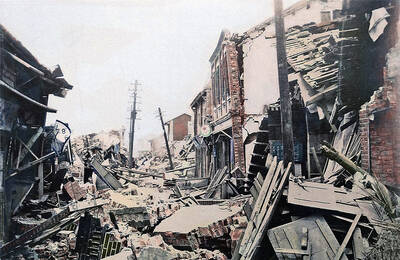
April 15 to April 21 Yang Kui (楊逵) was horrified as he drove past trucks, oxcarts and trolleys loaded with coffins on his way to Tuntzechiao (屯子腳), which he heard had been completely destroyed. The friend he came to check on was safe, but most residents were suffering in the town hit the hardest by the 7.1-magnitude Hsinchu-Taichung Earthquake on April 21, 1935. It remains the deadliest in Taiwan’s recorded history, claiming around 3,300 lives and injuring nearly 12,000. The disaster completely flattened roughly 18,000 houses and damaged countless more. The social activist and

Over the course of former President Ma Ying-jeou’s (馬英九) 11-day trip to China that included a meeting with Chinese Communist Party (CCP) leader Xi Jinping (習近平) a surprising number of people commented that the former president was now “irrelevant.” Upon reflection, it became apparent that these comments were coming from pro-Taiwan, pan-green supporters and they were expressing what they hoped was the case, rather than the reality. Ma’s ideology is so pro-China (read: deep blue) and controversial that many in his own Chinese Nationalist Party (KMT) hope he retires quickly, or at least refrains from speaking on some subjects. Regardless

Approaching her mid-30s, Xiong Yidan reckons that most of her friends are on to their second or even third babies. But Xiong has more than a dozen. There is Lucky, the street dog from Bangkok who jumped into a taxi with her and never left. There is Sophie and Ben, sibling geese, who honk from morning to night. Boop and Pan, both goats, are romantically involved. Dumpling the hedgehog enjoys a belly rub from time to time. The list goes on. Xiong nurtures her brood from her 8,000 square meter farm in Chiang Dao, a mountainous district in northern Thailand’s


 RSS
RSS