


Taiwan's Directorate General of Budget, Accounting and Statistics released an interesting figure in the middle of this month claiming that, of 12 countries, Taiwan led the world with the most cellular phone subscribers -- 111 per 100 people.
While the report didn't elaborate on the reasons for this seemingly implausible statistic, an informal survey of carriers suggests it has to do with the fact that many small businesses have a cellphone number as their main line to the outside world.
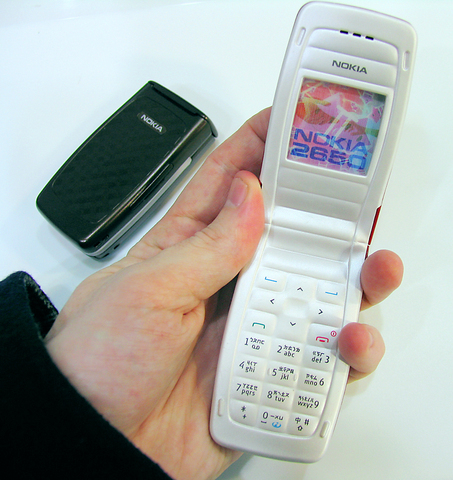
PHOTO: DAVID MOMPHARD, TAIPEI TIMES
"A lot of people have one number that services their business and another number for their personal cellphone," said a representative with the carrier FarEastTone.
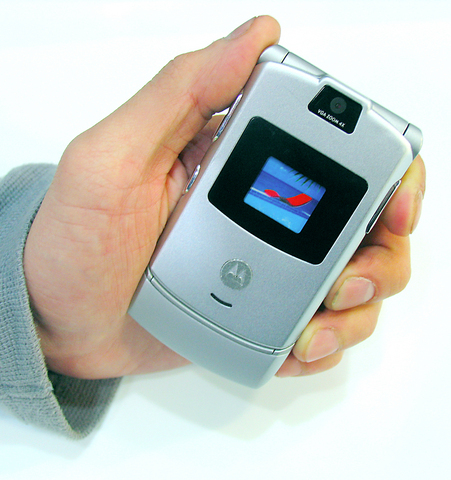
PHOTO: DAVID MOMPHARD, TAIPEI TIMES
And though many cellphones can accommodate two lines, users are just as likely to carry two phones.
Given this, Taiwan might also lead the world in the highest number of phones per capita. Time then to take a look at some of the models clipped to local belts and tucked inside local pants' pockets. Another informal survey, this time of cellphone salespeople, suggests that the models most popular among the populace are Motorola phones.
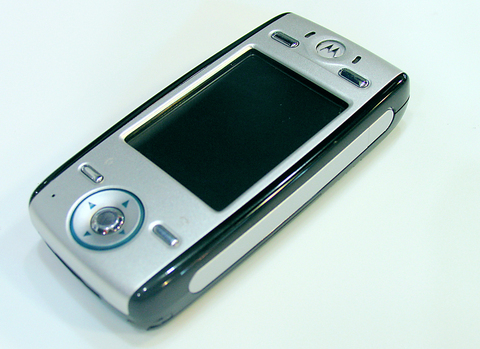
PHOTO: DAVID MOMPHARD, TAIPEI TIMES
This is casual confirmation of the company's own claim to have nearly one half of the cellphone market in Taiwan, and it's not surprising, given the number of Motorola V505s and V600s you see people fidgeting with on buses or at bars.
The phones have been among the best-selling in Taiwan for packing in a lot of functions for business-centric users and a lot of style options for the fashion conscious.
It has to be said the "domino-effect" plays a great part in the success of these and other models. Good word of mouth moves more quickly than any other kind of review. Word of mouth is also helping to sell Motorola's latest model, the V3.
The V3 owes its design aesthetic to laptop computers, specifically Apple' s Macintosh PowerBooks. Encased in anodized aluminum, it looks much like a Mac in miniature, save that it has a screen on the front that displays a photo of whoever is calling as well as other programmable information.
Open it up to reveal its chemically-etched touchpad, which resembles nothing so much as a computer interface found on the starship Enterprise -- Next Generation, of course. Of all the models currently on the market, it probably induces the most envy.
The V3 is also getting lots of good press, not the least of which was a runner-up award from Wallpaper magazine for gadget of the year (It lost out to Apple's iPod Mini).
Design aside, the V3 has a lot of functionality as well and packs in many features you won't find in other cellphones. But at more than NT$20,000, it better. That price tag has likely kept a lot of the model's good word of mouth to a minimum.
Less expensive, albeit less enviable, is Motorola's E680. It's not a "clamshell" phone and lacks the design savvy of the V3, but it packs features on the same footing with the V3. And, as one of the better-selling smart phones in Taiwan, it presents those features more stunningly than any phone in its class.
The first thing you notice about the E680 is its large screen and lack of a type pad, leading you to think, at a glance, that it's some sort of hand-held video game. In fact, it is a hand-held video game and much more; capable of downloading Quicktime movies, carrying a virtual office, and playing MP3s.
In fact, the sound quality of the E680 is comparable to an iPod -- better considering it ships with earphones far superior to Apple's little white ear buds.
The E680 uses a stylus in lieu of a keypad, making it a two-handed phone. It' s also fairly heavy, but at NT$13,000 its price is much lighter than the V3's.
There is another model rapidly networking its way into Taiwan's cool set, according to cellphone sales clerks -- Nokia's 2650. The reason for this are simple. Clamshell-style phones have long been the preferred model among Taiwanese; Nokia has held the number two spot in Taiwan's cellphone market, and the 2650 is among the company's first clamshell offerings.
"I used to sell Motorola exclusively," said Fu Jia-wei (傅家瑋), who owns a west-side cellphone dealership, "but I began selling Nokia shortly after they began offering a line of clamshell phones. The 2650 is probably my best-seller right now."
But the reasons for the phone's popularity are also a matter of simple math: It costs just NT$4,200. At that price, and given Nokia's famed easy-to-use interface, it's destined to be the company's next workhorse model.
One last note about upgrading phones -- or buying a second model to accommodate your business phone line: If you're unhappy with your current phone because of poor reception, remember that this usually has more to do with your carrier than with the phone itself, particularly if your phone is a newer model.
In Taiwan, Chunghwa Telecom has more transmission towers than any other carrier and is often the only service that will give you a signal in remote spots of the island's interior. Climb to the top of Jade Mountain with your Chunghwa Telecom-serviced phone and you'll be popular among fellow travelers who have no reception.
For this reason, picking a good cellular service is actually the first step to picking a good cellphone. A NT$20,000 Motorola V3 with all its fancy functions becomes an anodized aluminum paperweight outside your coverage area.

In late October of 1873 the government of Japan decided against sending a military expedition to Korea to force that nation to open trade relations. Across the government supporters of the expedition resigned immediately. The spectacle of revolt by disaffected samurai began to loom over Japanese politics. In January of 1874 disaffected samurai attacked a senior minister in Tokyo. A month later, a group of pro-Korea expedition and anti-foreign elements from Saga prefecture in Kyushu revolted, driven in part by high food prices stemming from poor harvests. Their leader, according to Edward Drea’s classic Japan’s Imperial Army, was a samurai
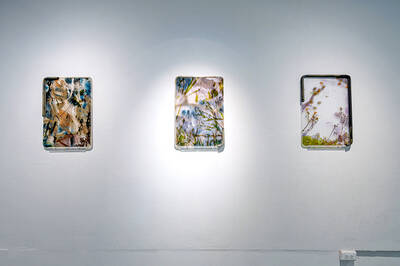
Located down a sideroad in old Wanhua District (萬華區), Waley Art (水谷藝術) has an established reputation for curating some of the more provocative indie art exhibitions in Taipei. And this month is no exception. Beyond the innocuous facade of a shophouse, the full three stories of the gallery space (including the basement) have been taken over by photographs, installation videos and abstract images courtesy of two creatives who hail from the opposite ends of the earth, Taiwan’s Hsu Yi-ting (許懿婷) and Germany’s Benjamin Janzen. “In 2019, I had an art residency in Europe,” Hsu says. “I met Benjamin in the lobby
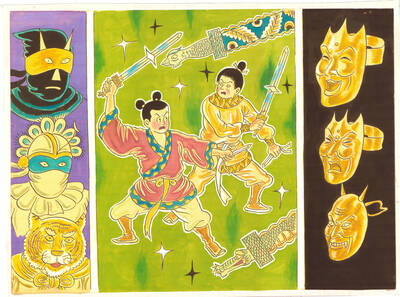
April 22 to April 28 The true identity of the mastermind behind the Demon Gang (魔鬼黨) was undoubtedly on the minds of countless schoolchildren in late 1958. In the days leading up to the big reveal, more than 10,000 guesses were sent to Ta Hwa Publishing Co (大華文化社) for a chance to win prizes. The smash success of the comic series Great Battle Against the Demon Gang (大戰魔鬼黨) came as a surprise to author Yeh Hung-chia (葉宏甲), who had long given up on his dream after being jailed for 10 months in 1947 over political cartoons. Protagonist

The following three paragraphs are just some of what the local Chinese-language press is reporting on breathlessly and following every twist and turn with the eagerness of a soap opera fan. For many English-language readers, it probably comes across as incomprehensibly opaque, so bear with me briefly dear reader: To the surprise of many, former pop singer and Democratic Progressive Party (DPP) ex-lawmaker Yu Tien (余天) of the Taiwan Normal Country Promotion Association (TNCPA) at the last minute dropped out of the running for committee chair of the DPP’s New Taipei City chapter, paving the way for DPP legislator Su


 RSS
RSS