


The dance style known as butoh emerged in the 1950s and 1960s as a highly original and local Japanese form. Very quickly, however, it became known, talked about and rhapsodized over in cities and artistic centers from one end of the planet to the other. Indeed so many articles have now been written about that it is probably all but impossible to say anything new on the subject.
What did these shaved, unsmiling, caterpillar-like figures -- covered from head to toe in white body paint and moving frequently in silence -- represent? People called it post-Hiroshima, post-humanistic and (rather often) post-human dance. It was mesmeric to watch once you slowed down your bio-rhythms, but its silences and its general sense of a pre-verbal mute numbness gave rise to excited chatter that, though it has inevitably lessened, was full of a puzzled, awed expectation.
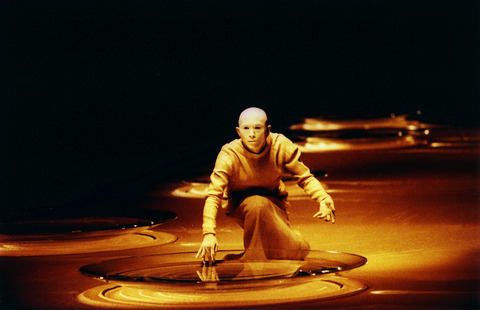
Founded in 1975 by its present director Ushio Amagatsu, Sankai Juku is, strictly speaking, second-generation butoh. The company has, nonetheless, established a worldwide following and has worked with highly prestigious artists such as composer Philip Glass. It claims to have performed over the last 30 years in 700 cities in 40 countries and has an especially strong association with Paris where many of its shows have premiered at the Theatre de la Ville. The company was last in Taipei in 1996 and before that in 1994.
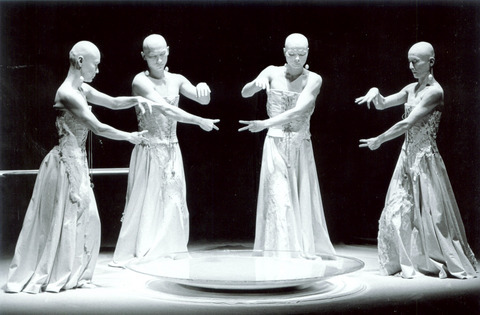
PHOTO COURTESY OF THE NATIONAL THEATRE
This time it's bringing a show called Hibiki: Resonance of Far Away (
A concise and accurate encapsulation of the nature of butoh is to see it as an attempt to recapture the shamanistic origins of the Japanese performing arts and rearticulate them as modern art. As a single-sentence definition this can hardly be bettered.
Japanese theater appears to have begun as an invitation to the gods to descend into the temple at festival time. Balinese dance to this day has exactly the same function, and Greek tragedy, too, began as ritual dance for the benefit of the god in the temples of Dionysus. The above explanation therefore appears beyond dispute. Far more extravagant descriptions and attempts at interpretation have flourished, nonetheless.
Butoh saw the return to the modern Japanese stage of the demons, ghosts and gods that had been banished by a Western socially-based, rational theater deriving from Henrik Ibsen. "To make gestures of the dead, to die again, to make the dead re-enact once more their deaths in their entirety -- these are what I want to experience within me." So wrote Hijikata Tatsumi, one of the style's pioneering choreographers.
It is a dance-form of terrible beauty: mysterious, simultaneously erotic and impersonal. Harmony alternates with rupture, slow-motion with violence. Figures resembling white maggots slowly writhe, then are suddenly and inexplicably stimulated to a vigorous squirming movement.
The appeal is essentially hypnotic and sub-rational. Japanese art has at all historical periods been rated as strange, remote and exotic by outsiders, but when it first appeared butoh dance was considered stranger by far than anything that had gone before. It could indeed be seen, as Hijikata had said, as bodies called forth from the morgue to re-enact their demise.
The critics and artistic gurus of Paris, Rome and New York had a field day. "One of the most original and startling dance theater groups," raved the New York Times about Sankai Juku. Brutalistic yet flowing, insect-like yet supple, savage yet svelte, emotionless yet steeped in an intense passivity -- paradoxes such as these seemed to characterize the puzzled yet fascinated reactions. Was it a form of Asiatic sorcery? Was it a totally new art form centered around "that absurd creature called Man?" Certainly, anything further removed from ballerinas pirouetting on tiptoe was impossible to imagine.
Botoh nonetheless shared with much 20th century art the desire to dissociate itself from the humane, liberal and carefully-considered traditions of earlier centuries. Instead, it wanted to go back to the primitive, the instinctual, the pre-rational. It wanted to awe, to perplex and to amaze. Western artists from Pablo Picasso to DH Lawrence had had similar preoccupations. But in most earlier artists, human concerns were interwoven with the return to the primeval. In butoh, by contrast, there was little evidence of such compromise.
Of course there were, and are, some conventional theatrical elements in any butoh performance. The lighting, for instance, is invariably dramatic, highlighting the figures in a way that is common to all strong theater. And the progress of the performance is far from shapeless -- instead, it rises to a climax and then falls away, just as in almost all dramatic displays. It is not without progression, in other words, as is, for instance, Tibetan or Korean temple chanting.
Sankai Juku's visit to Taiwan is not to be missed. It may be argued by connoisseurs that this is commercial butoh, that it has been too widely seen by now, and is too popular to be any longer at the cutting edge of anything.
But there is another, contrasting argument. This is that the finest art retains its quality, which doesn't diminish with time. One day Sankai Juku and its performers will be no more. They will have vanished back into the tomb from which, to some, they appear to have only recently emerged. So go and see them if you can. They can be guaranteed to provide an experience not to be measured in monetary terms.
One final point. The absence of women performers has, by and large, been a consistent element of butoh. There will be six performers in Hibiki in Taipei this weekend. All of them will be male.
Event Information:
What: Hibiki: Resonance of Far Away(
Where: The National Theatre, Taipei (
When: Tonight and tomorrow at 7:30pm, Sunday at 2:30pm.
Tickets: NT$600 to NT$3,000
Telephone: 2709-3788 for details. More information on the company can be found on www.sankaijuku.com.

“Taiwan’s Opposition Leader Comes to US With a Message Straight Out of Beijing” read a May 31 headline in the Wall Street Journal. Top US administration officials and members of Congress almost certainly read the WSJ, and if there was a bullet point takeaway that people in Washington should absorb ahead of Chinese Nationalist Party (KMT) Chair Cheng Li-wun’s (鄭麗文) arrival in DC on June 9, that headline is it. The last few columns have discussed this very topic, and the timing is not coincidental. While those top officials likely do not read the Taipei Times, judging by the number

With weighty, anxiety-inducing geopolitical topics dominating the headlines, checking in on the wild and weird state of local politics can take some of the edge off. This November’s elections will determine who will be in charge of fixing potholes in your neighborhood, not the potholes in Taiwan’s complicated geopolitical space. Recently, after an online interview with a Taipei-based journalist, I commented that Taipei journalists never go further than the MRT can take them. He laughed and agreed. Naturally, the Taipei mayoral race is eating up much of the press attention. TAIPEI CITY Democratic Progressive Party (DPP) candidate Puma Shen (沈伯洋) has
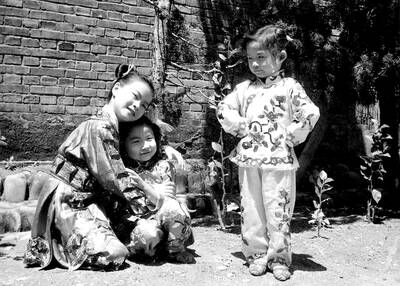
Audiences in Leicester, Cardiff, London and Sheffield will this month gather to watch a series of black-and-white Taiwanese-language films made more than 70 years ago. On the surface, these screenings commemorate the seventieth anniversary of taiyupian (台語片) — Taiwanese-language cinema. Yet the significance of these events extends far beyond nostalgia or film history. They represent a remarkable chapter in Taiwan’s ongoing effort to recover, preserve and reinterpret a cultural heritage that was once thought to have largely disappeared. The centerpiece of the program is the Ho Chi-ming (何基明) directed Xue Pinggui and Wang Baochuan (薛平貴與王寶釧), a film produced in 1955 and
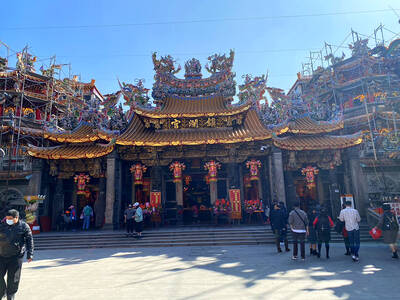
In December of 2008 Lee E-tin (李乙廷), a Miaoli county legislative hopeful, was convicted of vote-buying. Rather than buy votes retail, voter by voter, in the usual manner, Lee had done it wholesale, in a commendably efficient manner: he had visited local temples and made donations to gain their support. Because he did not normally make donations to temples, the court ruled he was attempting to improperly influence voter behavior. The case indicates how important temples are in influencing political life. Both judge and politician appeared to see them in the same way. Beijing sees them that way as well. Democratic Progressive


 RSS
RSS