


Legend has it that Palau used to consist of just two islands. A woman from one of the islands gave birth to a boy named Chuab who grew at an incredible pace into a giant and consumed all the food and some of the other children in his village.
The villagers became concerned about Chuab's appetite and decided to kill him. They built a bonfire, telling him it was in preparation for a special meal and tricked him into standing in the middle of it.

PHOTO: GRAHAM NORRIS, TAIPEI TIMES
The fire quickly engulfed him and killed him. Then, he fell into the water, and the parts of his body that protruded from the sea became the more than 300 islands that now make up this South Pacific paradise.
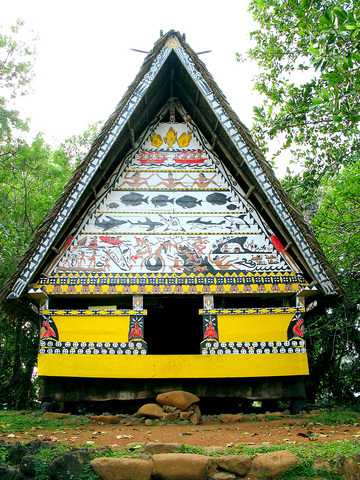
PHOTO: GRAHAM NORRIS, TAIPEI TIMES
Traditional -- if somewhat bizarre -- stories like this, as well as stunning scenery are attracting increasing numbers of Taiwanese looking for something unusual but not too far away.
Taiwanese have been visiting Palau for government and business purposes for many years, but in the past few years, Palau has experienced a flood of Taiwanese tourists.

PHOTO: GRAHAM NORRIS, TAIPEI TIMES
Palau is a lot closer than other popular destinations such as Bali, Thailand and Singapore. The convenience, along with the lure of azure waters and stunning natural scenery, drew more than 40,000 Taiwanese last year, nearly half the visitors to Palau.

PHOTO: GRAHAM NORRIS, TAIPEI TIMES
Next week, President Chen Shui-bian (陳水扁) will become the most high-profile Taiwanese to have made the three-and-a-half-hour flight.
For many Taiwanese, Palau might have been just another tiny country in the South Pacific they've never heard of were it not for the establishment of diplomatic ties in 1999 and the introduction of direct flights.
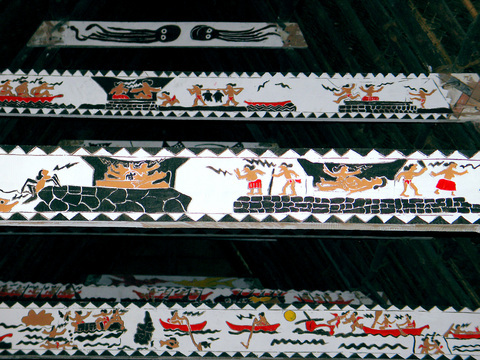
PHOTO: GRAHAM NORRIS, TAIPEI TIMES
The main attraction for many visitors is the diving. Palau is a volcanic peak poking up through the sea, and one of the most famous of the more than 50 diving locations is the Big Drop-Off, a 300m underwater cliff that offers divers amazing sights of colorful corals and reef animals. Those without the relevant licenses or inclination for diving can still enjoy Palau's fascinating marine habitats by snorkeling around the Rock Islands, numerous coral islets that host a wealth of colorful wildlife.
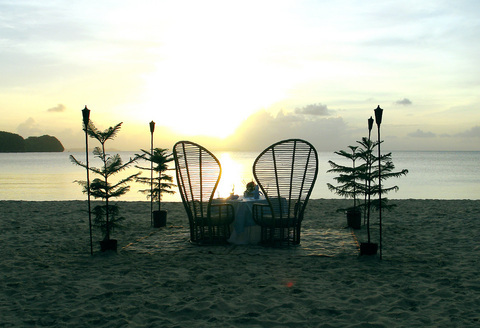
PHOTO: GRAHAM NORRIS, TAIPEI TIMES
Of course, most Taiwanese join tours, which usually include Palau's most famous sights. Hou Chi-chuan (侯啟全) and Deng Hsin-yi (鄧欣怡), for example, went to Palau for their honeymoon.
"We chose Palau because it seemed like a beautiful and relaxing place and a little more exotic than Europe," Hou said.
Deng said her favorite sights in Palau were the Big Drop-Off and Jellyfish Lake.
Hundreds of years ago a few jellyfish became trapped in a lagoon that was cut off from the sea. With no predators trapped with them, the jellyfish gradually lost their ability to sting, and tourists can now enjoy a surreal swim among thousands of their descendants.
Michael, a Taiwanese tour guide who has lived in Palau for the past two years, said Taiwanese like coming to Palau for the scenery and clear waters.
"People know that there are beautiful islands here and the water is very clear," he said. "It's very good for swimming and snorkeling."
People also come to find out about different cultures. Traditional Palauan culture was matrilineal, to a point. Men held the top positions in society, but they were all chosen by women. The Council of Chiefs was the main governing body in any village and they met in special halls called bai. The bai are one of the few places where Palau's history was recorded, in paintings on the beams.
Much of this traditional form of administration has been eroded by decades of domination by Western powers, evidence of which can be found around the islands.
The first significant contact with the West was in 1783, when British Captain Henry Wilson ran his ship aground off Ulong island. The locals helped Wilson repair his ship, and in return the captain took the local chief's son, Leeboo, to England for schooling. Leeboo died in England of smallpox, but he is remembered by a statue in the Palau Community College in the capital, Koror, as a symbol of bringing Western education to Palau.
From this benevolent first contact, Palau's relationship with the West took a turn for the worse. In 1885, Spain laid claim to the Caroline Islands, as they were then called, and missionaries got to work converting the population. Today, nearly half of all Palauans are Catholic.
Japan, which took over Palau after a brief spell of German rule, had a far greater impact than previous imperialists and turned the capital, Koror, into the center of its activities in the South Pacific.
The islands' population swelled to more than 40,000, of which just 10 percent were Palauans. The Japanese administration building in Koror is now the supreme court, and a Shinto shrine still exists in a nearby hamlet.
But it is evidence of the expulsion of the Japanese by the Americans in 1944 that is of interest to many visitors. Palau was a key part of the US invasion plan for Japan and was therefore fiercely defended by the Japanese. The battle dragged on for more than two months and destroyed most of the vegetation on the southern island of Peleliu and left more than 40 wrecked Japanese seaplanes and ships.
Nature has now taken hold of these machines of war and the Japanese fortifications and makes for fascinating dives and land tours. Some of the wrecks are in shallow waters that can even be viewed by snorkelers.
The most recent foreign influence on Palau comes from the US, which managed the islands from the end of World War II until independence in 1994. Palauan English has a distinct American twang, and many of the signs in Koror look like they were made in the US. The government is based on the US model and the currency is the US dollar.
Following years of occupation by Japan and the US, Palau is now independent, but Taiwan is making its mark. Three of the biggest hotels in Palau are run by Taiwanese, and Koror has a number of Taiwanese restaurants. There is even a First Commercial Bank in the city center.
One of the oldest hotels is the Airai View, built more than 20 years ago by the Japanese and now run by Taiwanese. It boasts Palau's largest storyboard, a 10m-long piece of wood with a story carved into it. The one at the Airai View tells a famous Palau legend about a woman who received an enchanted breadfruit tree from a deity. When a branch was cut, fish would rise through the tree's roots in the sea and come out of the branch. But jealous neighbors in the village cut the tree down and flooded the island forever. Apparently, evidence of the village can be found in the waters off the shores of Ngiwal Island.
Some locals complain that most of the tourist money goes back to Taiwan and that Taiwanese in tour groups don't venture into town on their own to buy souvenirs. But Jackson Henry, chairman of the Palau Visitors Authority, says things would be a lot worse without the Taiwanese.
"They fill the rooms in the hotels, and the hotels employ Palauans," he said. "And the hotels pay their taxes on time."
He said the Taiwanese investment in hotels was key to the sector's development, as Palauans simply didn't have access to the credit needed for such large projects.
He said the influence of the Taiwanese tourists was felt most clearly during the SARS epidemic in 2003, when flights were suspended from Taipei and the number of tourists fell from more than 2,000 a month to six.
"When they stop coming we feel it, the government feels it," he said.
When asked what he thought about the deluge of Taiwanese tourists, taxi driver Kuniwo Elewell said he welcomed them, but that he preferred the Japanese.
"The Japanese will pay the price you quote them, but the Taiwanese always want to bargain."
Palau:
Land Area: 500km2
Population: 18,000
Capital: Koror
Languages: Palauan and English spoken almost everywhere
Currency: US dollar (best to change money in Taiwan)
Flying time from Taipei: 3.5 hours
Price: NT$15,000-NT$25,000 for tour, depending on season, quality of hotel and number of people sharing a room
Visa: No visa required for Taiwan citizens or citizens of most Western countries
In late October of 1873 the government of Japan decided against sending a military expedition to Korea to force that nation to open trade relations. Across the government supporters of the expedition resigned immediately. The spectacle of revolt by disaffected samurai began to loom over Japanese politics. In January of 1874 disaffected samurai attacked a senior minister in Tokyo. A month later, a group of pro-Korea expedition and anti-foreign elements from Saga prefecture in Kyushu revolted, driven in part by high food prices stemming from poor harvests. Their leader, according to Edward Drea’s classic Japan’s Imperial Army, was a samurai

The following three paragraphs are just some of what the local Chinese-language press is reporting on breathlessly and following every twist and turn with the eagerness of a soap opera fan. For many English-language readers, it probably comes across as incomprehensibly opaque, so bear with me briefly dear reader: To the surprise of many, former pop singer and Democratic Progressive Party (DPP) ex-lawmaker Yu Tien (余天) of the Taiwan Normal Country Promotion Association (TNCPA) at the last minute dropped out of the running for committee chair of the DPP’s New Taipei City chapter, paving the way for DPP legislator Su
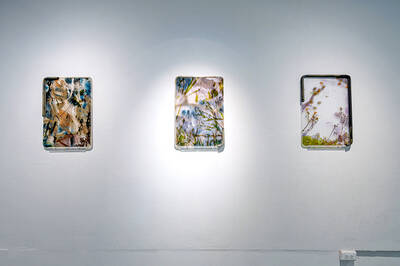
Located down a sideroad in old Wanhua District (萬華區), Waley Art (水谷藝術) has an established reputation for curating some of the more provocative indie art exhibitions in Taipei. And this month is no exception. Beyond the innocuous facade of a shophouse, the full three stories of the gallery space (including the basement) have been taken over by photographs, installation videos and abstract images courtesy of two creatives who hail from the opposite ends of the earth, Taiwan’s Hsu Yi-ting (許懿婷) and Germany’s Benjamin Janzen. “In 2019, I had an art residency in Europe,” Hsu says. “I met Benjamin in the lobby
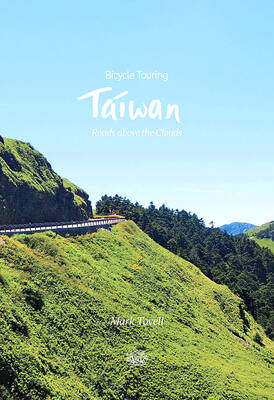
It’s hard to know where to begin with Mark Tovell’s Taiwan: Roads Above the Clouds. Having published a travelogue myself, as well as having contributed to several guidebooks, at first glance Tovell’s book appears to inhabit a middle ground — the kind of hard-to-sell nowheresville publishers detest. Leaf through the pages and you’ll find them suffuse with the purple prose best associated with travel literature: “When the sun is low on a warm, clear morning, and with the heat already rising, we stand at the riverside bike path leading south from Sanxia’s old cobble streets.” Hardly the stuff of your


 RSS
RSS