


Books and walking have a lot in common. Walking for its own sake, rather than as a means of getting somewhere, became popular in early 19th-century northern Europe, with writers eager to put themselves in closer contact with nature -- the source, they had come to believe, of the truest inspiration.
Still today, many people feel that walking is a form of therapy and its regular rhythms a form of meditation. It's healthy too. Hiking a set distance is apparently between two thirds and three quarters as beneficial to your system as jogging it.

Taipei is particularly fortunate for being surrounded by hills that, in the cooler winter months, provide an almost endless source of new outdoor experiences.
Englishman Richard Saunders has published two guides to day-trips on foot in the area, the first in 1998, which was re-issued last year in an expanded and improved edition. We will review this updated text later. Today we examine the second, newer volume.
One of the surprises of Taipei Day Trips 1 was the omission of Ta Tun Shan, the mountain that offers the most unspoiled hiking routes in the Yangmingshan area. But perhaps the author was saving it for the sequel, and here it is, with a long chapter close to the start of Taipei Day Trips 2.
Surprisingly, Saunders suggests a start at the fumarole on the side of Chihsing Shan (Seven Star Mountain). I've always found it better to take the S7 minibus from outside Peitou MRT Station which very conveniently takes you to the start of the trail to the Observation Platform overlooking the Danshui River estuary.
Alternatively, hikers can take the S6 from the same bus stop to its terminus at Ching Tien Temple, and from there do the hike over Ta Tun West Peak in the opposite direction (Saunders includes this route).
Either way it's a splendid three hours of walking, so long as you're happy negotiating some mildly slippery slopes with the aid of a couple of stalwart ropeways.
But Ta Tun Shan is only one of the 30 routes described in detail in this spectacularly useful book. Some of his day-trips take you much further afield. There's information on how to get to Paradise Valley -- not a valley at all but a grassy hilltop with extensive views -- and to the spectacular Turtle Mountain Island, both in Ilan County. Keelung Island is described as well. Then there's the trail inland from Fulong Beach to Shih Cheng, and even Fire Mountain in Miaoli County is included.
Other highlights for the intrepid are the airy heights of Wu Liao Chien (the less challenging, but still thrilling ridge of Huang Di Dien is described in the first volume), and the Pingxi Three Peaks in the Keelung River valley (best attempted in two trips, the author advises).
Historical details are also included so that you not only learn how to get to places, but something of their background as well. The history of Shih Men Reservoir in Taoyuan County, the origin of the standing stone on the way to Ta Tun Shan's Towards Heaven Pool, and the uses of the White Horse General Cave near Shen Keng are all there.
One of the greatest virtues of this magnificent book is its inclusion of place names in Chinese characters. This makes asking bus drivers to put you down where you want to be easy for non-Chinese speakers. Another attraction is that there's a general summary of the proposed walk before details of how to follow the trail are given. This way you can first get a general idea of the kind of excursion involved so you can then decide if it suits the time and energy you have at your disposal.
There's an appendix listing some recommended hot springs in the Taipei area (to list them all would, Saunders rightly says, be impossible). There is also a summary grading walks according to difficulty, giving their length, and advising on suitability for children and dogs.
It can't be overemphasized that the details provided in the book are exceptionally precise. Cross the road from the MRT station, he'll instruct, turn left, walk until you get to a pink building, then ascend the steps you find one minute's walk further to your right. After 10 minutes' climb, avoid an asphalt track to the left and continue up the paved route to the ridge. I've invented this, but it represents just the level of detail this book quite routinely includes.
All in all, this is a superb guidebook. There are 13 color photos (the rather murky black-and-white ones of the first volume have wisely been dispensed with). Yet, despite all the detail, Saunders still manages to make the tone of the text notably user-friendly. He hasn't only done a great deal of walking -- he also knows how to convey both his knowledge and his enthusiasm.
The happy result is that you can both enjoy this book when planning trips in advance and also rely on it to set your footsteps in the right direction on the trails themselves.
Few cities can claim such comprehensive, convenient and reliable handbooks to the hiking trails on their periphery. But then not many cities have wild countryside close at hand to the extent that Taipei has.

In late October of 1873 the government of Japan decided against sending a military expedition to Korea to force that nation to open trade relations. Across the government supporters of the expedition resigned immediately. The spectacle of revolt by disaffected samurai began to loom over Japanese politics. In January of 1874 disaffected samurai attacked a senior minister in Tokyo. A month later, a group of pro-Korea expedition and anti-foreign elements from Saga prefecture in Kyushu revolted, driven in part by high food prices stemming from poor harvests. Their leader, according to Edward Drea’s classic Japan’s Imperial Army, was a samurai

The following three paragraphs are just some of what the local Chinese-language press is reporting on breathlessly and following every twist and turn with the eagerness of a soap opera fan. For many English-language readers, it probably comes across as incomprehensibly opaque, so bear with me briefly dear reader: To the surprise of many, former pop singer and Democratic Progressive Party (DPP) ex-lawmaker Yu Tien (余天) of the Taiwan Normal Country Promotion Association (TNCPA) at the last minute dropped out of the running for committee chair of the DPP’s New Taipei City chapter, paving the way for DPP legislator Su

Located down a sideroad in old Wanhua District (萬華區), Waley Art (水谷藝術) has an established reputation for curating some of the more provocative indie art exhibitions in Taipei. And this month is no exception. Beyond the innocuous facade of a shophouse, the full three stories of the gallery space (including the basement) have been taken over by photographs, installation videos and abstract images courtesy of two creatives who hail from the opposite ends of the earth, Taiwan’s Hsu Yi-ting (許懿婷) and Germany’s Benjamin Janzen. “In 2019, I had an art residency in Europe,” Hsu says. “I met Benjamin in the lobby
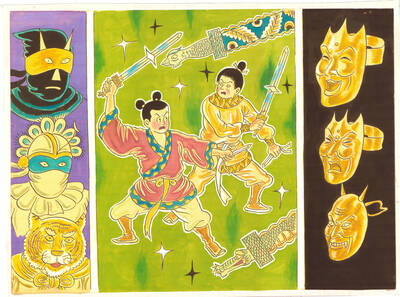
April 22 to April 28 The true identity of the mastermind behind the Demon Gang (魔鬼黨) was undoubtedly on the minds of countless schoolchildren in late 1958. In the days leading up to the big reveal, more than 10,000 guesses were sent to Ta Hwa Publishing Co (大華文化社) for a chance to win prizes. The smash success of the comic series Great Battle Against the Demon Gang (大戰魔鬼黨) came as a surprise to author Yeh Hung-chia (葉宏甲), who had long given up on his dream after being jailed for 10 months in 1947 over political cartoons. Protagonist


 RSS
RSS