


To millions of Americans, Botox is a magic bullet.
A few pinpricks and in a day the face is

PHOTOS: NY TIMES
returned to an approximation of its teenage

PHOTOS: NY TIMES
self, unlined and uninjured by the relentless insult of adult life.
But devotees of the youth potion were dismayed last week to learn that four people who went for wrinkle-smoothing treatments had been hospitalized for possible botulism poisoning.
There are many unanswered questions in the case. Investigators want to know whether a former osteopath in South Florida gave patients and himself injections of a bogus Botox, either homemade or illegally imported. (The former osteopath also fell ill.)
Botox, a toxin derivative that temporarily paralyzes tiny muscles that cause wrinkles, is manufactured by Allergan Inc, a California company. But doctors say there is a growing underground market for do-it-yourself and illegally imported or manufactured anti-aging compounds that are supposed to do what Botox does -- at a fraction of the cost -- but have not been approved for use in the US.
The Centers for Disease Control and Prevention, with the New Jersey and Florida health departments, are testing a Florida couple and the former doctor, along with an employee of the clinic, for botulism poisoning. Tim O'Connor, the spokesman for the Palm Beach County Health Department, said the Florida couple "exhibited all the signs of botulism" and had been treated with a botulism antidote.
Dr Leonard Hochstein, a plastic surgeon in Aventura, Florida, has administered Botox for five years and has not suspended its use because of the recent cases. He added, however, "I think there will be a reduction in interest in Botox, at least for a while. Anytime we have one of these nightmare knock-off do-it-yourself surgery scares, it affects all of us."
Allergan defended its popular product last week. A company spokeswoman, Stephanie Fagan, issued a statement saying that only two vials of Botox had been sold to the Advanced Integrated Medical Center in the last 12 months, enough for two to eight treatments. (A standard treatment in New York City would cost US$400 to US$1,000.) In an e-mail message, Fagan wrote that the company had investigated all the manufacturing and quality assurance processes and found no irregularities. No other doctors or patients have reported any other adverse events, she said.
The case came to the public's attention when Eric Kaplan, a South Florida chiropractor, and his wife, Bonnie, told doctors that they fell ill after they received shots they thought were Botox at the clinic in Oakland Park during Thanksgiving week. The Kaplans, who were admitted to Palm Beach Gardens Medical Center Nov. 26, were in serious but stable condition on Thursday.
Bach McComb, 47, the man they said injected them, was also hospitalized, along with his companion, Alma Hall. McComb, who has worked at the clinic, and Hall were admitted to the Bayonne Medical Center in Bayonne, New Jersey (McComb, who lives in Florida, had come to New Jersey to visit his mother.) Both spent at least part of last week on respirators. A man answering the phone at McComb's mother's house in Bayonne said she was too upset to speak. McComb was not available for comment.
O'Connor said Florida's health agency and the Centers for Disease Control were investigating what McComb might have injected the patients and himself with, whether Botox, a black-market or homemade formulation of botulinum, or something else.
Florence Evermon, Hall's sister, said on Thursday from her home in Georgia that doctors were optimistic. "She is young and healthy," she said. "And they think she's going to get well."
McComb had been licensed as an osteopathic physician, but his medical license was suspended by Florida in April last year after he was arrested by the Sarasota County sheriff's office on felony charges of trafficking in addictive pain medications, including Oxycodone. He is scheduled for trial in February.
He is known in cosmetic-surgery circles as an entrepreneur who has taught at seminars that claim to instruct doctors and others how to make their own cosmetic formulations, like collagen, a wrinkle filler, and botulinum toxin Type A, the toxin that is used in Botox, which is the trademark name for the formulation distributed by Allergan.
"No need for fancy equipment, sterile rooms, etc., most physicians already have all they need," proclaimed one flier sent to plastic surgeons in New York City last year, outlining promises for quick and easy profits. The fliers invited doctors and any of their staff members to two-day seminars where for US$1,150 they would learn to formulate anti-aging medications.
The seminars promised to teach "simple, safe and profitable" methods. "You can prepare hundreds of cubic centimeters of injectables at one time, in under an hour," the pamphlet reads, at costs of as little as US$1 a dose.
Zahra Karim and Chad Livdahl, naturopathic physicians who organized the conferences, did not respond to messages left with a receptionist at Powderz Inc., the Arizona company they founded.
In New York, Dr Michael Kane, a plastic surgeon and the author of The Botox Book (St. Martin's Press, 2002), bristled at the idea that people without medical degrees would attempt to make botulinum toxin or collagen.
"It's insane," Kane said. The environment and procedures used to make such pharmaceutical products, he added, "is far beyond the capabilities of a medical office, let alone people without medical degrees."
Although it is not known whether the four who fell ill were injected with a compound of McComb's making, they were clearly seeking a youthful appearance through pharmaceutical compounds. Since Botox was approved by the Food and Drug Administration in 2002 for cosmetic use in treating specific forehead wrinkles, sales have rocketed. Last year, Allergan sold US$564 million worth of Botox. As its popularity has grown so has the illegal market: Last year, an FDA investigation found black-market botulinum shipments coming from all over the world. Much comes from China, where botulinum toxin is sold under the brand names BTX-A and Botutox.
Kane and several other surgeons said they receive solicitations regularly from manufacturers promising cheap Botox and other products. One letter to Kane promised that Botutox "is better quality, better effect and lower price than Botox" and promised savings of 70 to 80 percent. (Botox costs doctors US$488 a vial.)
Another letter promised "a very stable clostridium botulinum toxin Type A." (In the fine print at the bottom of the pamphlet was the line, "Not for human use.") A phone call to its manufacturer, Toxin Research International, was answered by the same receptionist who answered the telephone for Powderz earlier in the day. She said she would convey another message to Karim and Livdahl. (Neither returned the call.) According to a report on Friday in The Sun-Sentinel of South Florida, paperwork and files from Toxin Research International were found at the clinic. A man who answered the phone and would not identify himself said he had no comment.
Dr Michelle Copeland, a New York plastic surgeon, said that she regularly receives such faxes.
"You know it's fake," Copeland said. "It's so inexpensive. I don't know where it's coming from. I would never buy it."
Allergan sells Botox only to licensed health care professionals, according to Fagan. But Advanced Integrated is licensed by the state as a therapeutic massage salon, not a medical clinic, according to state records. The director of the clinic, Thomas Toia, is a chiropractor, not a doctor.
Fagan wrote in an e-mail message that she could not comment on why Allergan shipped any Botox at all to Advanced Integrated, citing the ongoing investigation.
"When any account is established, we require proof of the health care practitioner's license," she added. A voice mail message greeting callers to Toia's line at the clinic said the mailbox was full. The clinic has been closed.
It is next to impossible to contract a case of botulism poisoning from Botox, according to interviews with several plastic surgeons and dermatologists. Dr Alastair Carruthers, a Vancouver dermatological surgeon who has studied botulinum toxin A for three decades, explained that exceedingly small doses of the purified botulinum toxin are injected. The toxin binds to the nerve endings in the injected muscles, blocking the release of the chemical that would otherwise signal the muscle to contract.
"The kinds of doses necessary to produce botulism would be in the range of 100 vials or more," Carruthers said. "And it would have had to have been injected directly into the diaphragm."
Carruthers said that it is unlikely that Allergan produced a faulty batch.
"It sounds like someone was cooking up some Botox in their kitchen or basement and got it wrong," he said.
But how could just anyone get his hands on botulinum toxin A?
"Look outside," he said. "Every shovelful of dirt contains the organism which will produce botulinum toxin." While the bacteria and spores themselves are harmless, the toxin produced when the spores are grown in an anaerobic environment can cause weakness and paralysis and can be fatal.
In the US, an average of about 110 cases of botulism are reported each year, according to statistics from the Centers for Disease Control. Of these, approximately 25 percent are food-borne, 72 percent are infant botulism, and the rest are wound botulism, frequently associated with intravenous drug use.
While Allergan stock took a dip last week, by week's end it had rebounded. "This has not created a panic," said Dr Steven Teitelbaum, a Los Angeles plastic surgeon. "Reasonable people know that hundreds of thousands, if not millions, of people have received Botox treatments," he said, and no one has ever contracted botulism before.
He suggested that patients use common sense. "First, be sure your doctor is a doctor," he said. "Second, be sure they have actually been trained in what they are doing. Third, Google them, and if the second item on the first page of a Google of their name is a link to a story saying that they were arraigned for running a pill mill, then consider finding another doctor."

Last week Joseph Nye, the well-known China scholar, wrote on the Australian Strategic Policy Institute’s website about how war over Taiwan might be averted. He noted that years ago he was on a team that met with then-president Chen Shui-bian (陳水扁), “whose previous ‘unofficial’ visit to the US had caused a crisis in which China fired missiles into the sea and the US deployed carriers off the coast of Taiwan.” Yes, that’s right, mighty Chen caused that crisis all by himself. Neither the US nor the People’s Republic of China (PRC) exercised any agency. Nye then nostalgically invoked the comical specter
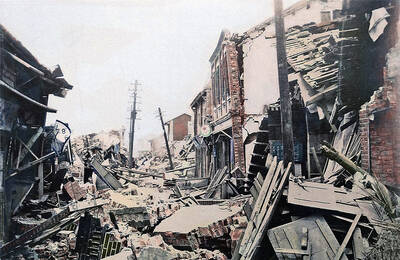
April 15 to April 21 Yang Kui (楊逵) was horrified as he drove past trucks, oxcarts and trolleys loaded with coffins on his way to Tuntzechiao (屯子腳), which he heard had been completely destroyed. The friend he came to check on was safe, but most residents were suffering in the town hit the hardest by the 7.1-magnitude Hsinchu-Taichung Earthquake on April 21, 1935. It remains the deadliest in Taiwan’s recorded history, claiming around 3,300 lives and injuring nearly 12,000. The disaster completely flattened roughly 18,000 houses and damaged countless more. The social activist and

Over the course of former President Ma Ying-jeou’s (馬英九) 11-day trip to China that included a meeting with Chinese Communist Party (CCP) leader Xi Jinping (習近平) a surprising number of people commented that the former president was now “irrelevant.” Upon reflection, it became apparent that these comments were coming from pro-Taiwan, pan-green supporters and they were expressing what they hoped was the case, rather than the reality. Ma’s ideology is so pro-China (read: deep blue) and controversial that many in his own Chinese Nationalist Party (KMT) hope he retires quickly, or at least refrains from speaking on some subjects. Regardless

Approaching her mid-30s, Xiong Yidan reckons that most of her friends are on to their second or even third babies. But Xiong has more than a dozen. There is Lucky, the street dog from Bangkok who jumped into a taxi with her and never left. There is Sophie and Ben, sibling geese, who honk from morning to night. Boop and Pan, both goats, are romantically involved. Dumpling the hedgehog enjoys a belly rub from time to time. The list goes on. Xiong nurtures her brood from her 8,000 square meter farm in Chiang Dao, a mountainous district in northern Thailand’s


 RSS
RSS