


Weight: unknown (i.e., none of your business); alcohol units: 2 (red wine); cigarettes: 0 (Hello, I live in Los Angeles); calories: who counts calories? It's all about carbs and they're none of your business, either.
Actresses watched today: I finally saw Bridget Jones: The Edge of Reason and, man, does this one make the first movie look like a masterpiece. What was Renee Zellweger thinking? It can't have been fun to put on all that weight, especially for a film as ghastly as this, and it sure won't be fun taking it off again.

PHOTO COURTESY OF UNIVERSAL STUDIOS
I haven't always been a fan of the actress, but I have begun to thaw. Or maybe this movie just made me feel sorry for her. I liked her a lot in White Oleander, a ludicrous movie where Michelle Pfeiffer shouted out to the homegirls in prison while flipping her blond tips. There was something so needy and true about Zellweger's character that I wanted to throw a big afghan around her and hustle her to a 12-step meeting for women who feel too much.
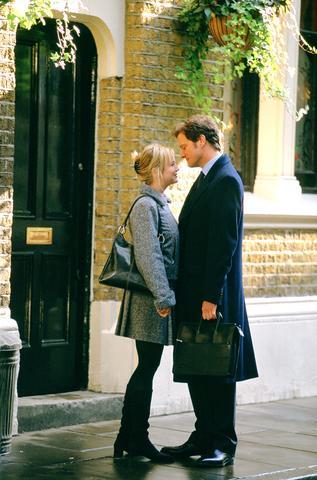
PHOTO COURTESY OF UNIVERSAL STUDIOS
Characters loathed today: What is the appeal of Bridget Jones? More to the point, what is the appeal of laughing at her swishing thighs, her lack of both charm and obvious intelligence?
At the screening a lot of women were cackling lustily every time the camera zoomed in on Bridget's bulbous posterior, which of course looks much like the posterior of most women who don't live for Pilates and in Beverly Hills. The film's director, Beeban Kidron, took obvious delight in this unhappy view, too. She either really disliked her star or thinks humiliating other women is great sport.
Whatever the case, you have to wonder why all these women (you go, sister!) relish the spectacle of a normally well-coiffed, highly paid Academy Award-winning actress, who dates rock stars no less, looking so bad.
In tabloids and on Web sites and television you can see photographs of people, and not just the famous, looking their very worst -- they're too thin, too fat, too wrinkled, too gray, too puckered and, really, just too human. Reality shows speak to our narcissism.
With celebrities, though, it's not just the routine matter of watching our idols fall and dancing on the broken pieces; it's as if we want to actually consume the pieces, absorb these once-perfect bodies into our own in some demented pantomime of communion. By blowing up like a balloon in the Bridget movies, Zellweger successfully bypasses the humiliation of the "gotcha" moment visited on actresses who are caught, via some paparazzi telephoto lens, shoveling Oreos in their mouths. Is this smart or stupid?
Unlike Sharon Maguire, who directed Bridget Jones's Diary, Kidron goes out of her way to make the character unattractive, sticking the camera under Bridget's chin and doing nothing nice with the lighting. Bridget is pleasantly plump in the first movie, as plush and appealing as an Eiderdown comforter, but here she's a greasy, bumbling, waddling train wreck.
Doesn't the poor thing read fashion magazines or go shopping in London's boutiques and groovy outdoor markets? Doesn't she wash her hair? There's an ugly and telling scene early in the movie when Bridget, who's a television host on some idiotic British show, parachutes out of a plane while on camera and lands smack in the middle of a pigsty. The metaphor is slammed in your face like a two-by-four.
So what do they see in her, anyway?: I understand why otherwise reasonable, sensible women eagerly took to Helen Fielding's original book, even if I couldn't stand all the phony self-loathing and the irritating cutesy constructions like "singleton." It's one thing when Martin Amis renames a Fiat a Fiasco; he can write. And because Fielding can't write a true, human-motivated character, I never understood why Hugh Grant's and Colin Firth's characters would be remotely interested in Bridget.
My assumption was always that she must work some seriously strong dark magic in the bedroom (the sequel proves me right), though I have to admit the woman did look cute in that Playboy Bunny outfit in the first movie, even if I gasped aloud at a glimpse of cellulite. Zellweger's dedication to her craft at that moment was totally awesome.
I suppose what some women like about Bridget Jones is that the character feeds the cherished fantasy that some one (some man) will love them for who they are inside, never mind the squishy bits. (That Bridget doesn't have much going on inside is supposed to be of no consequence.) That's an important fantasy, and sometimes it's also true, thank God. But what's grotesque about this particular iteration of the fantasy is that I cannot believe that Fielding buys into it, except as a necessary marketing element for attracting as large a readership as possible.
Let them eat cake, because men don't really mind if you look like the side of a barn. The truth is that from the sound of all the cackling women, it's not the men we have to worry about.
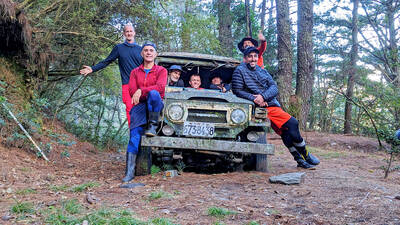
The year was 1991. A Toyota Land Cruiser set out on a 67km journey up the Junda Forest Road (郡大林道) toward an old loggers’ camp, at which point the hikers inside would get out and begin their ascent of Jade Mountain (玉山). Little did they know, they would be the last group of hikers to ever enjoy this shortcut into the mountains. An approaching typhoon soon wiped out the road behind them, trapping the vehicle on the mountain and forever changing the approach to Jade Mountain. THE CONTEMPORARY ROUTE Nowadays, the approach to Jade Mountain from the north side takes an

Last week Joseph Nye, the well-known China scholar, wrote on the Australian Strategic Policy Institute’s website about how war over Taiwan might be averted. He noted that years ago he was on a team that met with then-president Chen Shui-bian (陳水扁), “whose previous ‘unofficial’ visit to the US had caused a crisis in which China fired missiles into the sea and the US deployed carriers off the coast of Taiwan.” Yes, that’s right, mighty Chen caused that crisis all by himself. Neither the US nor the People’s Republic of China (PRC) exercised any agency. Nye then nostalgically invoked the comical specter

Relations between Taiwan and the Czech Republic have flourished in recent years. However, not everyone is pleased about the growing friendship between the two countries. Last month, an incident involving a Chinese diplomat tailing the car of vice president-elect Hsiao Bi-khim (蕭美琴) in Prague, drew public attention to the People’s Republic of China’s (PRC) operations to undermine Taiwan overseas. The trip was not Hsiao’s first visit to the Central European country. It was meant to be low-key, a chance to meet with local academics and politicians, until her police escort noticed a car was tailing her through the Czech capital. The
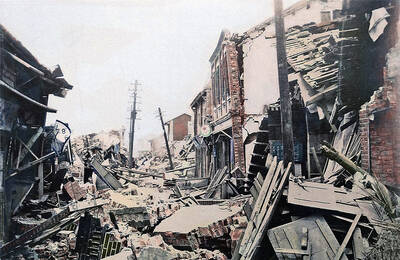
April 15 to April 21 Yang Kui (楊逵) was horrified as he drove past trucks, oxcarts and trolleys loaded with coffins on his way to Tuntzechiao (屯子腳), which he heard had been completely destroyed. The friend he came to check on was safe, but most residents were suffering in the town hit the hardest by the 7.1-magnitude Hsinchu-Taichung Earthquake on April 21, 1935. It remains the deadliest in Taiwan’s recorded history, claiming around 3,300 lives and injuring nearly 12,000. The disaster completely flattened roughly 18,000 houses and damaged countless more. The social activist and


 RSS
RSS