


In Mao Zedong's (
They chatter excitedly as they approach the 6m-tall bronze statue of the dictator outfitted in thick shoes and double-breasted military coat, before stopping to pose and snap photos in front of the revered revolutionary leader.
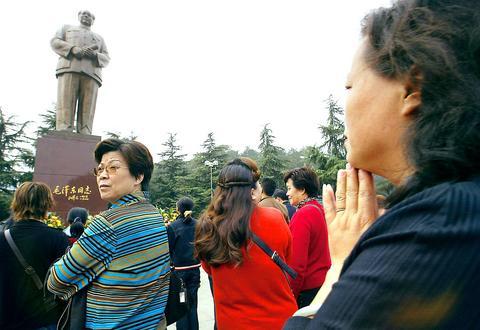
PHOTO: AFP
Twenty-eight years after his death and despite wide recognition in China that he committed grave errors which caused the deaths of tens of millions of people, Mao is still regarded by many as the country's greatest modern leader.
"I worship him. Most of the people coming here worship him," said Wang Ming, 35, a resident of Nanjing who travelled more than 1,500km to Shaoshan in central Hunan Province.
"He had a rebellious spirit and he led such a small and tiny army to fight against the Kuomintang, and he saved the country and the people."
At a strategically placed flower stand that sits on the small square, tourists line-up to buy bouquets that cost as much as 399 yuan (US$48). They place them gently and respectfully at the base of the statue.
Though even state media today continues to remind people that Mao was just a man and not a god, here the admonishment seems to fall on deaf ears.
People pray in front of his statue by bringing their hands together and kowtowing three times -- a ritual that in ancient, feudal China was reserved for the emperor alone.
"I pray that he may give me strength and courage to live a good life," said Zhu He, a visitor from Hubei Province.
On any given day, Mao's hometown is overrun with more than 4,000 tourists, or about 1.5 million visitors a year. It has become a money-spinning attraction that symbolizes one of the great contradictions of the politics of the ruling Communist Party of China.
Mao's vision of an egalitarian, Communist utopia has largely become an anachronism in a country that increasingly defines itself with market capitalist values.
Where once the Communist Party could justify its self-appointed totalitarian rule over its 1.3 billion people because the historical forces of the proletarian revolution were in its favor, 25 years of market economic reforms has vanquished that mandate.
Indeed, in front of a temple dedicated to him, where Mao and first wife Yang Kaihui told peasants to cast off their feudal and capitalist chains, hawkers do brisk business in Mao paraphernalia.
Anything and everything is available: postcards, books, statues, key rings, lighters, even the "East is Red" cigarettes named after a famous song composed in Mao's honor.
That the chairman's popularity continues nearly unadulterated is as much a result of Beijing's efforts to present all top leaders in the best light possible.
In this way, they guarantee the Communist Party's infallibility, said Joseph Cheng, a China analyst at City University of Hong Kong.
"To discredit Mao opens up Pandora's box," said Cheng. "Any leader could be criticized and then anything could be opened up for interpretation."
As such, the Mao Zedong Memorial Museum here remains an orgiastic celebration of Mao's achievements and the party's self-appointed mandate as the country's historically chosen rulers.
Pekjing University history professor Liu Zuxi argues respect for Mao goes beyond the myth-spinning of the party.
"They remember Mao's speech when he declared victory (and founded the People's Republic of China) on Oct. 1, 1949: `The Chinese people have stood up,'" Liu said.
The museum itself is filled with pictures and stories of the "great helmsman," and not surprisingly, the victory speech booms endlessly repeated throughout.
Fu Xiaoran, a museum spokeswoman, said the grounds were meant to be educational.
"We are one of the main educational bases of patriotism in China," Fu said, adding that all levels of party leadership were paying greater attention to "moral and ideological education."
Just how effective such education might be in a China whose revolutionary past is increasingly arcane is hard to measure.
What is certain, however, is that the party has steadfastly refused to bring final judgement on a man and his policies that Deng Xiaoping (
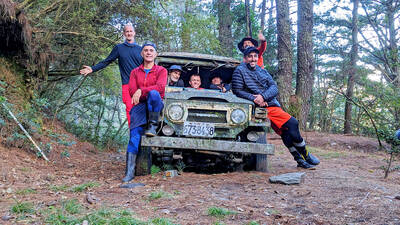
The year was 1991. A Toyota Land Cruiser set out on a 67km journey up the Junda Forest Road (郡大林道) toward an old loggers’ camp, at which point the hikers inside would get out and begin their ascent of Jade Mountain (玉山). Little did they know, they would be the last group of hikers to ever enjoy this shortcut into the mountains. An approaching typhoon soon wiped out the road behind them, trapping the vehicle on the mountain and forever changing the approach to Jade Mountain. THE CONTEMPORARY ROUTE Nowadays, the approach to Jade Mountain from the north side takes an

Last week Joseph Nye, the well-known China scholar, wrote on the Australian Strategic Policy Institute’s website about how war over Taiwan might be averted. He noted that years ago he was on a team that met with then-president Chen Shui-bian (陳水扁), “whose previous ‘unofficial’ visit to the US had caused a crisis in which China fired missiles into the sea and the US deployed carriers off the coast of Taiwan.” Yes, that’s right, mighty Chen caused that crisis all by himself. Neither the US nor the People’s Republic of China (PRC) exercised any agency. Nye then nostalgically invoked the comical specter
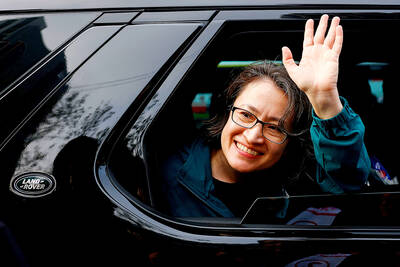
Relations between Taiwan and the Czech Republic have flourished in recent years. However, not everyone is pleased about the growing friendship between the two countries. Last month, an incident involving a Chinese diplomat tailing the car of vice president-elect Hsiao Bi-khim (蕭美琴) in Prague, drew public attention to the People’s Republic of China’s (PRC) operations to undermine Taiwan overseas. The trip was not Hsiao’s first visit to the Central European country. It was meant to be low-key, a chance to meet with local academics and politicians, until her police escort noticed a car was tailing her through the Czech capital. The
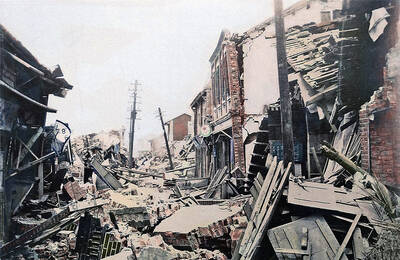
April 15 to April 21 Yang Kui (楊逵) was horrified as he drove past trucks, oxcarts and trolleys loaded with coffins on his way to Tuntzechiao (屯子腳), which he heard had been completely destroyed. The friend he came to check on was safe, but most residents were suffering in the town hit the hardest by the 7.1-magnitude Hsinchu-Taichung Earthquake on April 21, 1935. It remains the deadliest in Taiwan’s recorded history, claiming around 3,300 lives and injuring nearly 12,000. The disaster completely flattened roughly 18,000 houses and damaged countless more. The social activist and


 RSS
RSS