


In one of the more tangible signs that Taiwan's education system is re-engineering itself to place a greater emphasis on hands-on learning and creativity, the Power Tech 2004 competition concluded earlier this month with a record number of entrants.
This year, 120 four-person teams from junior high schools around the country took part in the contest in which the mission is to create machines within a two-and-a-half-hour time frame that can out-race and out-pull their opponents. The competition is a kind of cross between the Robot Wars and Junkyard Warrior competitions that challenge teams to create machines from scrap parts and then battle each other in a final face-off.
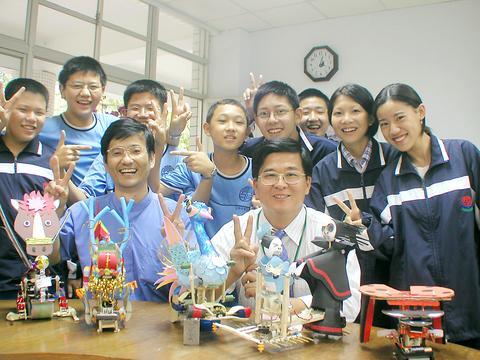
PHOTO: MAX WOODWORTH, TAIPEI TIMES
But the Power Tech competition, sponsored by the National Science Council, is a tamer affair, with the criteria for victory including the creativity of the design of each robot and a written report on the building principles of each machine, as well as the final robot-on-robot competitions.
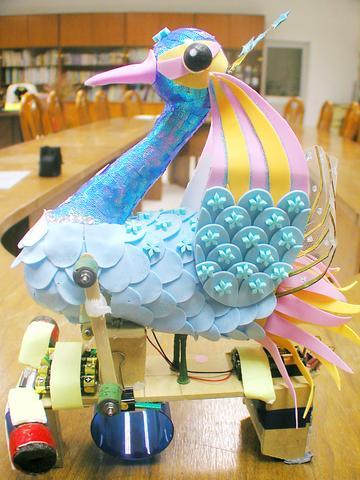
PHOTO: MAX WOODWORTH, TAIPEI TIMES
In all three categories in the two years of the competition, teams from Tainan's Chorngming Junior High School have stood out as the best in Taiwan, with one team from Changhua's Yangming Junior High School being the only competitor to give the champions a run for their money this year.
On visiting Chornming Junior High School and speaking with its ebullient principal Lin Mao-sheng (
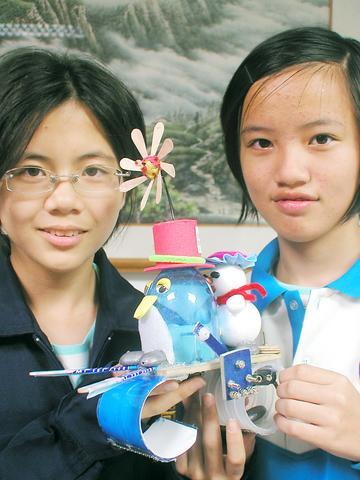
PHOTO: MAX WOODWORTH, TAIPEI TIMES
"We try to think of education as a field that the students need to cultivate themselves. For that, we try to provide them with more opportunities to learn creatively and to give them a stage where they can demonstrate their potential to others," Lin said, glowing on account of the students from his school who placed first and third at the finals of the Power Tech competition at Taipei Teachers College on Nov. 6.
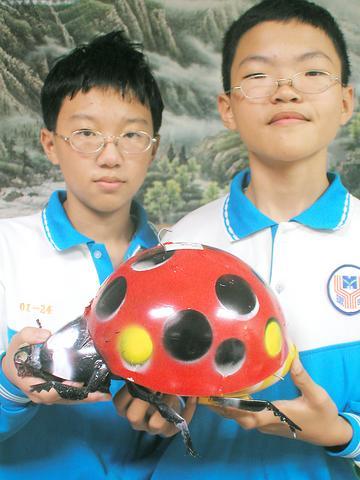
PHOTO: MAX WOODWORTH, TAIPEI TIMES
Lin appointed one of his teachers, Chang Cheng-guo (
"Maybe more than anything, this type of activity teaches the students the value of teamwork," he said. "When two methods are tested, there is often a clearly favorable choice, so for the sake of the team, everyone needs to cooperate based on observable facts instead of egos."
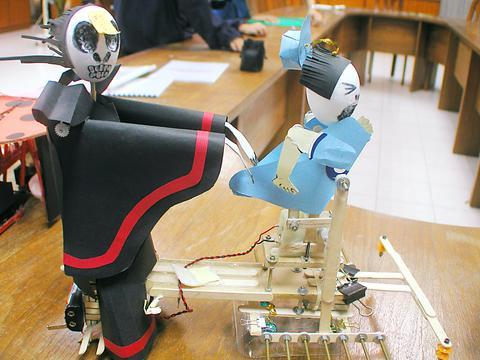
PHOTO: MAX WOODWORTH, TAIPEI TIMES
In the competition, teams are provided with a uniform-size motor and batteries and can use an assortment of materials including wood boards, nuts, bolts, stones, metal weights and flexible plastic strips to build machines that can generate forward movement on a standardized rubber surface without the use of wheels. Machines cannot exceed 30cm in length and 20cm in width. The three winning teams arrived at the competition with their designs already agreed upon and completed the machines within an hour, using the remaining time for fine tuning.

PHOTO: MAX WOODWORTH, TAIPEI TIMES
The elimination round required that machines be made to crawl, while the finals called for machines that move by bouncing.
In each stage the challenge was the same: to find the optimal weight that makes each machine light enough to beat opponents in the race portion of the contest, but heavy enough to avoid being dragged into defeat in the final tug-of-war section. Reaching that balance required experience with a range of physical principles, the students said.
"There was a lot of trial and error, as we moved the robots' center of gravity and shaved off weight here and there," said Jacky Yang (
To make the machines crawl, each robot needed to be able to shift its weight and create enough friction to grip the surface as the front and back sections expanded and contracted to generate forward movement. If the weight was misplaced, the machines would simply writhe around, Yang said.
For the bouncing machines, weighted arms were attached to the motor to spin and generate up-and-down thrust causing the frame to bounce on flexible plastic bumpers. The machine's weight was balanced so that each bounce created forward movement. Months of experimentation taught the teams the optimal weight and length of the arms to generate the greatest thrust and the most advantageous angle of the frame. Poorly designed machines would tip over or vibrate limply without moving forward.
Chornming's team had an ace up its sleeve in the elimination round with a machine whose rear area featured downward-angled pointed metal spikes that prevented backward movement -- a critical element in its victory in the tug-of-war section. Judges at the finals banned the use of the metal spikes, but the Chornming team fashioned similar digging rods from wood for its bouncing machine.
"The students haven't begun taking courses in physics but by making these machines they already have knowledge of the concepts of mechanics, motion, friction and elasticity. Since it's a lot of fun, they don't even realize how much they've learned in the process," said Yangming High School principal Su Yi-li (
And the students did, indeed, appear to be having fun with the competition. The designs of the winning machines are elaborate and hilariously conceived. Chornming's first-place team won with a machine whose concept is a student being chased by a ghoul that represents exam pressure. The student's legs and arms spin furiously, generating the robot's thrust, while the cartoon-like ghoul's outstretched arms move up and down as if to grab at the student's collar. Yangming's second-place machine was of a skiing penguin. The other winning designs included ladybugs, a dragon and a peacock.
Having outshone all the other teams in Taiwan, the three teams from Chornming and Yangming now have the opportunity to travel to Tokyo next month for four days to be observers at a national contest, where, Chang said, the standards of the machines should inspire his students.
"In Japan they take these competitions very seriously and have been organizing them for a long time with sponsorship from the education ministry. They are really on a different level," Chang said.
The students, of course, are overjoyed at the prospect of a trip to Tokyo, courtesy of the National Science Council. "I can't wait. We'll study all the winning tactics there and bring them back for next year. Then we'll win for sure," Yang said.

Last week Joseph Nye, the well-known China scholar, wrote on the Australian Strategic Policy Institute’s website about how war over Taiwan might be averted. He noted that years ago he was on a team that met with then-president Chen Shui-bian (陳水扁), “whose previous ‘unofficial’ visit to the US had caused a crisis in which China fired missiles into the sea and the US deployed carriers off the coast of Taiwan.” Yes, that’s right, mighty Chen caused that crisis all by himself. Neither the US nor the People’s Republic of China (PRC) exercised any agency. Nye then nostalgically invoked the comical specter

Relations between Taiwan and the Czech Republic have flourished in recent years. However, not everyone is pleased about the growing friendship between the two countries. Last month, an incident involving a Chinese diplomat tailing the car of vice president-elect Hsiao Bi-khim (蕭美琴) in Prague, drew public attention to the People’s Republic of China’s (PRC) operations to undermine Taiwan overseas. The trip was not Hsiao’s first visit to the Central European country. It was meant to be low-key, a chance to meet with local academics and politicians, until her police escort noticed a car was tailing her through the Czech capital. The
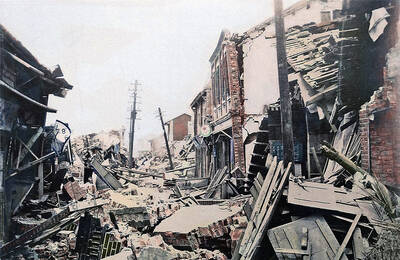
April 15 to April 21 Yang Kui (楊逵) was horrified as he drove past trucks, oxcarts and trolleys loaded with coffins on his way to Tuntzechiao (屯子腳), which he heard had been completely destroyed. The friend he came to check on was safe, but most residents were suffering in the town hit the hardest by the 7.1-magnitude Hsinchu-Taichung Earthquake on April 21, 1935. It remains the deadliest in Taiwan’s recorded history, claiming around 3,300 lives and injuring nearly 12,000. The disaster completely flattened roughly 18,000 houses and damaged countless more. The social activist and

Over the course of former President Ma Ying-jeou’s (馬英九) 11-day trip to China that included a meeting with Chinese Communist Party (CCP) leader Xi Jinping (習近平) a surprising number of people commented that the former president was now “irrelevant.” Upon reflection, it became apparent that these comments were coming from pro-Taiwan, pan-green supporters and they were expressing what they hoped was the case, rather than the reality. Ma’s ideology is so pro-China (read: deep blue) and controversial that many in his own Chinese Nationalist Party (KMT) hope he retires quickly, or at least refrains from speaking on some subjects. Regardless


 RSS
RSS