


With the annual Johnny Walker Classic now relocated to China and the cessation of other international tournaments such as the BMW Open, the nation's once busy golfing calendar has been slashed to near zero in recent years. Golf may be the on decline, but if Tsai Teh-lung (
Reportedly invented in Sweden in 1937, minigolf is governed by the World Minigolf Federation (WMF) and has been played at a semi-professional level since the inaugural European Championships were held in 1959. The WMF has 36 member nations and a total of 40,000 playing and paying members on its books worldwide.
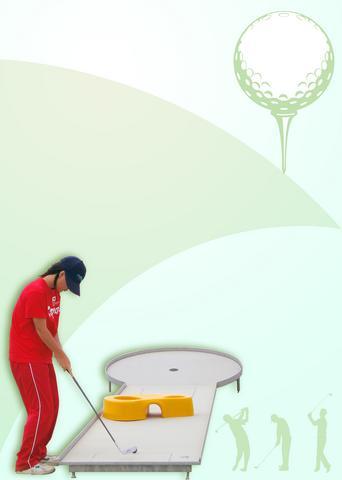
The sport remains hugely popular in Sweden, but Germany has for many years been considered the global center of minigolf. The country is home to the world minigolf governing body and with more than 5,000 minigolf courses and 13,500 officially recognized fulltime minigolfers, Germany is now officially the most minigolf mad country in the world.
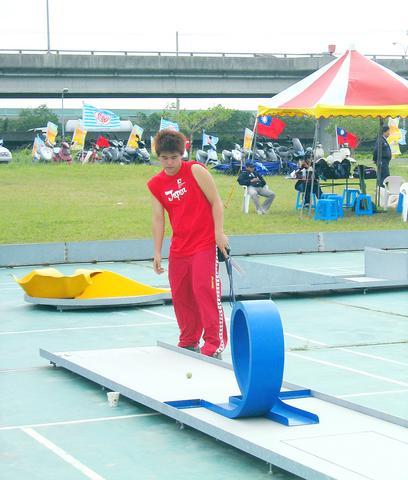
PHOTOS: GAVIN PHIPPS
Introduced six years ago to Taiwan by Tsai, who now heads the ROC (Taiwan) Minigolf Sport Association (TMA,
Established in 2000, the Asia Minigolf Championship is organized by the Asia Minigolf Sport Federation, which is based out of Chofu City, Tokyo and currently has five member nations -- Japan, India, Singapore, Thailand and Taiwan. The handful of Taiwanese minigolfers who took to mini-fairways to represent their country are all students of the Taipei Physical Education College's (
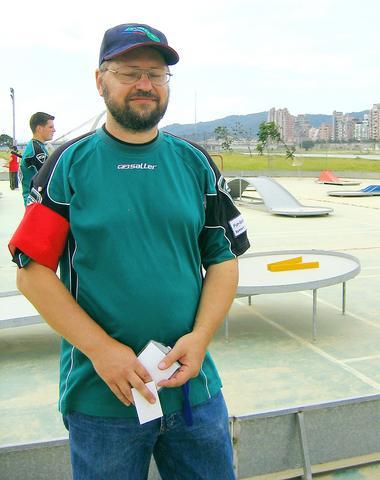
Held at the Dachia Ying Feng Sport Park (大佳迎風河濱公園), adjacent to Dachia Riverside Park (大佳河濱公園), the 2004 Asian Minigolf Championship attracted 37 participants representing teams from Taiwan, Japan and Singapore and a dozen members of invitational teams from Germany and Finland. A team from Pakistan was forced to withdraw at the last minute because of problems securing visas.
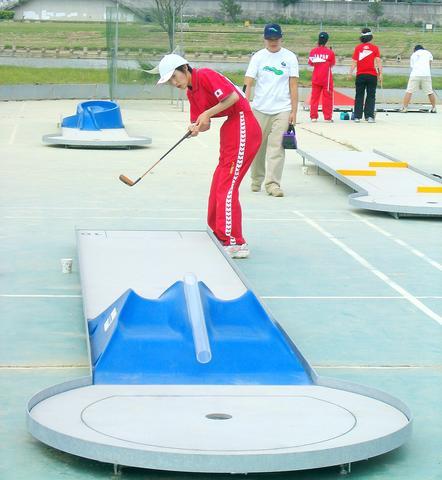
After four days of play the title of Asian Champions went to Japan, with Taiwan coming a close second and Singapore's two-man team clinching third place. A special invitational tournament was won by Germany. Media coverage may have been sparse and the crowds were more curious on-lookers than minigolfing buffs, but organizers still hailed Taiwan's hosting of its first international miningolf tournament as a huge success.
"It was the first time Taiwan has hosted a competition and we didn't expect a huge turnout. People did come to watch, though, and the sport did generate some interest," said Chen Chun-liang (
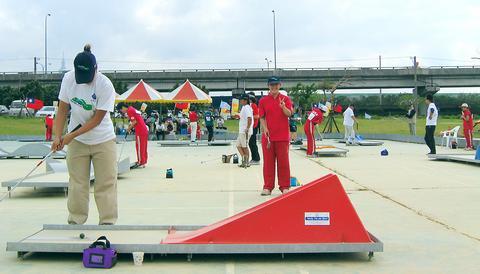
To host the event, the association appropriated funds totaling NT$6 million from the National Council of Physical Fitness and the Taipei City Government's Sports Council to construct the country's first competition-standard minigolf courses.
"We have tried to popularize [minigolf], but, still, very few people play it. Courses are expensive to build so it was a great boost for us that despite financial difficulties we were able to build two courses," Tsai said. "By hosting the competition we believe that more people will learn about minigolf and become players."
The courses were both built in accordance with the guidelines laid down by the WMF and with the help of sporting goods suppliers, Gymco Sports Ltd (
"We built two courses, one of which, the Eternit, is portable and made of steel and the other, the Betong is permanent and made of concrete." said Gymco's Sunny Chen. "Because we wanted the courses to be of the highest quality and meet international standards, it was a lengthy and costly process. The ground needed to be made playable with a leveling system and consultants had to be brought in to ensure the work was done properly."
Not to be confused with crazy or adventure golf, which are characterized by undulating greens, landscaping, obstacles and multi-level holes, minigolf holes feature only one or two square or triangular barriers and are built to specific guidelines.
Each hole has to have a run of at least 6.25m in length and 0.9m in width and the target circle, in which the hole sits, must measure approximately 1.4m in diameter. The courses may look easy in comparison to those of crazy golf, but, according to Gerhard Zimmermann, President of the German Minigolf Federation, a lot of skill is needed to conquer a well-constructed minigolf course.
"It's a matter of angles and knowing when and how much back spin to add to the shots. Players employ certain techniques and each hole posses its own unique problems," said Zimmermann. "It looks easy, but getting a hole-in-one is very difficult and on average players finish an 18-hole course with a score of 25."
Due to its fragility, the 18-hole NT$2.5 million prefabricated steel Eternit course has been disassembled and now sits in storage. According to Chen, the association was afraid to leave the course in place because they feared it would be the target of vandalism. Taiwan's only permanent international competition-standard minigolf course, the NT$3million concrete Betong course remains in place at the park.
"The concrete course is permanent and open to the public, but there are still no club and ball rental facilities. The land belongs to the city government so we can't establish our own rental store there," said Chen. "We're hoping that one will be set up shortly as it is a waste to have built Taipei's first minigolf course and just let it sit there unused."
While players can currently use the course free of charge there are no immediate plans to establish club and ball rental facilities. Talks between the TMA and the city government are ongoing, but it is hoped that the minigolf course in the Dachia Ying Feng Sport Park will be up and running by early next year.
"It might take some time to establish a permanent base for minigolf in Taiwan, but I'm confident that given time, minigolf will take off," said TMA member and minigolfer Kuo Wei-sheng (

Last week Joseph Nye, the well-known China scholar, wrote on the Australian Strategic Policy Institute’s website about how war over Taiwan might be averted. He noted that years ago he was on a team that met with then-president Chen Shui-bian (陳水扁), “whose previous ‘unofficial’ visit to the US had caused a crisis in which China fired missiles into the sea and the US deployed carriers off the coast of Taiwan.” Yes, that’s right, mighty Chen caused that crisis all by himself. Neither the US nor the People’s Republic of China (PRC) exercised any agency. Nye then nostalgically invoked the comical specter
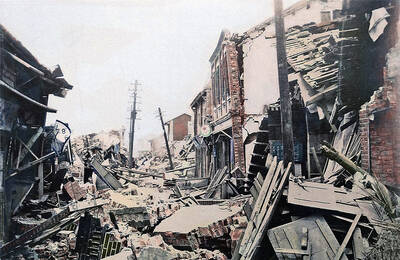
April 15 to April 21 Yang Kui (楊逵) was horrified as he drove past trucks, oxcarts and trolleys loaded with coffins on his way to Tuntzechiao (屯子腳), which he heard had been completely destroyed. The friend he came to check on was safe, but most residents were suffering in the town hit the hardest by the 7.1-magnitude Hsinchu-Taichung Earthquake on April 21, 1935. It remains the deadliest in Taiwan’s recorded history, claiming around 3,300 lives and injuring nearly 12,000. The disaster completely flattened roughly 18,000 houses and damaged countless more. The social activist and

Over the course of former President Ma Ying-jeou’s (馬英九) 11-day trip to China that included a meeting with Chinese Communist Party (CCP) leader Xi Jinping (習近平) a surprising number of people commented that the former president was now “irrelevant.” Upon reflection, it became apparent that these comments were coming from pro-Taiwan, pan-green supporters and they were expressing what they hoped was the case, rather than the reality. Ma’s ideology is so pro-China (read: deep blue) and controversial that many in his own Chinese Nationalist Party (KMT) hope he retires quickly, or at least refrains from speaking on some subjects. Regardless

Approaching her mid-30s, Xiong Yidan reckons that most of her friends are on to their second or even third babies. But Xiong has more than a dozen. There is Lucky, the street dog from Bangkok who jumped into a taxi with her and never left. There is Sophie and Ben, sibling geese, who honk from morning to night. Boop and Pan, both goats, are romantically involved. Dumpling the hedgehog enjoys a belly rub from time to time. The list goes on. Xiong nurtures her brood from her 8,000 square meter farm in Chiang Dao, a mountainous district in northern Thailand’s


 RSS
RSS