


When Erik Weihenmayer, the first and only blind man to reach the summit at Mount Everest, decided to teach six blind Tibetan schoolchildren how to climb, he returned to the scene of his greatest accomplishment. The goal: Lhakpa Ri, a 7,045m peak next to the world's highest mountain.
"It's the easiest 23,000-foot (7,000m) peak in the world," Weihenmayer said. "Although, that's like saying it's the most gentle piranha in the world."
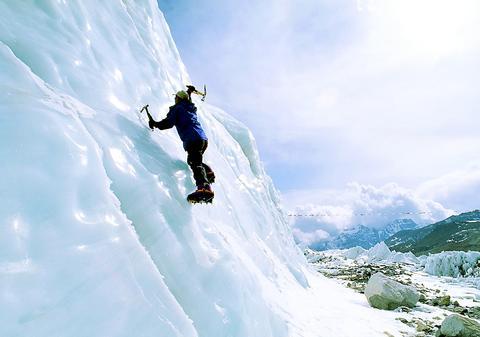
PHOTO: NY TIMES
His expedition crew of 40 people and 60 yaks, strapped with duffel bags, tents, propane tanks, folding chairs, cooking equipment and other essential gear, wound its way through the Qomolangma (Chinese for Everest) Nature Preserve in southern Tibet for an arduous two-week trek to Advance Base Camp, where the north face of Mount Everest towered to the right and Lhakpa Ri rose to the left.
Trekking through the Himalayas above lower Everest Base Camp at 5,544m is dangerous enough for a sighted person, let alone for blind teenagers with little climbing experience, as was the case on this expedition, called Climbing Blind.
Footpaths worn into loose rock on mountainsides can be as narrow as the width of two hiking boots, with thousand-foot drop-offs that can send any stumbling climber into an uncontrollable slide to icy glacial rivers.
"When stones are kicked over the side, I can hear them falling very far and I know that it's dangerous," said Kyila, 18, one of two girls on the trip. Like most Tibetans, she does not have a last name. "But I'm not scared. I follow the sound of the bell."
Leading six visually impaired teenagers through Himalayan trails required a sighted escort trekking in front of each one. On average, it took the teenagers only 50 percent longer to cover the same ground as a sighted person.
At 6,340m, Mount Everest Advance Base Camp is a desolate, sub-freezing, rock-covered encampment the size of half a football field on top of a glacier. The solid ice beneath rocks that were chopped away to level out the mess-tent floor numbed everyone's feet at every meal. Temperatures at night reached 30 below zero with the wind chill, causing headlamp batteries and water bottles to freeze solid, as well as the instantaneous solidification of mucous from any runny nose.
The importance of keeping track of gear had to be impressed upon the group.
"Finding mittens, poles and other equipment quickly is essential," Weihenmayer said. "If a blind person misplaces something and it's 30 below zero, he may never find it again."
The six children never complained and did not appear intimidated. They were not strangers to adverse conditions. Tibetans treat the blind as outcasts because they believe they are possessed by demons or have committed evil in a prior life.
Tashi, 19, has a father who sold him to a Chinese couple. They beat him when he did not make enough money as a beggar, so he ran away at 11 and survived on the streets of Lhasa in Tibet. Recently, he found his way back to his village, where upon his return his father told him that he had "lost him," not sold him.
Luckily, Tashi had found a loving home at Braille Without Borders, a local vocational school for the visually impaired.
Braille Without Borders was founded in 1998 by Sabriye Tenberken, a blind German expatriate. Shocked at how Tibetans treated their visually impaired after coming there to study, she discovered that a Tibetan Braille language did not even exist. So she created one.
Running the school of 44 students and 11 staff on a budget of US$27,000 a year is one of many achievements that has led to Tenberken's nomination this fall for Time Magazine Asia and Europe's Heroine of the Year.
Tenberken wrote to Weihenmayer after hearing of his Everest ascent, asking if he would meet her students. Weihenmayer felt compelled to do more.
"Everest was a great achievement, but I wanted to add to what I did," Weihenmayer said. "These kids haven't been born into all the opportunity I've had. I wanted to be that opportunity for these kids."
He spent almost two years planning and finding sponsors to fund the Climbing Blind expedition.
The exhaustion of trekking to 7,000m forced setbacks when three of the students developed altitude sickness and cerebral edema, a life-threatening swelling of the brain caused by low oxygen levels. The symptoms were severe headaches, disorientation and nausea. They were sent to lower altitude to recover along with five adults who were also sick.
Lhakpa Ri proved too ambitious a climb for the remaining three students, and the expedition was modified. Rope teams of guides and children explored the East Rongbuk Glacier, which bridges Lhakpa Ri and Mount Everest. Negotiating fissures and mulans, glacier holes caused by melting water, proved challenging enough and still taught the teenagers valuable lessons.
"Four people connected by one rope has a symbolic value," Tenberken said. "It reinforces the concept of teamwork."
The accomplishment of climbing to 7,000m remains significant -- all six teenagers hold a record for reaching the highest altitude of any blind children in the world.

In late October of 1873 the government of Japan decided against sending a military expedition to Korea to force that nation to open trade relations. Across the government supporters of the expedition resigned immediately. The spectacle of revolt by disaffected samurai began to loom over Japanese politics. In January of 1874 disaffected samurai attacked a senior minister in Tokyo. A month later, a group of pro-Korea expedition and anti-foreign elements from Saga prefecture in Kyushu revolted, driven in part by high food prices stemming from poor harvests. Their leader, according to Edward Drea’s classic Japan’s Imperial Army, was a samurai

Located down a sideroad in old Wanhua District (萬華區), Waley Art (水谷藝術) has an established reputation for curating some of the more provocative indie art exhibitions in Taipei. And this month is no exception. Beyond the innocuous facade of a shophouse, the full three stories of the gallery space (including the basement) have been taken over by photographs, installation videos and abstract images courtesy of two creatives who hail from the opposite ends of the earth, Taiwan’s Hsu Yi-ting (許懿婷) and Germany’s Benjamin Janzen. “In 2019, I had an art residency in Europe,” Hsu says. “I met Benjamin in the lobby

April 22 to April 28 The true identity of the mastermind behind the Demon Gang (魔鬼黨) was undoubtedly on the minds of countless schoolchildren in late 1958. In the days leading up to the big reveal, more than 10,000 guesses were sent to Ta Hwa Publishing Co (大華文化社) for a chance to win prizes. The smash success of the comic series Great Battle Against the Demon Gang (大戰魔鬼黨) came as a surprise to author Yeh Hung-chia (葉宏甲), who had long given up on his dream after being jailed for 10 months in 1947 over political cartoons. Protagonist

Peter Brighton was amazed when he found the giant jackfruit. He had been watching it grow on his farm in far north Queensland, and when it came time to pick it from the tree, it was so heavy it needed two people to do the job. “I was surprised when we cut it off and felt how heavy it was,” he says. “I grabbed it and my wife cut it — couldn’t do it by myself, it took two of us.” Weighing in at 45 kilograms, it is the heaviest jackfruit that Brighton has ever grown on his tropical fruit farm, located


 RSS
RSS