


It is a truth universally acknowledged that a book written about somewhere you know has the edge over another of comparable quality written about anywhere else.
Jack Kerouac could easily have written The Trumpeter of Bull Mountain. There's the same enthusiasm for a life of travel, the same adventures among down-at-heel companions, the same search for enlightenment and interest in Zen, the same eye for a memorable character or bizarre event, and the same close shaves with the law. In addition, half this book takes place in Kerouac country -- the San Francisco Bay Area, the mountains of Oregon and California's High Sierra. There's only one major difference -- the other half takes place in Taipei.

If you've ever heard jazz riffs issuing forth on a trumpet from a Taipei underpass, the person responsible is more than likely to have been this writer. During much of the period covered by this autobiographical narrative, mainly the last 15 years, he divided his time between Taiwan and the American west coast, taking odd jobs, studying for a degree in English Literature and -- his main source of income in Taiwan until recently -- busking.
Once the action moves to Taiwan, local detail comes thick and fast. He gets assaulted after insulting a Taipei taxi-driver, goes on a variety of visa runs, lives in cut-price hotels and dormitories, plays jam sessions at the Bluenote club and In-Between Cafe, encounters an international assortment of street musicians including a band from Peru, notes the most profitable pedestrian tunnels, and praises Taiwan's National Health Insurance system.
Playing the trumpet to the passing crowds proves profitable. He makes US$1,400 from two weeks' busking in 1993, playing only three hours a day. And at the Lunar New Year in 1991 he collects an astonishing US$459 in Keelung in a mere 40 minutes.
It's entirely possible that some readers will fling down this book with exclamations of annoyance. It's certainly true that it's uneven. Nonetheless, there is a remarkable freshness and honesty about many passages, particularly the Taipei ones. The same quality informs the descriptions of trekking in the wilderness of the American northwest, though some of the material there has been less thoroughly cleaned up and remains in journal form. All these sections are nonetheless down-to-earth and well-observed.
It's when the author begins to outline his views on topics such as abortion or the essential nature of Californian life that tedium sets in. These chapters have the feel of previously written texts added simply to bulk out the book. All authors know this problem and resort to different devices to solve it. The central inspiration of most books results in a limited amount of good writing, but conventional wisdom has it that the average printed volume should consist of some 250 pages. A certain amount of padding is thus understandable and probably, if the reader is in a generous mood, excusable.
By and large, however, the old maxim holds true -- closely observed detail fuels interest, abstraction spells boredom. Luckily for us, McClave expends little energy on his theories when writing about Taiwan.
This is a very American book -- in its restlessness, its consciousness of inner emptiness, its search for meaning via Oriental spirituality. It was no accident that Somerset Maugham, when writing The Razor's Edge in 1952 about someone seeking enlightenment in the Himalayas, made his hero
American.
The "bull" of the title refers to one's true inner nature, from which we have almost all become alienated. And, as in so many stories of spiritual search via a Bohemian life-style, the journey, especially the mountain journey, takes on the shape of a search for that lost inner self. This derives from the Oriental mystics such people frequently take as their masters, but it's probably a universal feeling, an archetype. For McClave, the spiritually-tinged journey takes the form of the hike along the John Muir Trail with which the book concludes.
Given the commercialism of the present era, it's good to find that the legacy of Kerouac and the Beats, for all its many shortcomings, hasn't entirely vanished. McClave understands his literary origins perfectly clearly -- he comments at one point that almost everyone he met trekking appeared to be, like him, in their 50s, trying to recapture (he surmises) the dreams of their youth. And American Bohemianism of 40 years ago, which quickly became a worldwide phenomenon, was essentially the expression of a youth culture. Its problem was always what its followers would do when they were no longer young. McClave, in this brave and often fascinating book, demonstrates that for such people, the years that follow are by no means without hope.
The author grew up in Flushing, Michigan, and even hopped freight trains, Kerouac-like, when he was young. Today he is today married to a Taiwanese and works in Taipei as an English teacher.

In late October of 1873 the government of Japan decided against sending a military expedition to Korea to force that nation to open trade relations. Across the government supporters of the expedition resigned immediately. The spectacle of revolt by disaffected samurai began to loom over Japanese politics. In January of 1874 disaffected samurai attacked a senior minister in Tokyo. A month later, a group of pro-Korea expedition and anti-foreign elements from Saga prefecture in Kyushu revolted, driven in part by high food prices stemming from poor harvests. Their leader, according to Edward Drea’s classic Japan’s Imperial Army, was a samurai

Located down a sideroad in old Wanhua District (萬華區), Waley Art (水谷藝術) has an established reputation for curating some of the more provocative indie art exhibitions in Taipei. And this month is no exception. Beyond the innocuous facade of a shophouse, the full three stories of the gallery space (including the basement) have been taken over by photographs, installation videos and abstract images courtesy of two creatives who hail from the opposite ends of the earth, Taiwan’s Hsu Yi-ting (許懿婷) and Germany’s Benjamin Janzen. “In 2019, I had an art residency in Europe,” Hsu says. “I met Benjamin in the lobby
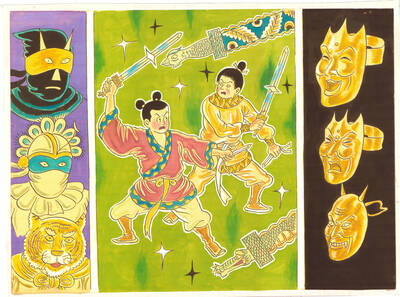
April 22 to April 28 The true identity of the mastermind behind the Demon Gang (魔鬼黨) was undoubtedly on the minds of countless schoolchildren in late 1958. In the days leading up to the big reveal, more than 10,000 guesses were sent to Ta Hwa Publishing Co (大華文化社) for a chance to win prizes. The smash success of the comic series Great Battle Against the Demon Gang (大戰魔鬼黨) came as a surprise to author Yeh Hung-chia (葉宏甲), who had long given up on his dream after being jailed for 10 months in 1947 over political cartoons. Protagonist

Peter Brighton was amazed when he found the giant jackfruit. He had been watching it grow on his farm in far north Queensland, and when it came time to pick it from the tree, it was so heavy it needed two people to do the job. “I was surprised when we cut it off and felt how heavy it was,” he says. “I grabbed it and my wife cut it — couldn’t do it by myself, it took two of us.” Weighing in at 45 kilograms, it is the heaviest jackfruit that Brighton has ever grown on his tropical fruit farm, located


 RSS
RSS